Facts
The respondents were appointed as Junior Assistants in 2013 and promoted to Senior Assistants in 2016.
Source reference: para. 2(b)Historically, promotion to the post of Assistant Regional Transport Officer (ARTO) was governed by Executive Instructions dated 17.11.1981, pending finalization of recruitment rules.
Source reference: para. 2(a)In 2017, the cadre was restructured, and the ARTO post was upgraded to Group B.
Source reference: para. 2(c)In 2019, the ministerial cadre was further restructured, redesignating Senior Assistants as Assistant Section Officers (ASO) with a separate internal promotional hierarchy.
Source reference: para. 2(d)The respondents sought promotion to ARTO under the 1981 Instructions.
Source reference: para. 2(g)While their representations were pending/rejected, the State notified the Odisha Transport Service (Method of Recruitment and Conditions of Service) Rules, 2021 on 05.01.2022, which mandated recruitment to ARTO posts via competitive examination.
Source reference: para. 2(o)A Single Judge and a Division Bench of the Odisha High Court directed the State to convene a DPC under the old 1981 Instructions, holding that vacancies arose prior to the 2021 Rules.
Source reference: paras. 2(q), 8Issues
1. Whether an employee has a vested right to be considered for promotion based on rules/instructions that existed at the time the vacancy arose, despite subsequent amendment or notification of new recruitment rules.
Source reference: para. 132. Whether the "supersession" clause in the 2021 Rules saved the pending recommendation for a Departmental Promotion Committee (DPC) as a "thing done" under the previous executive instructions.
Source reference: para. 23Law Applied
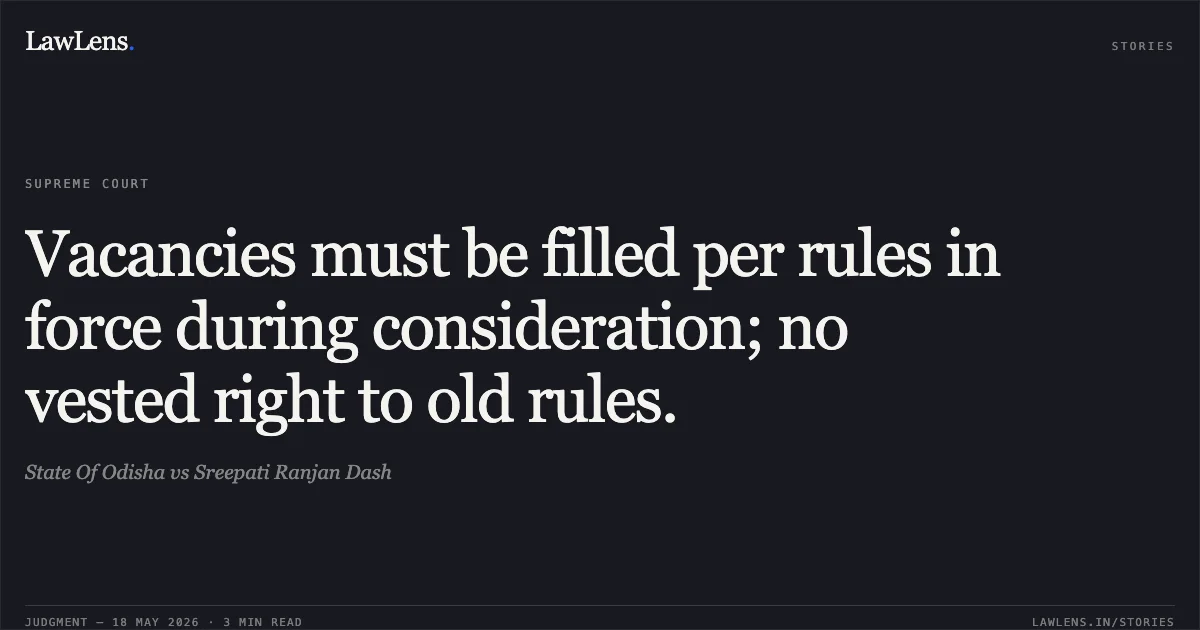
The Court primarily applied the principle that an employee has no vested right to promotion or to be governed by repealed rules, but only a right to be considered under the "rules in force" at the time of actual consideration.
Source reference: para. 13, 15It relied on State of H.P. v. Raj Kumar (2023) 3 SCC 773, which expressly overruled Y.V. Rangaiah v. J. Sreenivasa Rao and established that there is no universal rule that vacancies must be filled per the law existing when they arose.
Source reference: para. 13The Court also applied Union of India v. Somasundaram Viswanath (1989) 1 SCC 175, affirming that statutory rules framed under the proviso to Article 309 supersede executive instructions.
Source reference: para. 25Reasoning
The Court found that the High Court erred by failing to apply the ratio of Raj Kumar, which mandates that the "rule in force" at the time of consideration governs promotions.
Source reference: paras. 14, 17The 1981 Executive Instructions were explicitly a pro-tem arrangement "pending finalization of cadre rules".
Source reference: para. 19Once the 2021 Rules were notified under Article 309, they became the sole authority for recruitment.
Source reference: para. 25Regarding the "savings" clause in the 2021 Rules, the Court reasoned that a mere recommendation by the Transport Commissioner to hold a DPC did not constitute a "thing done or omitted to be done"; only a completed appointment would have been saved.
Source reference: para. 24Furthermore, the ARTO post was a "selection post," meaning the State had the policy discretion to change the recruitment method from promotion to competitive examination based on administrative necessity.
Source reference: paras. 27-28Holding
The Court answered the issues in the negative, holding that the respondents had no vested right to be considered under the 1981 Instructions once the 2021 Rules came into force.
The Supreme Court set aside the High Court's orders, ruling that the State cannot be compelled to fill vacancies under repealed/superseded instructions when a conscious policy decision (2021 Rules) has been made to restructure the cadre and recruitment process. The appeals were allowed.
Source reference: paras. 28-30Original Court PDF
State Of OdishavsSreepati Ranjan Dash
Click to open original judgment
Original judgment, available to read, download and summarize on LawLens.in