Facts
The Department filed appeals under Section 260A of the Income-tax Act, 1961, challenging an ITAT order dated 7 July 2023.
Source reference: no citationThe lead appeal was returned by the Registry on 20 January 2024 for defects and was due for re-presentation by 30 January 2024, but was re-presented only on 21 March 2026, causing a delay of 781 days.
Source reference: p. 2–3The Department sought condonation, attributing the delay to the simultaneous filing of approximately 530 other appeals, voluminous records, and the work involved in correcting and re-presenting connected appeals.
Source reference: p. 3Issues
Whether the Department provided sufficient cause to condone the 781-day delay in re-presenting the tax case appeal.
Source reference: p. 3–5Whether a liberal approach to delay could be justified because the appellant was a government department and the delay was attributed to its counsel’s workload and administrative requirements.
Source reference: p. 3–6Law Applied
An application to condone delay in re-presentation is not subject to the same rigorous tests as an application under Section 5 of the Limitation Act; it may be decided on the explanation in the supporting affidavit.
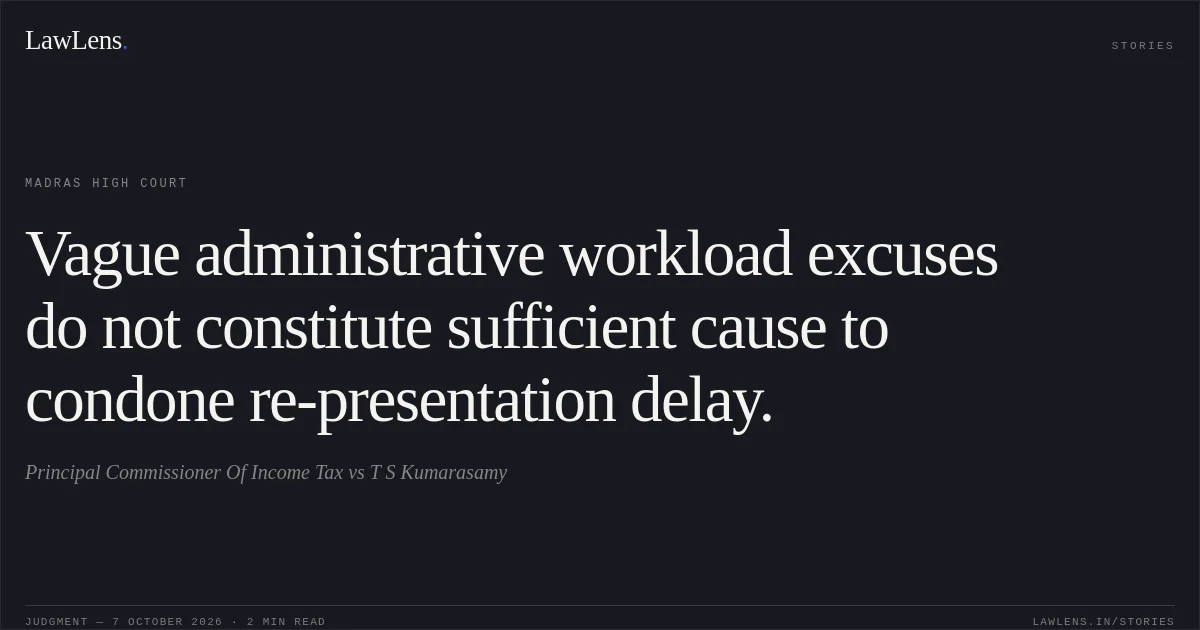
Source reference: p. 4Nevertheless, the applicant must offer a reasonable, plausible and bona fide explanation for the delay; generalized administrative workload or procedural excuses are insufficient.
Source reference: p. 4–5The Court relied on State of Madhya Pradesh v. Bherulal, (2020) 10 SCC 654, and Office of the Chief Post Master General v. Living Media India Ltd., (2012) 3 SCC 563, for the principle that the Government receives no automatic exemption from limitation and must explain delay with diligence and bona fides.
Source reference: p. 6–8It also relied on State of Maharashtra v. Borse Brothers Engineers and Contractors Pvt. Ltd., (2021) 6 SCC 460, and Shivamma v. Karnataka Housing Board, 2025 INSC 1104, concerning the insufficiency of procedural explanations and administrative lethargy.
Source reference: p. 9–12Reasoning
Although the Court recognized that re-presentation applications are assessed less rigorously than Section 5 applications, the Department’s explanation did not account coherently for the period from 30 January 2024 to 21 March 2026.
Source reference: p. 4–5Assertions about handling approximately 530 appeals, voluminous records and procedural requirements were general and did not explain the prolonged inaction.
Source reference: p. 4–5The Department’s status as a government litigant did not warrant a different standard, particularly in light of the Supreme Court authorities rejecting routine administrative explanations.
Source reference: p. 5–12The Court also noted that it had dismissed the assessees’ applications involving an approximately 954-day re-presentation delay in appeals arising from the same ITAT order and saw no basis to treat the Department differently.
Source reference: p. 13Holding
The Court held that the Department had not shown satisfactory cause for the 781-day delay.
It dismissed the applications seeking condonation and consequentially rejected the W.A. SR matters; there was no order as to costs.
Source reference: p. 13–14Acts & Sections Cited
2 provisions across 2 statutes referred to in this judgment. Each provision opens on LawLens.
Limitation Act, 19631
Code of Civil Procedure, 19081
Original Court PDF
Principal Commissioner Of Income TaxvsT S Kumarasamy
Click to open original judgment
Original judgment, available to read, download and summarize on LawLens.in