Facts
The deceased, who was married to A1, lived with him and members of his family.
Source reference: no citationAfter she died by suicide, her husband lodged a complaint alleging that the accused had subjected her to cruelty.
Source reference: no citationFollowing trial, the Mahila Court convicted A1 under Section 498A IPC but acquitted him of the other charges; it acquitted A2–A6 of all charges, including under Sections 498A and 306 IPC. A1 appealed his conviction, and the State appealed the acquittals of A2–A6.
Source reference: p. 3–5The prosecution relied on testimony from the deceased’s husband and relatives, among other evidence.
Source reference: p. 7, 10–11The defence produced documents indicating a property dispute between A1 and the deceased’s husband.
Source reference: p. 7, 10–11Issues
Whether the evidence established that A1 subjected the deceased to cruelty warranting conviction under Section 498A IPC.
Source reference: p. 8–10Whether the acquittal of A2–A6, including on the charges under Sections 498A and 306 IPC, should be reversed.
Source reference: p. 5–6, 11–12Law Applied
The Court considered Sections 498A and 306 IPC and Section 113A of the Evidence Act.
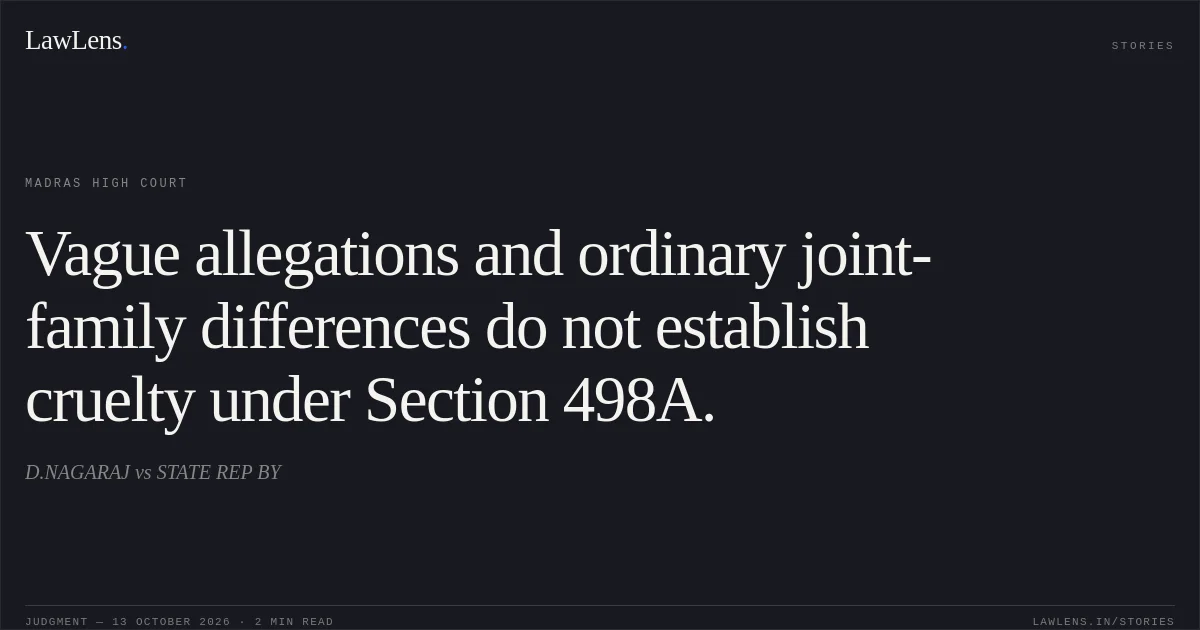
Source reference: no citationIt stated that a Section 498A conviction requires specific evidence of the nature of the alleged cruelty and when it occurred; vague allegations or evidence of ordinary differences among relatives living in a joint family are insufficient.
Source reference: p. 9Section 113A permits a presumption of abetment of suicide in the circumstances specified by that provision, but the Court held that the presumption in this case had been rebutted.
Source reference: p. 12The Court also considered the charges under Sections 506(ii) and 34 IPC in reviewing the State’s appeal.
Source reference: p. 3–5Reasoning
The prosecution’s allegations against A1 were vague and lacked particulars identifying the nature and timing of the alleged cruelty.
Source reference: p. 8–11The deceased’s parents and sister did not support the allegation of a dowry demand, and the evidence, viewed alongside documents showing a property dispute, was consistent with differences within a joint family rather than legally established cruelty.
Source reference: p. 8–11The email relied on by the State described a single incident that the Court found insufficient to establish Section 498A cruelty; the diary was not proved to have been written by the deceased.
Source reference: p. 10The Court found no adequate evidence of abetment of suicide and held that the Section 113A presumption had been rebutted.
Source reference: p. 12It also noted that the acquittal of A1 under Section 306 IPC had not been challenged, further undermining the State’s appeal concerning the other accused.
Source reference: p. 12Holding
The Court allowed A1’s appeal, set aside his conviction and sentence under Section 498A IPC, and acquitted him; any fine paid was to be refunded and any bail bond cancelled.
It dismissed the State’s appeal, leaving the acquittals of A2–A6 undisturbed.
Source reference: p. 12Acts & Sections Cited
6 provisions across 2 statutes referred to in this judgment. Each provision opens on LawLens.
Code of Criminal Procedure, 19733
Indian Penal Code, 18603
Original Court PDF
D.NAGARAJvsSTATE REP BY
Click to open original judgment
Original judgment, available to read, download and summarize on LawLens.in