Facts
The petitioners sought the quashing of FIR No. 11198001201657 of 2020, registered for offences under Sections 306, 406, 120B, 323, 504, 506(2), and 114 of the IPC
Source reference: p. 1The deceased, Pruthvirajsinh, committed suicide after killing his family
Source reference: p. 1542 days later, his father (a retired Dy.S.P.) filed an FIR based on a discovered nine-page "suicide note" containing partnership accounts and allegations
Source reference: p. 4-6The Informant alleged that Petitioner No. 1 (the deceased's partner) cheated the deceased of ₹45,30,482
Source reference: p. 10the petitioners pressured the deceased to marry his minor daughter to Petitioner No. 4 and execute a will in their favor
Source reference: p. 11Allegations of "black magic" were also raised
Source reference: p. 12A chargesheet was filed during the pendency of the petition
Source reference: p. 16Issues
1. Whether the allegations in the FIR and the suicide note satisfy the ingredients of "abetment" under Section 306 read with Section 107 of the IPC
Source reference: p. 172. Whether the High Court can exercise its inherent powers under Section 482 of the CrPC to quash an FIR after a chargesheet has been filed
Source reference: p. 283. Whether the disputes related to partnership accounts and vague allegations of family pressure constitute a criminal offence or are primarily civil/personal in nature
Source reference: p. 13-14Law Applied
The Court applied Sections 107 and 306 of the IPC, which require proof of direct or indirect acts of incitement or instigation proximate to the time of suicide
Source reference: p. 17-18The Court relied on Ramesh Kumar v. State of Chhattisgarh (2001) to define "instigation" as goading or provoking someone to act
Source reference: p. 21The Court relied on Naresh Kumar v. State of Haryana (2024) to emphasize that harassment without positive action is insufficient for Section 306
Source reference: p. 21Under Jayedeepsinh Pravinsinh Chavda v. State of Gujarat (2024), mens rea must be explicitly discernible
Source reference: p. 23the Court cited Shaileshbhai Ranchhodbhai Patel v. State of Gujarat (2024), confirming that Section 482 powers remain available post-chargesheet
Source reference: p. 28the parameters for quashing established in State of Haryana v. Bhajan Lal
Source reference: p. 29Reasoning
The Court found that the allegations regarding partnership dues and family marriage pressures were vague, omnibus, and lacked specific dates or instances
Source reference: p. 19-20It reasoned that even if Petitioner No. 1 owed money, a financial dispute does not inherently constitute "instigation" to commit suicide under Section 107
Source reference: p. 20The Court noted the 42-day delay in filing the FIR was unexplained, especially given the Informant’s background as a senior police officer
Source reference: p. 12, 19It observed that the deceased's "suicide note" primarily contained accounts and lacked evidence of a "continued course of conduct" that left the deceased with no other option
Source reference: p. 20, 26Regarding Sections 504 and 506, the Court held that "mere abusive language" or "rudeness" does not amount to intentional insult leading to a breach of peace
Source reference: p. 27-28The "black magic" allegations were deemed unsupported by material evidence
Source reference: p. 26Holding
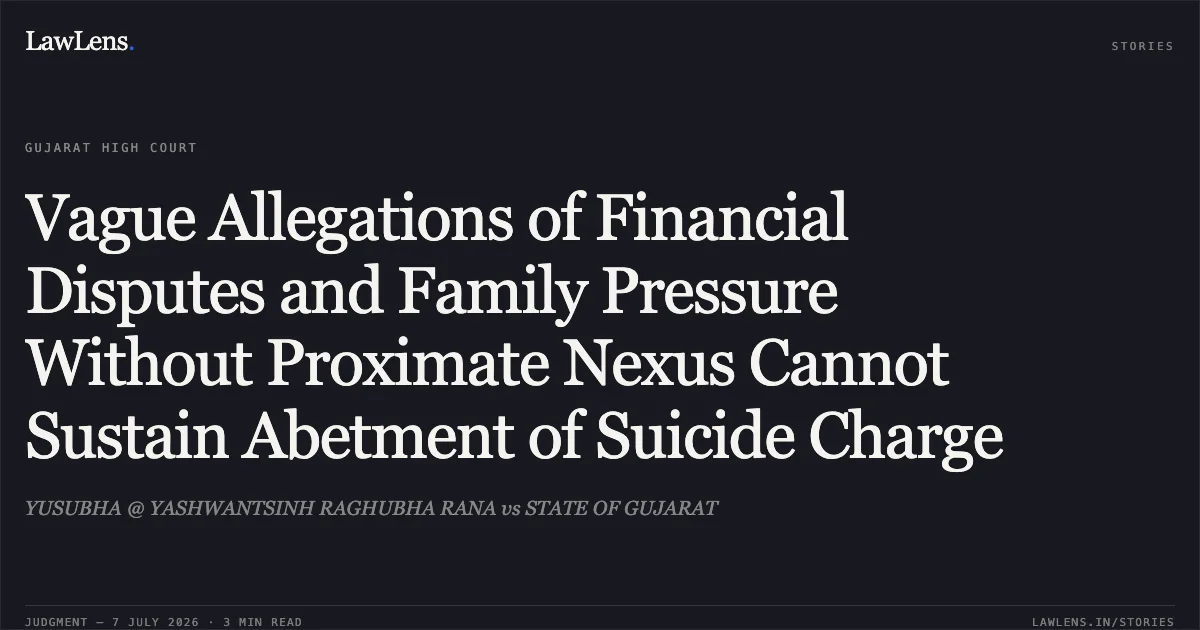
The Court held that the FIR and chargesheet, even if accepted in their entirety, failed to disclose a prima facie case of abetment or criminal breach of trust
It ruled that the High Court’s power under Section 482 is not curtailed by the filing of a chargesheet if the proceedings constitute an abuse of process
Source reference: p. 28the Court allowed the petition and quashed FIR No. 11198001201657 and all consequential proceedings against the petitioners
Source reference: p. 30The proceedings were maliciously instituted with an ulterior motive, falling under the Bhajan Lal parameters for quashing
Source reference: p. 30Acts & Sections Cited
16 provisions across 4 statutes referred to in this judgment. Each provision opens on LawLens.
Indian Penal Code, 18608
Code of Criminal Procedure, 19735
Arms Act, 19591
Original Court PDF
YUSUBHA @ YASHWANTSINH RAGHUBHA RANAvsSTATE OF GUJARAT
Click to open original judgment
Original judgment, available to read, download and summarize on LawLens.in