Facts
Hansaben, wife of Bhupat Govabhai Vala, allegedly lived in a joint matrimonial household at Village Devda with her husband and in-laws.
Source reference: p.2The prosecution alleged that her sisters-in-law, Vijyaben and Gitaben, subjected her to physical and mental cruelty, including taunts concerning a loan of Rs.13,000/- allegedly borrowed by Hansaben’s father.
Source reference: p.2After a prior dispute was settled and Hansaben returned to her matrimonial home, she allegedly faced further harassment.
Source reference: p.8On 17 June 2011, she attempted suicide by pouring kerosene on herself and setting herself ablaze; she was treated at hospitals and died of burn injuries on 27 June 2011.
Source reference: p.8A complaint was recorded while she was undergoing treatment, and a dying declaration was also recorded by the Executive Magistrate.
Source reference: pp.8–10The respondents were prosecuted under Sections 498A, 306 and 114 of the Indian Penal Code.
Source reference: p.1The Sessions Court, Porbandar, acquitted them in Sessions Case No.44 of 2011 by judgment dated 31 January 2013.
Source reference: p.1The State challenged the acquittal under Section 378(1)(3) of the Code of Criminal Procedure.
Source reference: p.1Issues
1. Whether the trial court was justified in acquitting the respondents of the offences under Sections 498A, 306 and 114 of the IPC.
Source reference: para.112. Whether the trial court properly appreciated the oral, documentary and dying-declaration evidence produced by the prosecution.
Source reference: para.113. Whether the acquittal suffered from illegality, irregularity or perversity warranting appellate interference.
Source reference: para.11Law Applied
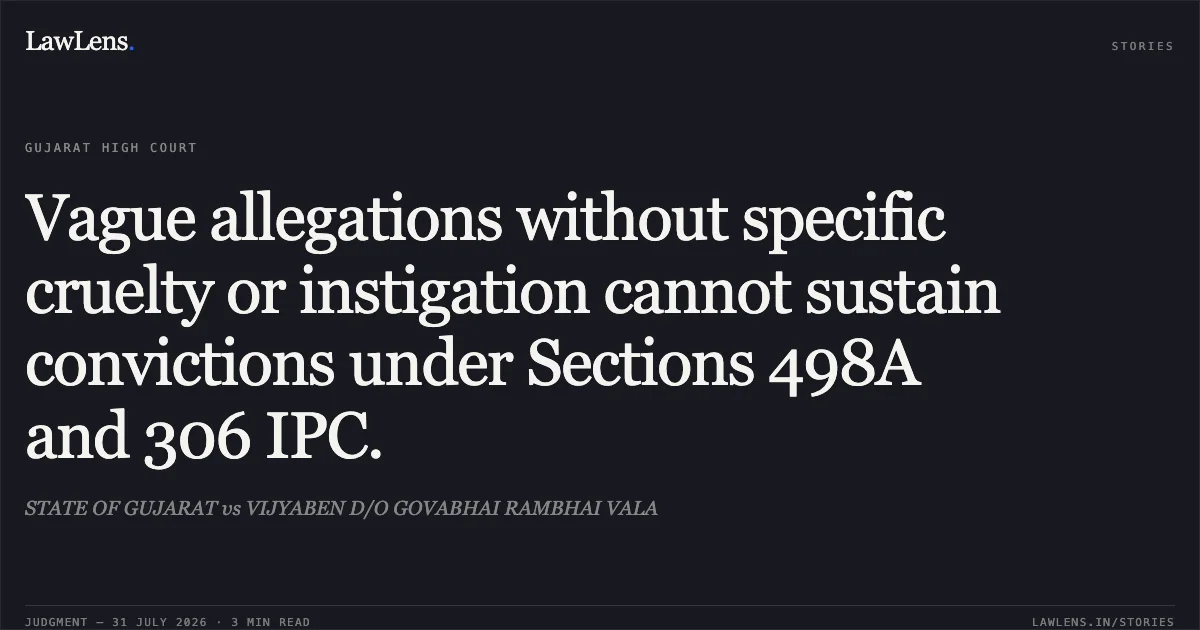
The Court applied Sections 498A and 306 read with Section 107 of the IPC, holding that conviction requires cogent evidence establishing cruelty, abetment, instigation, intentional aid or active participation; vague allegations of harassment are insufficient.
Source reference: paras.13–16The Court relied on Ramesh Kumar v. State of Chhattisgarh, (2001) 9 SCC 618, and Ram Pyarey v. State of Uttar Pradesh, [2025] 6 SCC 820, for the principle that a suicide within seven years of marriage does not automatically attract Sections 498A or 306 IPC and that foundational facts must be proved.
Source reference: para.16In an appeal against acquittal under Section 378 CrPC, the appellate court may reappreciate the evidence, but must respect the double presumption of innocence; where two reasonable views are possible, the acquittal should not be disturbed.
Source reference: paras.17–20These principles were drawn from Chandrappa v. State of Karnataka, (2007) 4 SCC 415, Rajesh Prasad v. State of Bihar, (2022) 3 SCC 471, Babu Sahebagouda Rudragoudar v. State of Karnataka, (2024) 8 SCC 149, and Ramesh v. State of Karnataka, (2024) 9 SCC 169.
Source reference: paras.17–20Reasoning
The Court found that the prosecution evidence did not specify the particular acts, nature, frequency or circumstances of the alleged physical or mental cruelty.
Source reference: para.13The dying declaration merely attributed the suicide to harassment by the respondents without identifying any specific conduct constituting cruelty or abetment.
Source reference: paras.13–14The evidence of the deceased’s relatives, together with the investigation material, indicated that Vijyaben and Gitaben were residing separately—Vijyaben with her minor son and Gitaben with her husband and in-laws at Village Badej, approximately 80 kilometres away—thereby weakening the allegation that they continuously harassed Hansaben in the matrimonial household.
Source reference: para.13The trial court had also considered the deceased’s extensive burn injuries, stated to be approximately 85%–90%, and assigned reasons for treating the dying declaration as unreliable.
Source reference: para.14Since there was no credible evidence of instigation, intentional aid, active participation or legally cognisable cruelty, the essential ingredients of Sections 498A and 306 IPC were not established.
Source reference: paras.18–22The High Court further held that the trial court’s view was a reasonable one and was neither perverse nor manifestly illegal so as to justify interference in an appeal against acquittal.
Source reference: paras.18–22Holding
The High Court answered the issues in favour of the respondents.
It held that the prosecution failed to prove beyond reasonable doubt that the respondents had subjected Hansaben to cruelty or abetted her suicide.
Source reference: paras.21–22The trial court’s acquittal was found to be legally sustainable and free from perversity, illegality or material infirmity.
Source reference: paras.21–22The State’s appeal was dismissed, the judgment and order of acquittal dated 31 January 2013 were confirmed, the bail bonds were cancelled, and the record and proceedings were directed to be returned to the trial court.
Source reference: para.23Acts & Sections Cited
6 provisions across 2 statutes referred to in this judgment. Each provision opens on LawLens.
Code of Criminal Procedure, 19733
Indian Penal Code, 18603
Original Court PDF
STATE OF GUJARATvsVIJYABEN D/O GOVABHAI RAMBHAI VALA
Click to open original judgment
Original judgment, available to read, download and summarize on LawLens.in