Facts
The Appellant, a Forest Range Officer, was accused in a 2001 FIR involving the illegal felling and transportation of timber by M/s Keshari Traders (RMP).
Source reference: para. 3It was alleged that the Forest Department and OFDC officials conspired with the RMP to allow the felling of live green trees under the guise of "salvage operations" for windfall timber, causing a loss of approximately ₹34.80 lakhs to the State.
Source reference: para. 3The High Court of Orissa dismissed the Appellant’s discharge application, holding that the role of the Appellant and the validity of the prosecution sanction must be examined during trial.
Source reference: para. 8, 13The Appellant challenged this, contending that no specific overt act was attributed to him and that similarly situated co-accused (higher-ranking IFS officers) had already been discharged.
Source reference: para. 10, 21Issues
1. Whether the criminal proceedings against the Appellant are liable to be quashed/discharged in the absence of specific allegations or overt acts attributed to him in the charge sheet.
Source reference: para. 16, 192. Whether the Appellant is entitled to discharge on the ground of parity when similarly situated co-accused have already been discharged.
Source reference: para. 15, 21Law Applied
The Court applied Section 227 of the Cr.P.C. regarding the discharge of an accused when no sufficient ground for proceeding exists.
Source reference: para. 5, 20It relied on Neelu Chopra v. Bharti, establishing that a complaint must specify the particulars and individual roles of each accused rather than mere general allegations.
Source reference: para. 16It further applied the "Bhajan Lal Guidelines" from State of Haryana v. Bhajan Lal, which permit quashing when allegations, even if accepted, do not prima facie constitute an offence.
Source reference: para. 17Finally, it invoked the principle of parity and the doctrine that a trial should not be a "ritualistic procedure" causing irreparable harm when "grave suspicion" is absent, citing Yogesh v. State of Maharashtra.
Source reference: para. 21-23Reasoning
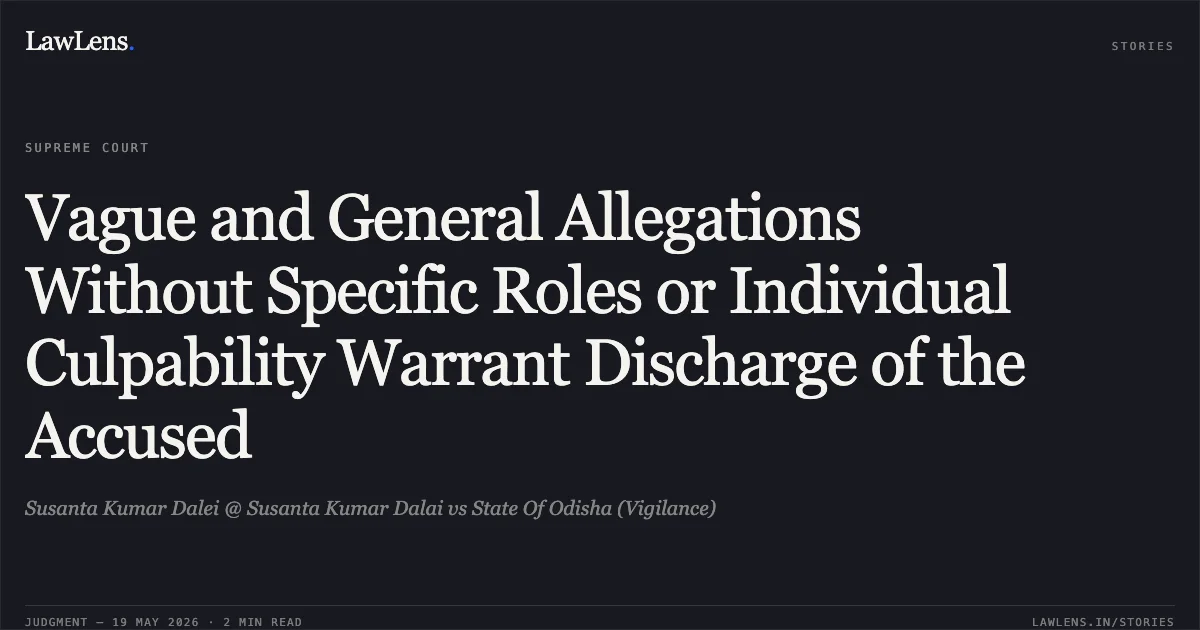
The Court observed that the FIR and charge sheet contained general and joint accusations without attributing specific roles or overt acts to the Appellant.
Source reference: para. 15, 19It found the allegations to be vague and insufficient to satisfy the requirements of criminal pleading as established in Neelu Chopra.
Source reference: para. 16Crucially, the Court noted that higher-ranking officers (IFS officers) in the same administrative chain had already been discharged by the High Court under similar circumstances.
Source reference: para. 21The Supreme Court reasoned that continuing the prosecution against the Appellant alone, when no qualitatively stronger evidence existed against him compared to the discharged co-accused, violated the principle of parity and Article 14 of the Constitution.
Source reference: para. 21The Court emphasized that while a detailed appreciation of evidence is not required at the discharge stage, there must be a "grave suspicion"; here, the allegations were deemed "inherently improbable" and an abuse of the process of law.
Source reference: para. 17, 23Holding
The Court answered the issues in the affirmative, holding that the continuation of proceedings against the Appellant amounted to harassment and an abuse of the process of court.
The Supreme Court set aside the High Court's judgment, allowed the appeal, and ordered the discharge of the Appellant from the alleged offences.
Source reference: para. 24Acts & Sections Cited
10 provisions across 3 statutes referred to in this judgment. Each provision opens on LawLens.
Prevention of Corruption Act, 19882
Indian Penal Code, 18602
Code of Criminal Procedure, 19736
Original Court PDF
Susanta Kumar Dalei @ Susanta Kumar DalaivsState Of Odisha (Vigilance)
Click to open original judgment
Original judgment, available to read, download and summarize on LawLens.in