Facts
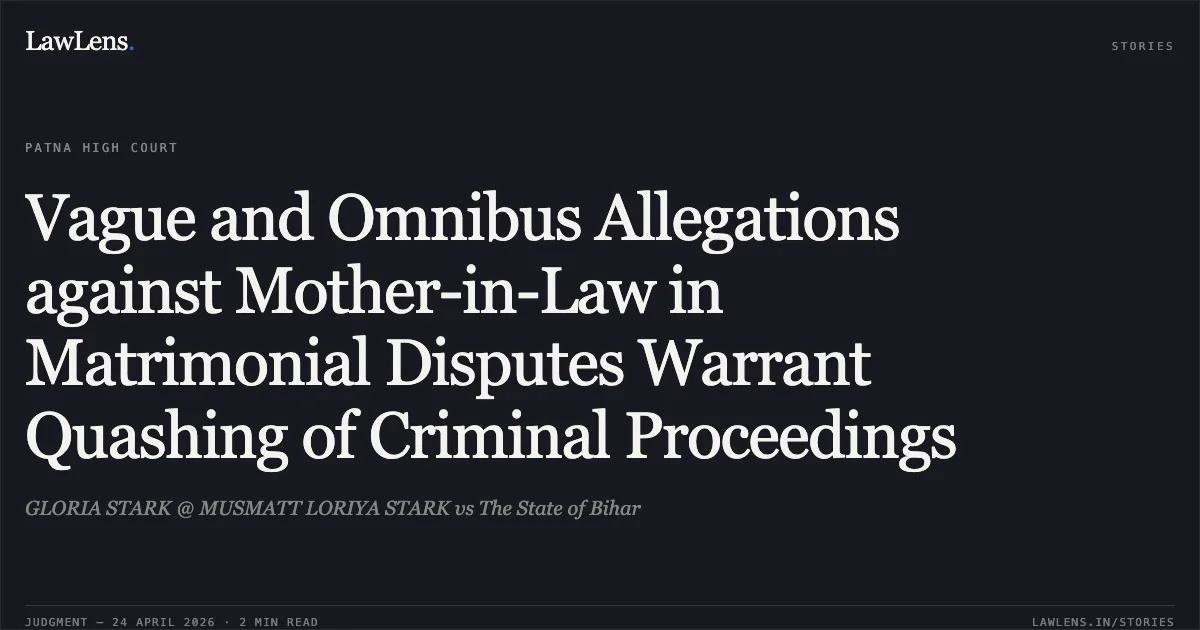
The petitioner, the mother-in-law of the informant (Opposite Party No. 2), sought to quash an order of cognizance dated 25.11.2020 passed by the ACJM-2, Patna.
Source reference: p. 1-2The case originated from Buddha Colony P.S. Case No. 307 of 2018, where the informant alleged she was tortured for dowry (specifically money for a motorcycle and land) by her husband and "sasurali" (in-laws).
Source reference: p. 2Following unsuccessful compromises mediated by the husband and a Mahila Helpline, the informant alleged her husband ultimately abandoned and attacked her.
Source reference: p. 2The petitioner argued that the allegations against her were vague, general, and omnibus in nature.
Source reference: p. 2Issues
1. Whether the order of cognizance against the petitioner (mother-in-law) should be quashed on the grounds that the allegations were vague and omnibus.
Source reference: p. 2 / para. 42. Whether the criminal proceedings constituted an abuse of the process of law in the context of a matrimonial dispute essentially between the husband and wife.
Source reference: p. 2-6Law Applied
The Court primarily relied on Section 482 of the Cr.P.C. regarding the inherent powers of the High Court to prevent abuse of the process of law.
Source reference: p. 4-5It applied the legal principles established in Abhishek v. State of Madhya Pradesh (2023), which integrated precedents such as Kahkashan Kausar alias Sonam v. State of Bihar (2022) regarding the quashing of "general and omnibus" allegations against in-laws.
Source reference: para. 13Preeti Gupta v. State of Jharkhand (2010) regarding the tendency to implicate all immediate relations in matrimonial disputes.
Source reference: para. 14Neelu Chopra v. Bharti (2009) regarding the requirement of specific particulars for each accused.
Source reference: para. 15Reasoning
The Court examined the FIR and found that the allegations against the petitioner were limited to a general statement that the husband and "sasurali" people tortured the informant for dowry.
Source reference: p. 2Applying the Abhishek precedent, the Court reasoned that such "vague, general and omnibus" allegations, if left unchecked, lead to the misuse of Section 498A IPC.
Source reference: p. 3The Court observed that the core of the dispute appeared to be between the husband and wife rather than the mother-in-law.
Source reference: p. 2Following the directive in Mahmood Ali v. State of U.P. (2023), the Court looked "between the lines" of the FIR to determine if the proceedings were vexatious or instituted with an ulterior motive, concluding that allowing the prosecution to continue against the petitioner in the absence of specific allegations would result in an abuse of the process of law.
Source reference: p. 3-5Holding
The Court answered the issues in the affirmative, holding that the prosecution against the petitioner could not be sustained due to the lack of specific allegations.
The petition was allowed, and the order of cognizance dated 25.11.2020 passed by the ACJM-2, Patna in Buddha Colony P.S. Case No. 307 of 2018, along with the subsequent proceedings against the petitioner, was quashed.
Source reference: p. 5-6Acts & Sections Cited
4 provisions across 2 statutes referred to in this judgment. Each provision opens on LawLens.
Indian Penal Code, 18602
Original Court PDF
GLORIA STARK @ MUSMATT LORIYA STARKvsThe State of Bihar
Click to open original judgment
Original judgment, available to read, download and summarize on LawLens.in