Facts
The marriage between Respondent No. 2 and the petitioner’s brother was solemnized on April 27, 2018
Source reference: para. 2The respondent resided with her husband at Rewa until August 2, 2018
Source reference: para. 2The petitioner, the sister-in-law of the respondent, was employed as a guest lecturer at Katni and resided there separately from the couple, supported by an appointment order dated January 23, 2018, and an experience certificate
Source reference: para. 2, 3On June 28, 2019, an FIR (Crime No. 0496 of 2019) was registered at PS Kotwali, Rewa, against the petitioner and others for offenses under Sections 498A, 506, and 34 of the IPC and Sections 3/4 of the Dowry Prohibition Act
Source reference: para. 1The petitioner moved the High Court under Section 528 of the Bharatiya Nagarik Suraksha Sanhita (BNSS), 2023, seeking quashment of the FIR, contending false implication based on vague and omnibus allegations
Source reference: para. 1, 4Issues
1. Whether the allegations in the FIR and the statement under Section 161 of the CrPC/BNSS prima facie constitute a case against the petitioner
Source reference: para. 7, 92. Whether the continuation of criminal proceedings against a relative residing separately, based on general and omnibus allegations, amounts to an abuse of the process of law
Source reference: para. 8, 9Law Applied
Section 528 of the BNSS, 2023 (corresponding to Section 482 of the CrPC), regarding the inherent powers of the High Court to quash proceedings to prevent abuse of process
Source reference: para. 1Principles from Kansraj v. State of Punjab, which cautioned against the tendency to over-implicate relatives in dowry cases
Source reference: para. 8Standards set in Preeti Gupta v. State of Jharkhand and Geeta Mehrotra v. State of Uttar Pradesh, holding that vague and general allegations without specific overt acts are insufficient for prosecution
Source reference: para. 8The court invoked the parameters of State of Haryana v. Bhajan Lal to determine when quashing is necessary to prevent a miscarriage of justice
Source reference: para. 9Reasoning
The court observed that the allegations against the petitioner were general and "omnibus" in nature, lacking any specific date, time, or description of overt acts
Source reference: para. 7Documentary evidence, including the petitioner's appointment order and experience certificate, established that she resided in Katni—a different city—during the relevant period of the matrimonial dispute
Source reference: para. 2, 7The court noted that even the respondent's subsequent statement under Section 161 CrPC omitted specific allegations against the petitioner, which significantly weakened the prosecution's case
Source reference: para. 4, 7The court found that the matrimonial discord was primarily between the spouses, as evidenced by the husband’s successful petition for restitution of conjugal rights
Source reference: para. 4, 8Applying the Supreme Court’s warnings against the "over-implication" of relatives, the court determined that there was no prima facie material to link the petitioner to the alleged offenses
Source reference: para. 8, 9Holding
The court held that the allegations were too vague to sustain a criminal trial and that continuing the proceedings would result in a miscarriage of justice
The High Court allowed the petition and quashed the FIR bearing Crime No. 0496 of 2019, along with all consequential proceedings, insofar as they related to the petitioner
Source reference: para. 10While the petitioner was discharged, the court clarified that proceedings against other co-accused (the husband and other relatives) would continue in accordance with the law
Source reference: para. 10Acts & Sections Cited
7 provisions across 5 statutes referred to in this judgment. Each provision opens on LawLens.
Bharatiya Nagarik Suraksha Sanhita, 20231
Indian Penal Code, 18602
Hindu Marriage Act, 19551
Code of Criminal Procedure, 19731
Original Court PDF
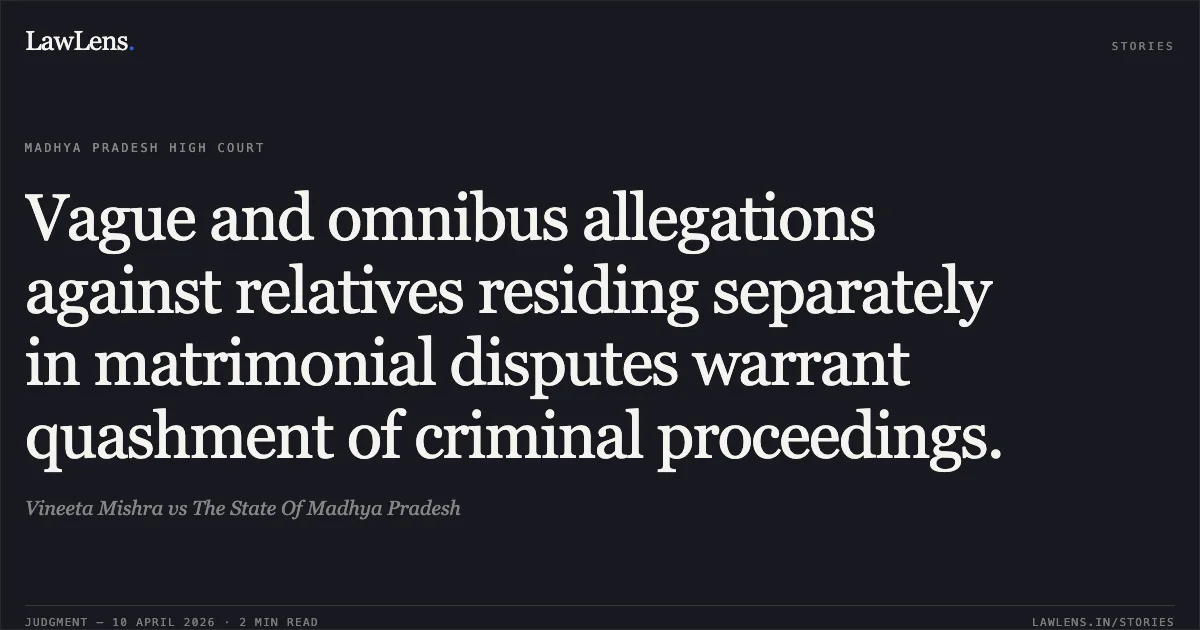
Vineeta MishravsThe State Of Madhya Pradesh
Click to open original judgment
Original judgment, available to read, download and summarize on LawLens.in