Facts
The parties married before the Marriage Officer, Ranchi, on 28 July 2011 and subsequently underwent a Hindu customary ceremony.
Source reference: para. 1The appellant-husband, a medical student pursuing studies abroad, alleged that the respondent-wife mistreated his parents, abused him, withdrew from cohabitation, maintained a separate mess in the matrimonial home, and caused him mental cruelty.
Source reference: paras. 1–2He therefore sought dissolution of marriage under Section 27(1)(d) of the Special Marriage Act, 1954, on the ground of cruelty.
Source reference: paras. 1–2The respondent denied the allegations and alleged dowry demands, forcible termination of her pregnancy, physical and mental cruelty, and an illicit relationship of the appellant with another woman.
Source reference: para. 4She also stated that she continued to reside in the matrimonial home and was willing to resume conjugal life.
Source reference: para. 4The Family Court framed issues concerning maintainability, cause of action, cruelty, entitlement to divorce, and other reliefs, and dismissed the petition after finding that cruelty had not been proved.
Source reference: paras. 5–6The husband preferred an appeal under Section 19(1) of the Family Courts Act, 1984.
Source reference: paras. 1, 7Issues
Whether the respondent-wife had treated the appellant-husband with cruelty so as to entitle him to a decree of divorce under Section 27(1)(d) of the Special Marriage Act, 1954?
Source reference: paras. 5, 30–31Whether the Family Court’s finding that the alleged cruelty was not proved was perverse or otherwise liable to interference in first appeal under Section 19(1) of the Family Courts Act, 1984?
Source reference: paras. 21–29, 49–52Whether the respondent’s institution of criminal proceedings and complaints against the appellant and his family amounted to matrimonial cruelty?
Source reference: para. 47Law Applied
The Court applied Section 27(1)(d) of the Special Marriage Act, 1954, under which divorce may be sought on the ground of cruelty, and Section 19(1) of the Family Courts Act, 1984, which permits an appeal to the High Court on facts and law.
Source reference: paras. 1, 21–23Cruelty was assessed according to the principles in Dr. N.G. Dastane v. Mrs. S. Dastane, requiring conduct that creates a reasonable apprehension that living with the other spouse would be harmful or injurious.
Source reference: para. 31Shobha Rani v. Madhukar Reddi, holding that cruelty has no fixed definition and depends on the parties’ circumstances.
Source reference: paras. 32–34Joydeep Majumdar v. Bharti Jaiswal Majumdar, requiring cruelty to be grave and weighty rather than ordinary marital wear and tear.
Source reference: para. 39Samar Ghosh v. Jaya Ghosh, recognising that mental cruelty must be determined on the particular facts and circumstances of each case.
Source reference: para. 41The Court further held that merely pursuing a legal remedy does not constitute cruelty unless the proceedings are shown to have been instituted maliciously and without basis.
Source reference: para. 47A finding is perverse only where it ignores material evidence, relies on irrelevant material, or is so irrational that no reasonable court could have reached it, as explained in Arulvelu v. State.
Source reference: paras. 27–29Reasoning
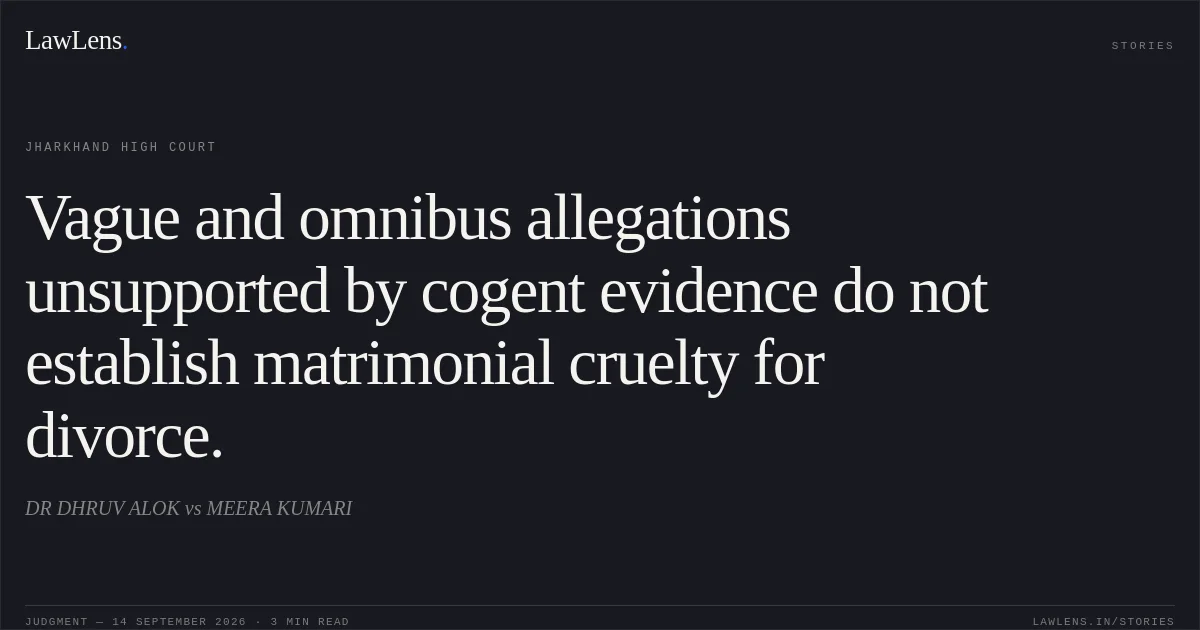
Although the High Court, as a first appellate court, was entitled to reappraise the entire evidence, it found that the appellant’s allegations were general, omnibus, and unsupported by specific incidents demonstrating grave or weighty cruelty.
Source reference: paras. 22–23, 44–46The appellant did not identify any concrete conduct that made it unsafe or unreasonable for him to live with the respondent, and he admitted that he had not lodged any police complaint against her.
Source reference: para. 18The evidence of his mother and other witnesses was substantially repetitive, hearsay, or insufficient to establish the alleged cruelty.
Source reference: para. 14The respondent’s separate residence or mess within the matrimonial home and the parties’ lack of communication, without more, did not satisfy the legal threshold of cruelty.
Source reference: paras. 45–48The Court also held that the respondent’s criminal complaint and proceedings against the appellant and his family could not, by themselves, constitute cruelty in the absence of proof that they were malicious and baseless.
Source reference: para. 47Accordingly, the Family Court’s conclusion was supported by the evidence and was not perverse.
Source reference: paras. 49–51Holding
The High Court held that the appellant failed to prove that the respondent had subjected him to cruelty within the meaning of Section 27(1)(d) of the Special Marriage Act, 1954.
The Family Court’s dismissal of the divorce petition was neither perverse nor legally infirm and required no interference.
Source reference: paras. 48–52The appeal was dismissed, and any pending interlocutory application was also disposed of.
Source reference: paras. 53–54Acts & Sections Cited
4 provisions across 3 statutes referred to in this judgment. Each provision opens on LawLens.
Family Courts Act, 19842
Special Marriage Act, 19541
Code of Civil Procedure, 19081
Original Court PDF
DR DHRUV ALOKvsMEERA KUMARI
Click to open original judgment
Original judgment, available to read, download and summarize on LawLens.in