Facts
The appellant (husband), along with his parents, was accused of causing his wife’s death by suicide through continuous dowry harassment and torture.
Source reference: p. 1-2The trial court acquitted the accused of charges under Section 304-B IPC, finding no evidence of dowry demands.
Source reference: p. 1-2However, relying on oral testimonies (PW2–PW5) and unverified letters (Exts. 6 & 7), the trial court convicted them under Section 498-A IPC and Section 4 of the Dowry Prohibition (DP) Act, despite noting the allegations were "general and omnibus".
Source reference: p. 2The High Court subsequently set aside the DP Act conviction but upheld the Section 498-A conviction while reducing the sentences.
Source reference: p. 3Issues
1. Whether a conviction under Section 498-A IPC can be sustained solely on general and omnibus allegations without specific instances of cruelty or harassment.
Source reference: p. 3 / para. 52. Whether unverified letters, where the handwriting was not proven to be that of the deceased, can form the basis of a criminal conviction.
Source reference: p. 6-7 / para. 10Law Applied
Section 498-A of the Indian Penal Code, 1860, which defines "cruelty" under two limbs: Explanation (a) regarding willful conduct likely to drive a woman to suicide, and Explanation (b) regarding harassment for unlawful demands.
Source reference: p. 7Section 4 of the Dowry Prohibition Act, 1961.
Source reference: p. 2The evidentiary requirement that allegations of cruelty must be specific rather than "general and omnibus" to meet the standard of proof in criminal law.
Source reference: p. 3, 7Reasoning
The Court observed a fundamental inconsistency in the lower courts' findings: while the trial court found no evidence of dowry demands, it nonetheless convicted the appellant under the DP Act and Section 498-A.
Source reference: p. 2-3The Supreme Court noted that the testimony of the deceased’s relatives (PW2, PW3, PW5) lacked specific dates or definite instances of torture, rendering them "omnibus" in nature.
Source reference: p. 5-6Regarding the documentary evidence (Exts. 6 & 7), the Court found that the Investigating Officer failed to verify the handwriting, and the letters themselves were undated and vague, reflecting family discord rather than criminal cruelty.
Source reference: p. 6-7The Court determined that although Section 498-A covers non-dowry harassment, the prosecution failed to prove any "mindless action" or "willful conduct" that met the statutory threshold of cruelty.
Source reference: p. 7Holding
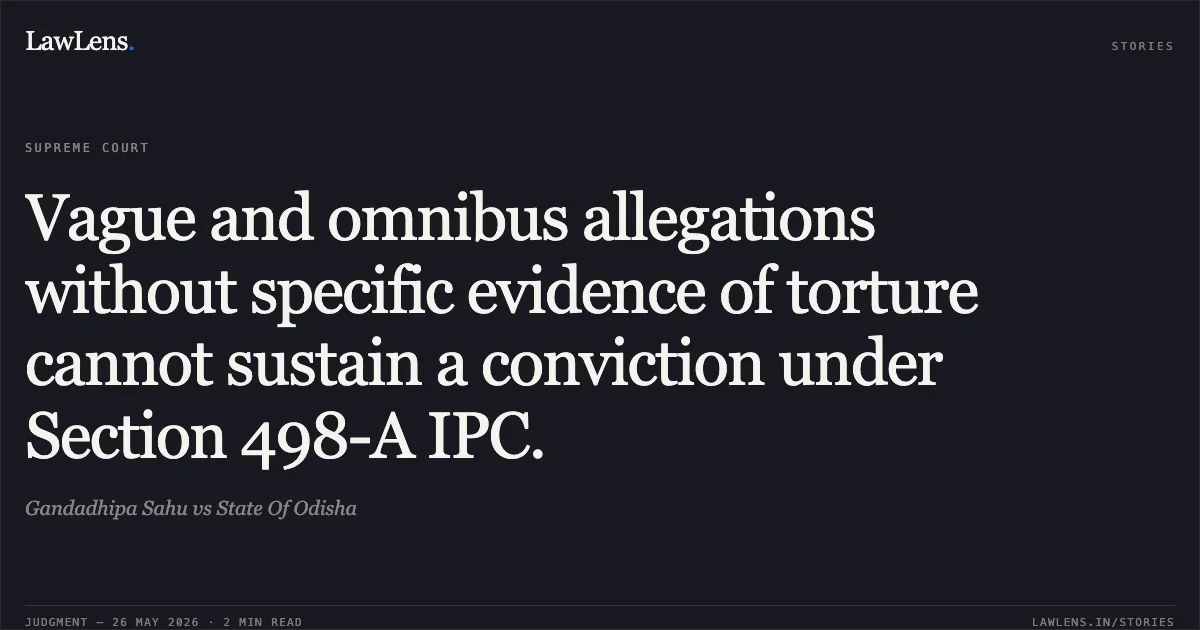
The Supreme Court held that the evidence fell short of establishing the crime under Section 498-A IPC.
The Court clarified that general allegations without substantiation cannot support a conviction.
Source reference: p. 7-8The Court allowed the appeal, reversed the judgments of the trial court and High Court, and acquitted the appellant. The appellant was ordered to be released forthwith.
Source reference: p. 7-8Acts & Sections Cited
3 provisions across 3 statutes referred to in this judgment. Each provision opens on LawLens.
Indian Penal Code, 18601
Dowry Prohibition Act, 19611
Probation of Offenders Act, 19581
Original Court PDF
Gandadhipa SahuvsState Of Odisha
Click to open original judgment
Original judgment, available to read, download and summarize on LawLens.in


