01Facts
The petitioners, namely the husband, parents-in-law, sister-in-law and other relatives of the de facto complainant, sought quashing of G.R. Case No. 4280 of 2024 arising from Nagerbazar P.S. Case No. 173 of 2024, registered under Sections 498A, 406 and 34 of the Indian Penal Code and pending before the Additional Chief Judicial Magistrate, Barrackpore.
¶ 1The complainant alleged that, after marriage, the petitioners and other in-laws physically and mentally tortured her, pressured her to bring additional money, assaulted her, drove her out of the matrimonial home and refused to return her stridhan articles.
¶ 3The parties filed written submissions and the State produced the case diary during the hearing.
¶ 402Issues
i.Whether the allegations in the FIR and materials in the case diary disclosed the essential ingredients of offences under Sections 498A, 406 and 34 of the IPC against the petitioners.
¶ 5, 7ii.Whether continuation of the criminal proceedings, in the absence of specific and particularised allegations against the petitioners, would amount to an abuse of the process of law warranting exercise of the High Court’s quashing jurisdiction.
¶ 6–703Law Applied
The Court applied Section 498A IPC, including its Explanation defining “cruelty” as wilful conduct likely to drive a woman to suicide or cause grave injury or danger to her physical or mental health, or harassment intended to coerce an unlawful demand for property or valuable security.
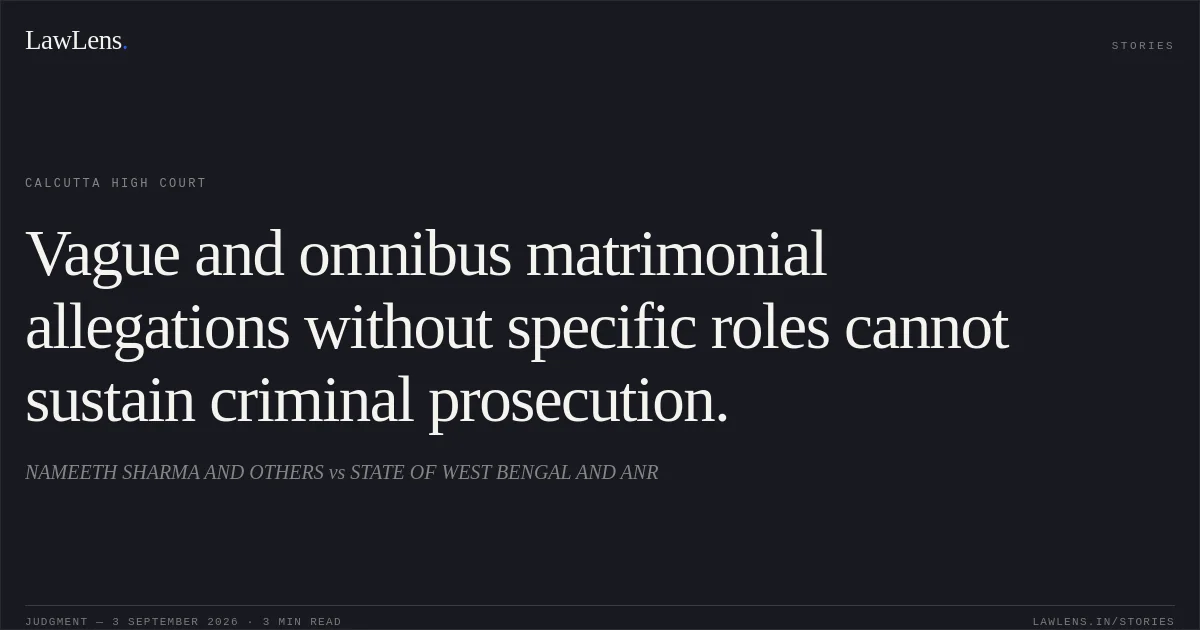
¶ 5Relying on Dara Lakshmi Narayana & Ors. v. State of Telangana & Anr., the Court held that vague, omnibus and unparticularised allegations against relatives in matrimonial disputes, without specifying the time, place, manner or individual role of the accused, cannot ordinarily sustain criminal prosecution.
¶ 6The Court further relied on G.V. Rao v. L.H.V. Prasad, (2000) 3 SCC 693, and Preeti Gupta v. State of Jharkhand, (2010) 7 SCC 667, for the principle that courts must scrutinise matrimonial allegations with care and prevent misuse of criminal proceedings against family members.
¶ 6, 30–31Such proceedings fall within the seventh category of cases identified in State of Haryana v. Bhajan Lal, where prosecution may be quashed to prevent abuse of process.
¶ 6Provisions in the judgment · 5 · Linked ones open on LawLens
Indian Penal Code, 1860 Section 406Section 34
Dowry Prohibition Act, 1961 Section 3Section 4
Code of Criminal Procedure, 1973 Section 482
04Reasoning
The Court found that the allegations against the petitioners were general and lacked specific particulars establishing their individual involvement in cruelty, unlawful dowry-related harassment, misappropriation of stridhan or any common intention.
¶ 7Applying the principles in Dara Lakshmi Narayana and the other precedents, the Court held that merely naming several members of the husband’s family in a matrimonial complaint, without concrete allegations or specific acts attributable to each accused, was insufficient to constitute the alleged offences.
¶ 6On its examination of the case diary, the Court concluded that the allegations were omnibus and that none of the essential ingredients of the offences were made out against the petitioners; continuation of the proceedings would therefore constitute an abuse of the process of law.
¶ 705Holding
The revision petition was allowed.
¶ 8The High Court quashed the proceedings in G.R. Case No. 4280 of 2024 arising out of Nagerbazar P.S. Case No. 173 of 2024 under Sections 498A, 406 and 34 IPC against Nameeth Sharma, Kamal Nayan Sharma, Sunita Sharma alias Sunita K. Sharma, Nidhi Sharma alias K. Nidhi Sharma, Pankaj Sharma, Poonam Sharma and Satya Narayan Sharma.
¶ 9Connected applications were disposed of, any interim order was vacated, and the judgment was directed to be communicated to the trial court for necessary compliance.
¶ 10–12Original Court PDF
NAMEETH SHARMA AND OTHERSvsSTATE OF WEST BENGAL AND ANR
Click to open original judgment
Original judgment, available to read, download and summarize on LawLens.in