Facts
Applicant No. 3 (husband) and Respondent No. 2 (wife), both medical professionals, married on 15.02.2023.
Source reference: para 2Due to higher studies in different cities, cohabitation was limited.
Source reference: para 2On 03.04.2025, the husband filed for restitution of conjugal rights under Section 9 of the Hindu Marriage Act.
Source reference: para 2Subsequently, on 25.09.2025, the wife lodged an FIR at Mahila Thana, Sagar, alleging dowry demand and cruelty under Sections 85, 316(2), 351(2), and 3(5) of the Bhartiya Nagarik Suraksha Sanhita (BNSS), 2023, and Sections 3/4 of the Dowry Prohibition Act.
Source reference: para 1The applicants (husband and parents-in-law) moved the High Court to quash the proceedings, claiming the FIR was a malicious "counterblast" to the matrimonial suit.
Source reference: para 3Issues
1. Whether the allegations against the parents-in-law (Applicants 1 & 2) meet the threshold of specificity required to sustain criminal prosecution.
Source reference: para 62. Whether the criminal proceedings against the husband (Applicant 3) constitute an abuse of process warranting quashment under Section 528 BNSS.
Source reference: para 10Law Applied
The Court applied Section 528 of the Bharatiya Nagarik Suraksha Sanhita, 2023 (formerly Section 482 Cr.P.C.) regarding inherent powers to prevent abuse of process.
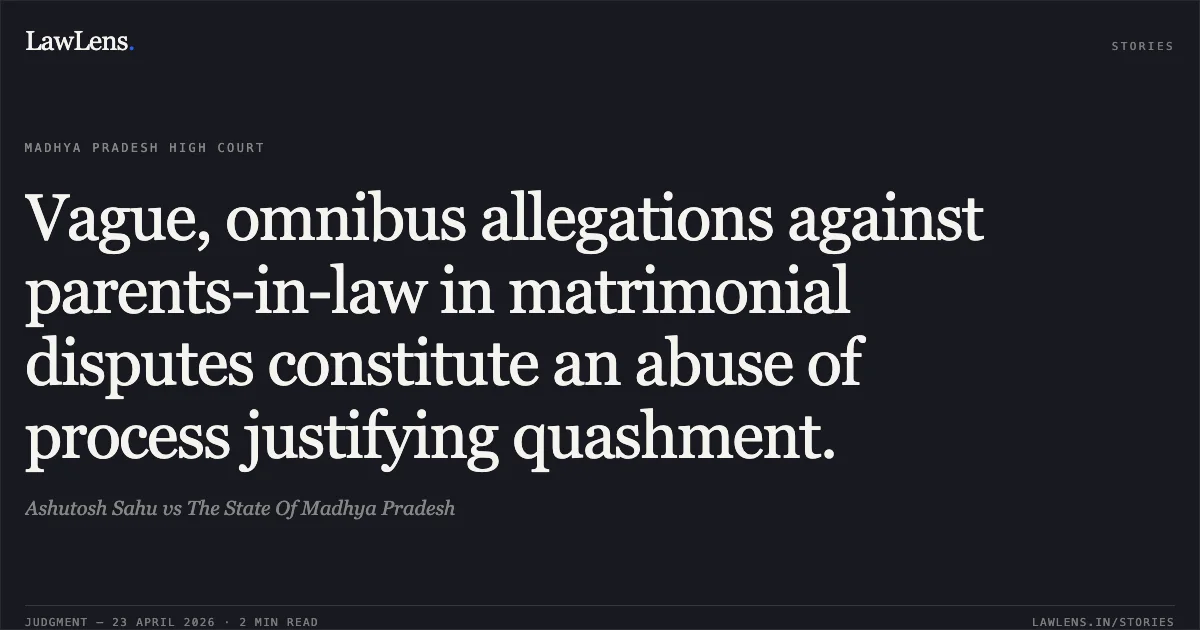
Source reference: para 1It relied on Preeti Gupta v. State of Jharkhand (2010) and Kahkashan Kausar v. State of Bihar (2022), which establish that general, omnibus, and sweeping allegations against relatives in matrimonial disputes without specific overt acts justify quashment.
Source reference: para 8It further referenced Arnesh Kumar v. State of Bihar (2014) regarding the tendency to implicate all family members.
Source reference: para 9It acknowledged that while "counterblast" FIRs are scrutinized, disputed questions of fact regarding the husband’s conduct must be resolved at trial.
Source reference: para 10-11Reasoning
The Court distinguished between the roles of the parents-in-law and the husband. Regarding Applicants 1 and 2, it found the allegations to be "vague and omnibus," lacking specific dates or overt acts.
Source reference: para 6It noted the wife primarily resided in Delhi for studies and had negligible cohabitation with the parents-in-law, making the claims of daily harassment improbable.
Source reference: para 6Conversely, the Court found that the allegations against Applicant 3 (husband) disclosed a prima facie case of matrimonial discord and cruelty.
Source reference: para 10Although the FIR was filed after the husband’s Section 9 petition, the Court held that this "retaliatory action" inference is a matter of evidence that cannot be adjudicated in a quashing petition, as the Court cannot conduct a "roving enquiry" into the truth of the allegations at this stage.
Source reference: para 10-11Holding
The petition was partly allowed. The FIR and all consequential proceedings (RCT No. 3596/2025) were quashed specifically regarding Applicant Nos. 1 and 2 (parents-in-law) to prevent abuse of process.
The petition was dismissed regarding Applicant No. 3 (husband), and the trial court was directed to proceed against him in accordance with law.
Source reference: para 14Acts & Sections Cited
9 provisions across 5 statutes referred to in this judgment. Each provision opens on LawLens.
Bharatiya Nagarik Suraksha Sanhita, 20231
Code of Criminal Procedure, 19731
Bharatiya Nyaya Sanhita, 20234
Hindu Marriage Act, 19551
Original Court PDF
Ashutosh SahuvsThe State Of Madhya Pradesh
Click to open original judgment
Original judgment, available to read, download and summarize on LawLens.in