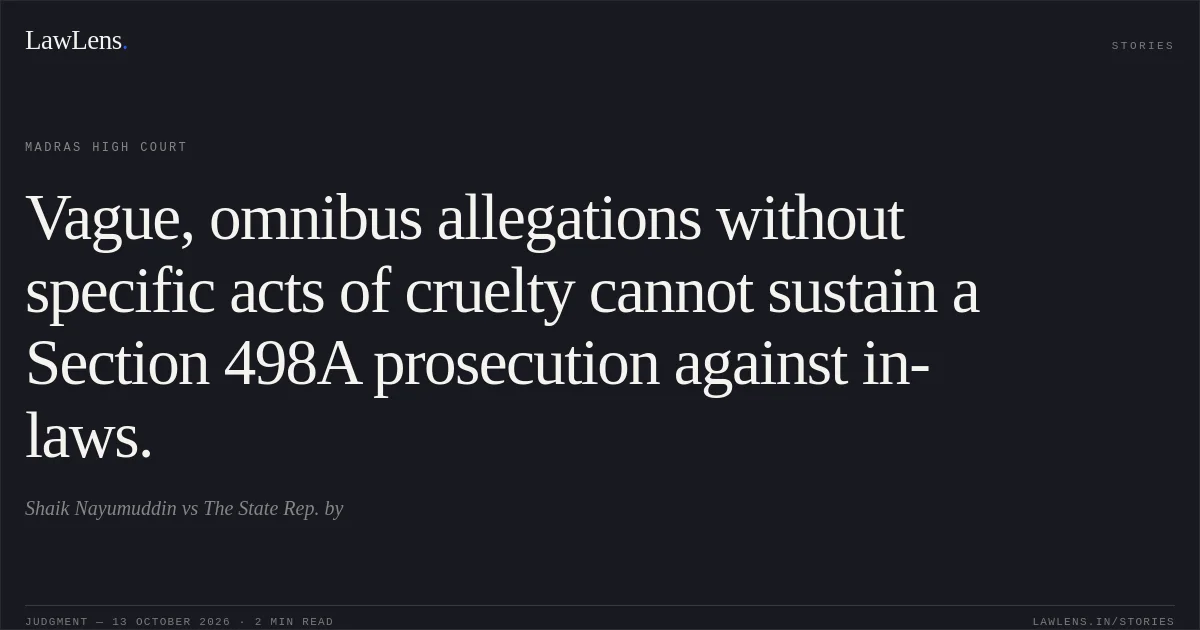
Facts
The second respondent alleged that, following her 2013 marriage to A1, she was subjected to harassment by her husband and the petitioners, his parents.
Source reference: pp. 2–3She and A1 separated in March 2019; she later complained about divorce notices and alleged demands and appropriation of money and property.
Source reference: pp. 2–3After investigation, the police filed a final report, and the Magistrate took cognizance of offences under Section 498A IPC and Section 4 of the Muslim Women (Protection of Rights on Marriage) Act, 2019, read with Section 34 IPC, against all accused.
Source reference: p. 3A2 and A3 sought to quash the proceedings against them under Section 528 BNSS, contending that the allegations were general and lacked specific allegations of their involvement.
Source reference: pp. 1, 4Issues
Whether the allegations against A2 and A3 disclosed the ingredients of cruelty under Section 498A IPC sufficient to sustain prosecution
Source reference: pp. 4–5Whether the criminal proceedings in C.C. No. 1249 of 2025 should be quashed as against A2 and A3
Source reference: pp. 5–6Law Applied
Section 498A IPC applies where a husband’s relative subjects a woman to “cruelty,” which includes wilful conduct likely to drive her to suicide or cause grave injury or danger to life, or harassment intended to coerce her or a related person to meet an unlawful demand for property or valuable security.
Source reference: pp. 4–5The Court relied on Dara Lakshmi Narayana v. State of Telangana, (2025) 3 SCC 735, for the principle that generalised accusations against a husband’s family, without specific allegations indicating active involvement, should not form the basis for criminal prosecution.
Source reference: p. 5The petition was brought under Section 528 BNSS, 2023.
Source reference: p. 1Reasoning
The Court found that the complainant had separated from A1 in March 2019, did not live with A2 and A3, and that they lived separately; it also found no specific allegations describing harassment or cruelty by them.
Source reference: pp. 4–5The allegations concerning control of the complainant’s salary and household work were treated as directed specifically at A1, while the accusations against A2 and A3 were characterised as bald and general.
Source reference: p. 4Applying the ingredients of Section 498A IPC and the principle in Dara Lakshmi Narayana, the Court concluded that the material did not disclose a sufficient basis to continue the prosecution against A2 and A3.
Source reference: pp. 5–6Holding
The High Court allowed the petition and quashed the proceedings in C.C. No. 1249 of 2025 as against A2 and A3 only.
It directed the trial court to proceed against A1 in accordance with law and closed the connected miscellaneous petitions.
Source reference: p. 6Acts & Sections Cited
3 provisions across 3 statutes referred to in this judgment. Each provision opens on LawLens.
Bharatiya Nagarik Suraksha Sanhita, 20231
Indian Penal Code, 18601
Muslim Women (Protection of Rights on Marriage) Act, 20191
Original Court PDF
Shaik NayumuddinvsThe State Rep. by
Click to open original judgment
Original judgment, available to read, download and summarize on LawLens.in
![Railway pensioners qualify for additional pension only upon completing 80 years of age.. OM PRAKASH MISHRA vs NORTH EASTERN RAILWAY. CAT - ['Allahabad']. LawLens](/stories/thumbnails/railway-pensioners-qualify-for-additional-pension-only-upon-completing-80-years-of-age-e4a0c68f01cd4886b5cdc93e3a4b5e33.webp)