Facts
The petitioner, a Warder at Central Jail Gwalior, was charged on 23/04/2018 with two counts of misconduct: (1) bringing prohibited materials into jail for prisoners, and (2) abandoning his assigned post at Sayed Baba Dargah Wall Guard to converse with prisoners near the warrant cell
Source reference: para. 2, 10Following a departmental enquiry where 15 prosecution witnesses were examined, the Enquiry Officer found both charges proved
Source reference: para. 3The disciplinary authority imposed a punishment of stoppage of four increments with cumulative effect via order dated 31/05/2019
Source reference: para. 1On appeal, the appellate authority upheld the findings of guilt but reduced the punishment to the stoppage of two increments with cumulative effect
Source reference: para. 4The petitioner challenged these orders under Article 226, alleging the charges were vague and the orders were passed without application of mind
Source reference: para. 5-6Issues
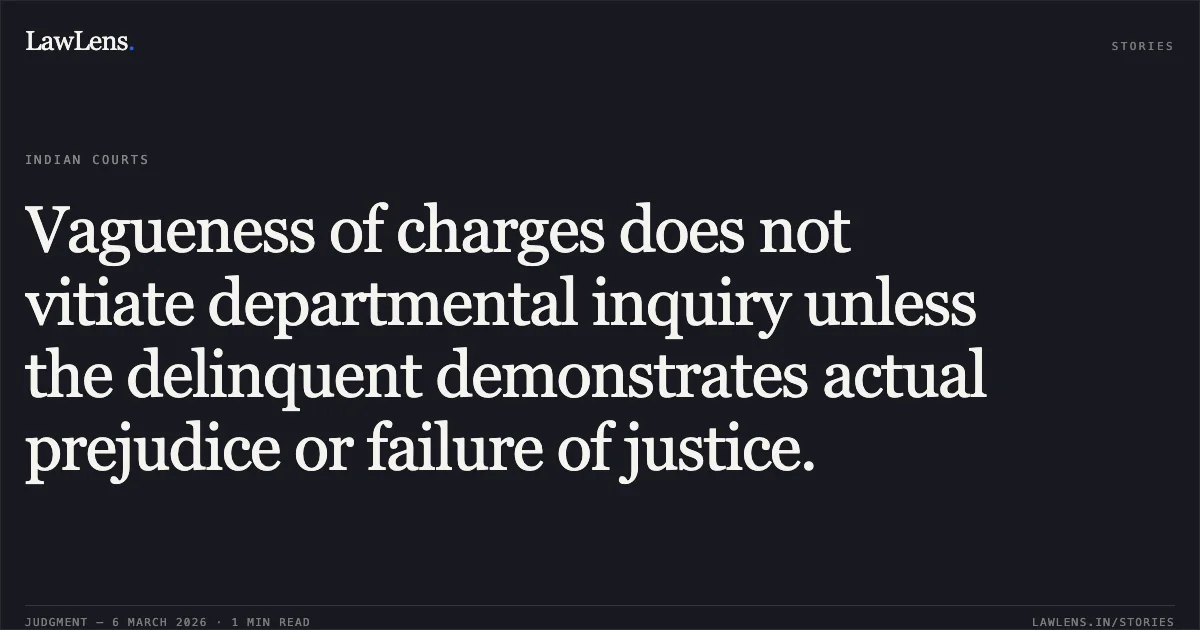
1. Whether the charges levelled against the petitioner were so vague and indefinite as to cause prejudice to his defense and vitiate the enquiry.
Source reference: para. 5, 162. Whether the findings of the disciplinary authority were perverse or based on "no evidence."
Source reference: para. 153. Whether the High Court can reappreciate evidence in a departmental enquiry under the power of judicial review.
Source reference: para. 21Law Applied
The court applied the principles of judicial review under Article 226 of the Constitution, specifically as defined in *Union of India v. P. Gunasekaran*, which prohibits the High Court from reappreciating evidence or interfering with findings of fact unless they are perverse
Source reference: para. 21Regarding the vagueness of charges, it relied on *Krishnakali Tea Estate v. Akhil Bharatiya Chah Mazdoor Sangh*, holding that omissions or errors in a charge do not vitiate proceedings unless the delinquent was actually misled and suffered a failure of justice
Source reference: para. 19-20It further cited *Boloram Bordoloi v. Lakhimi Gaolia Bank*, noting that a disciplinary authority concurring with an Enquiry Officer’s report need not provide elaborate independent reasons
Source reference: para. 23Finally, it referenced *Anant R. Kulkarni v. Y.P. Education Society* regarding the necessity of specific charges
Source reference: para. 5Reasoning
The Court found that while Charge No. 1 (bringing prohibited material) lacked specific details, Charge No. 2 (abandoning post) was highly specific and supported by CCTV footage and witness testimony
Source reference: para. 13, 16The Court observed that the petitioner submitted a 72-page reply and effectively cross-examined 15 witnesses, indicating he fully understood the allegations; thus, no prejudice was caused by any alleged vagueness
Source reference: para. 18, 20The disciplinary authority's finding was not based on "no evidence," as witness PW-7 specifically testified that a prisoner caught with contraband claimed to have received it from "Mama" (the petitioner)
Source reference: para. 14-15The Court emphasized that under the *P. Gunasekaran* guidelines, it cannot act as an appellate court to re-examine the reliability or adequacy of evidence
Source reference: para. 21-22Since the enquiry followed due process and the findings were grounded in material evidence, there was no basis for interference
Source reference: para. 24Holding
The Court dismissed the writ petition, upholding the impugned orders
It held that the petitioner failed to demonstrate any procedural defect or prejudice caused by the framing of charges
Source reference: para. 20, 22The Court concluded that the appellate authority had already exercised leniency by reducing the punishment, and the findings of misconduct were justified by the evidence on record
Source reference: para. 24Holding: The High Court will not interfere with disciplinary findings of fact in the absence of perversity or procedural illegality
Source reference: para. 21-23Acts & Sections Cited
1 provisions across 1 statute referred to in this judgment. Each provision opens on LawLens.
Code of Criminal Procedure, 19731
Original Court PDF
Shiv Charan Sharma v. State of Madhya Pradesh and Others, Writ Petition No. 13317 of 2022 (High Court of Madhya Pradesh, Gwalior Bench)
Click to open original judgment
Original judgment, available to read, download and summarize on LawLens.in