01Facts
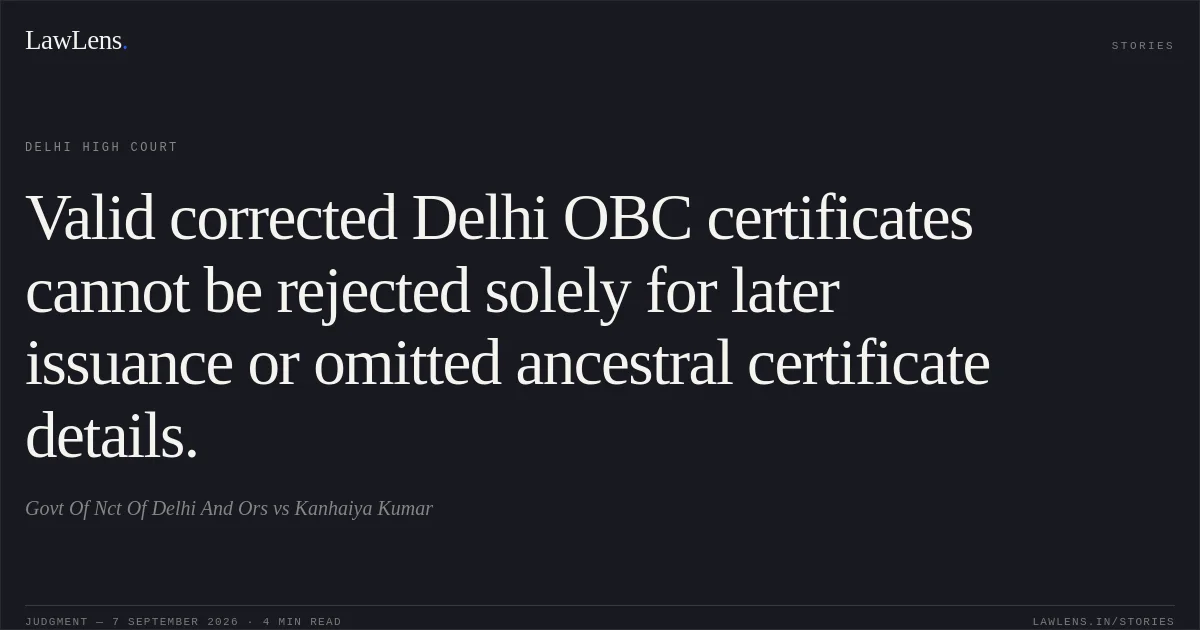
The connected writ petitions concerned the eligibility of the respondents for consideration as Other Backward Classes (“OBC”) candidates in recruitments conducted by the DSSSB/GNCTD.
¶ 4–61 · pp. 4–39In Neerja’s case, the original advertisement required possession of an OBC certificate issued by the GNCTD. Her certificate dated 27 September 2009 was subsequently cancelled by the Revenue Authorities, but a fresh certificate dated 27 August 2018 was issued pursuant to an order of the High Court and recognised her as belonging to the Jangra Brahmin community, an OBC in Delhi, Haryana and the Central List.
¶ 4–13 · pp. 4–18In Suman’s and Anju’s cases, the respondents initially possessed certificates based on certificates issued outside Delhi, but later obtained corrected Delhi OBC certificates issued on the basis of certificates of family members by the GNCTD.
¶ 14–28 · pp. 18–26In Ram Tirath’s, Lal Chand’s and Kanhaiya Kumar’s cases, the respondents initially produced certificates referring to outside-State certificates or lacking particulars concerning an old family certificate. They subsequently obtained fresh Delhi OBC certificates during the document-verification process.
¶ 29–40, 41–51, 52–61 · pp. 26–39The Tribunal directed consideration of the respondents as OBC candidates, leading to the present writ petitions.
02Issues
i.1. Whether an OBC certificate issued by the GNCTD, including one based on an outside-State caste certificate or a subsequently corrected certificate, satisfied the relevant advertisement conditions for OBC reservation?
¶ 4–8, 9.1–9.16 · pp. 4–18ii.2. Whether a candidate could be denied OBC consideration merely because the certificate relied upon was issued after the recruitment cut-off date or because the certificate did not expressly mention the old certificate of a family member?
¶ 16–20, 34–39, 46–50 · pp. 19–23, 29–36iii.3. Whether the GNCTD Office Memorandum dated 31 May 2021, clarifying the validity of Delhi OBC certificates irrespective of whether they mentioned an old family certificate, applied retrospectively to the recruitments in question?
¶ 35–37, 46–48 · pp. 29–31, 35–36iv.4. Whether the respondents were entitled to declaration of their results and consequential appointment-related consideration?
¶ 11–13, 20–22, 25–28, 38–40, 49–51, 58–61 · pp. 17–18, 22–26, 31, 35–3903Law Applied
The Court applied the express terms of the relevant recruitment advertisements, which required OBC candidates to possess certificates issued by the competent authority and, in the later advertisements, recognised Delhi OBC certificates issued by the GNCTD Revenue Department.
¶ 5–7, 15, 23, 30, 42, 53 · pp. 4–5, 18–19, 23, 26, 31–33, 37It relied on the Government of India circular dated 8 April 1994, which permitted the State of migration to issue OBC certificates on the basis of a genuine certificate issued to the candidate’s father by the State of origin, while preserving the rule that OBC benefits in the State of migration depended on recognition of the community in that State.
¶ 10.1–10.6 · pp. 15–17The Court further applied the GNCTD Office Memorandum dated 31 May 2021, treating it as a clarification that an OBC (Delhi) certificate remained valid whether or not it mentioned an old certificate of the candidate’s father, siblings or paternal uncles; a clarification operates retrospectively, as recognised in Sree Sankaracharya University of Sanskrit v. Manu, (2023) 19 SCC 30.
¶ 35–37 · pp. 29–31The Court also followed the principle in Neerja v. SDM, Najafgarh & Ors., whereby a corrected certificate issued after an erroneous certificate could relate back to the date of the original certificate where the candidate was not responsible for the administrative error.
¶ 9.11–9.16, 17–20 · pp. 11–17, 22–23Provisions in the judgment · 5
Advertisement (recruitment advertisement in W.P.(C) 88/2017 and connected matters) (alias, unresolved) Section 5Section 6
Government of India, Department of Personnel and Training O.M. No. 36012/22/93-Estt.(SCT) dated 08/09/1993 (persons/sections (Creamy layer) in column 3 of the Schedule) (alias, unresolved) Section 1
GNCTD Notification No. 88 dated 20/10/1996 (alias, unresolved) Section 1
GNCTD Notification No. 88 dated 11/12/1996 (alias, unresolved) Section 1
04Reasoning
The Court held that the advertisements primarily required a valid OBC certificate issued by the competent authority and did not authorise rejection merely because the certificate was founded on an outside-State certificate, provided the candidate’s community was recognised as an OBC in Delhi.
In Neerja’s case, the fresh GNCTD certificate satisfied the advertisement and the Jangra Brahmin community was included in the Delhi OBC list; therefore, the earlier cancellation could not defeat her claim.
¶ 9.13–9.16, 10.5–10.6 · pp. 13–17In Suman’s and Anju’s cases, the corrected Delhi certificates complied with the specific requirement that the certificate be issued by the GNCTD on the basis of a family member’s certificate.
¶ 16–20, 23–26 · pp. 19–26In Ram Tirath’s, Lal Chand’s and Kanhaiya Kumar’s cases, the later certificates were Delhi OBC certificates and the alleged defect was only the absence of an express reference to an old family certificate.
¶ 35–39, 46–50, 58–59 · pp. 29–31, 35–38The Court held that this requirement stood diluted by the clarificatory OM dated 31 May 2021, which applied retrospectively; consequently, the recruiting authorities could not reject the respondents solely on that ground.
¶ 35–39, 46–50, 58–59 · pp. 29–31, 35–38The Court therefore found no error in the Tribunal’s directions to treat the respondents as eligible OBC candidates.
05Holding
The Court held that all respondents were entitled to be considered as OBC candidates under the relevant advertisements.
The writ petition in DSSSB v. Sunita & Ors. was disposed of on that basis, with a direction to declare Neerja’s result and take consequential action within eight weeks.
¶ 11–13 · pp. 17–18The writ petitions concerning Suman, Anju, Ram Tirath, Lal Chand and Kanhaiya Kumar were dismissed, and the concerned authorities were directed to declare their results and take consequential action within eight weeks.
¶ 20–22, 25–28, 38–40, 49–51, 58–61 · pp. 22–26, 31, 35–39Original Court PDF
Govt Of Nct Of Delhi And OrsvsKanhaiya Kumar
Click to open original judgment
Original judgment, available to read, download and summarize on LawLens.in