Facts
The petitioner, Valarmathi, sought a review of the court’s previous order dated 30.06.2026 in W.A.No.1591 of 2024.
Source reference: p. 1-2The case concerns the distribution of terminal benefits of a deceased government employee.
Source reference: p. 2The petitioner argued that as one of the three Class-I legal heirs, she was entitled to an equal share (one-third) of the service benefits.
Source reference: p. 2The deceased employee had specifically nominated his mother (the first respondent) to receive the Death-cum-Retirement Gratuity (DCRG).
Source reference: p. 2The review was also filed by a new counsel who had not appeared in the original writ appeal.
Source reference: para. 2Issues
1. Whether the existence of multiple Class-I legal heirs overrides a valid nomination made by a government servant under the Pension Rules regarding DCRG.
Source reference: para. 32. Whether the petitioner established an "error apparent on the face of the record" sufficient to invoke the court's power of judicial review.
Source reference: para. 3Law Applied
Tamil Nadu Pension Rules, 1978, specifically regarding the settlement of Death-cum-Retirement Gratuity (DCRG).
Source reference: para. 2A government employee is entitled to nominate any person falling under the definition of "family" to receive DCRG; once a valid nomination exists, the authorities are legally bound to settle the amount in favor of that nominee.
Source reference: para. 3Standard for review jurisdiction requires the identification of an "error apparent" rather than a mere re-argument of the merits.
Source reference: para. 3Reasoning
The court reasoned that the deceased employee’s nomination of his mother was valid as she falls within the definition of "family" under the relevant rules.
Source reference: para. 3Consequently, the government authorities have a statutory obligation to pay the DCRG to the nominee.
Source reference: para. 3The court observed that while family disputes regarding the distribution of assets may exist, such disputes must be resolved through independent legal proceedings and do not invalidate the administrative action taken based on a valid nomination.
Source reference: para. 3The court found that the petitioner’s arguments did not point to a clerical or manifest error in the original judgment but rather sought a reconsideration of the merits, which does not meet the threshold for exercising review powers.
Source reference: para. 3Holding
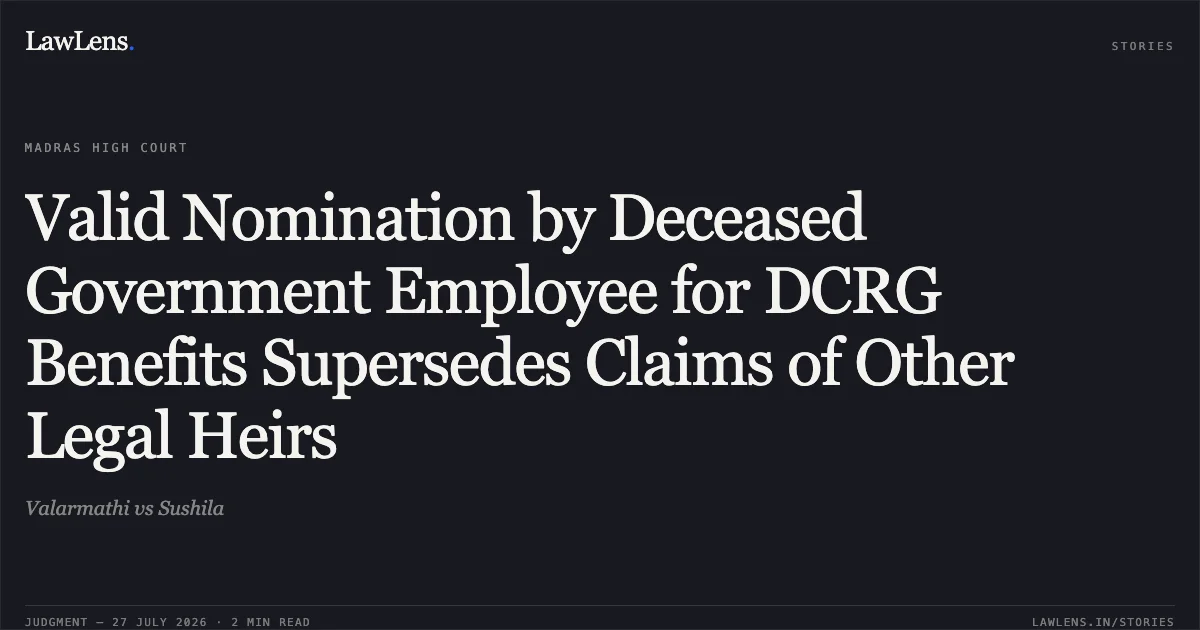
The court held that a valid nomination under the Pension Rules must be honored by the authorities regardless of the presence of other legal heirs.
The court held that no error apparent on the face of the record was established.
Source reference: para. 3The Review Application was dismissed, and the connected miscellaneous petition was closed.
Source reference: para. 3Acts & Sections Cited
2 provisions across 1 statute referred to in this judgment. Each provision opens on LawLens.
Code of Civil Procedure, 19082
Original Court PDF
ValarmathivsSushila
Click to open original judgment
Original judgment, available to read, download and summarize on LawLens.in


