Facts
On September 24, 2010, Mr. Srinivas Komuravelli died in a railway accident at Sewri station while traveling from Dockyard Road to Vikhroli at approximately 11:30 p.m.
Source reference: para 2The Railway Claims Tribunal, Mumbai, dismissed the appellants' claim for compensation on January 7, 2015, ruling that the death did not constitute an "untoward incident"
Source reference: para 1An inquest panchnama and police report confirmed that a valid ticket for the journey from Vikhroli to Dockyard Road, along with a Hyderabad-Mumbai ticket, were recovered from the deceased
Source reference: para 4The respondent contended that the deceased was hit while crossing the tracks, as his body was found on the track heading toward CSMT, opposite his intended direction of travel
Source reference: para 5Issues
1. Whether the deceased was a "bonafide passenger" within the meaning of the Railways Act, 1989
Source reference: para 42. Whether the death of the deceased resulted from an "untoward incident" (accidental fall from a train) under Section 123 of the Railways Act, 1989
Source reference: para 1, 5, 10Law Applied
The court primarily applied Section 123 of the Railways Act, 1989, which defines an "untoward incident" to include the accidental falling of any passenger from a train carrying passengers
Source reference: para 1, 10Section 124, which provides for compensation unless specific exceptions (e.g., suicide or self-inflicted injury) are established
Source reference: para 11The court relied on Balu Narayan Gawale & Anr. v. Union of India, establishing that the burden of proof lies on the Railways to prove a passenger was crossing tracks if they wish to deny a claim
Source reference: para 11The court applied the principle from Smt. Jaishree Vijay Gondake & Ors. v. Union of India, holding that the absence of a Motorman’s report regarding a person being hit weakens the respondent's claim of track crossing
Source reference: para 12Reasoning
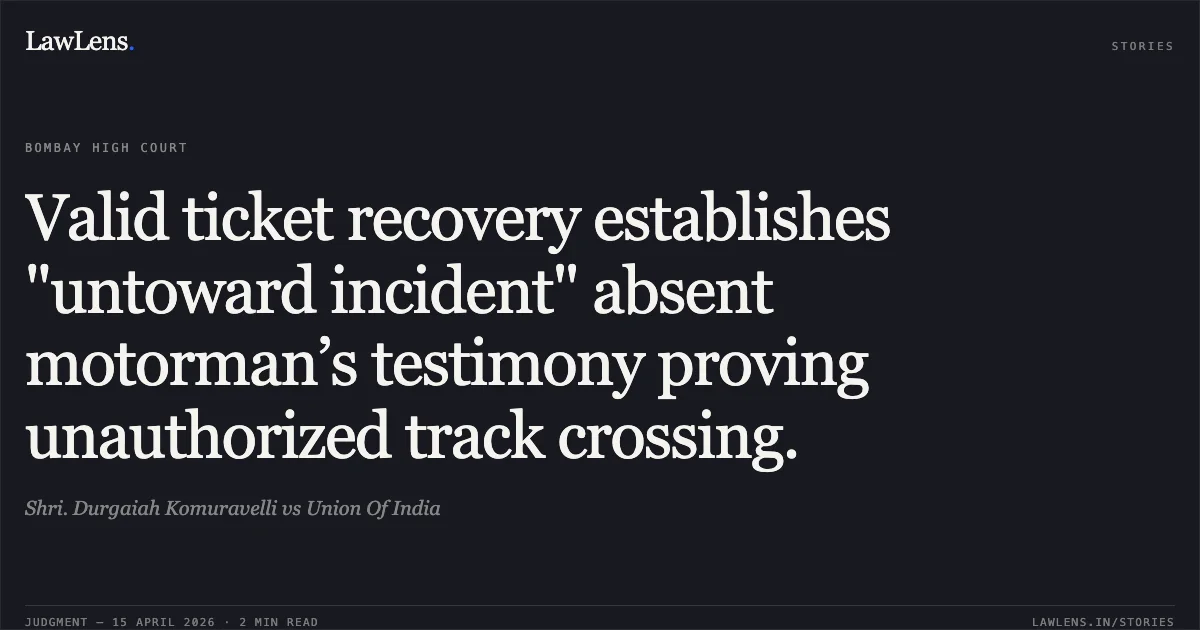
The court found the deceased was a "bonafide passenger" because the respondent’s own records and the inquest panchnama confirmed the recovery of valid tickets
Source reference: para 4The court rejected the respondent's theory of track crossing due to a lack of evidence. It noted that the respondent failed to produce any eyewitnesses, did not examine the Motorman who allegedly hit the deceased, and failed to provide train details in Form-2 as required
Source reference: para 6The court reasoned that while the deceased was found on the opposite track, it was plausible he was pushed by the rush at Sewri station, lost his balance, and fell into the path of an oncoming CSMT-bound train
Source reference: para 5Emphasizing that the Railways Act is social welfare legislation, the court held that in cases of doubt and absent contrary evidence from the authorities, an interpretation favoring the claimants must be adopted
Source reference: para 9-10Holding
The High Court allowed the appeal, setting aside the Tribunal’s order
The death was caused by an "untoward incident" under Section 123 of the Railways Act, 1989
Source reference: para 10As the father of the deceased passed away during the pendency of the appeal, the court directed the respondent to pay the sole surviving claimant (the mother) a compensation of Rs. 4 lakhs within eight weeks of her application
Source reference: para 14-15No interest was awarded
Source reference: para 14Acts & Sections Cited
2 provisions across 1 statute referred to in this judgment. Each provision opens on LawLens.
Railways Act, 19892
Original Court PDF
Shri. Durgaiah KomuravellivsUnion Of India
Click to open original judgment
Original judgment, available to read, download and summarize on LawLens.in