Facts
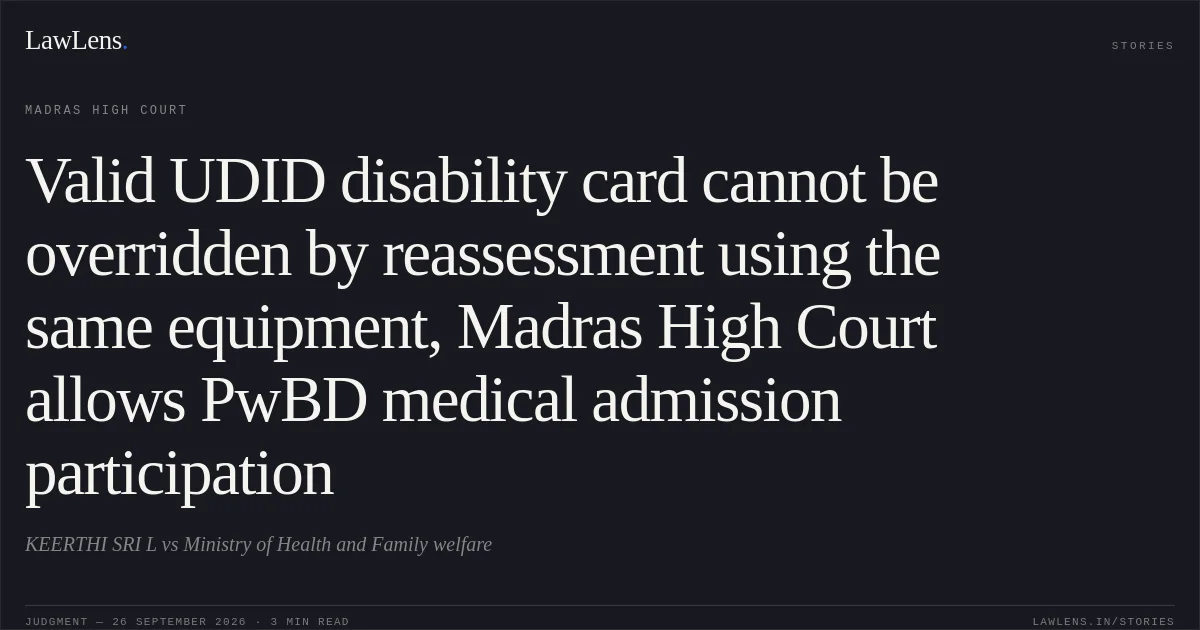
The petitioner, claiming locomotor disability, possessed a UDID Card issued by the Department of Empowerment of Persons with Disabilities (DEPwD), recording her disability at 50%.
Source reference: p.3; para. 6Relying on the UDID Card, she applied for NEET-UG 2026 under the Persons with Benchmark Disabilities (PwBD) category. During counselling, the third respondent required her to undergo assessment by the Regional Medical Board. That Board assessed her disability at 20%, following which the petitioner appealed; the Appellate Disability Assessment Board assessed it at 28%.
Source reference: p.3; para. 6The petitioner challenged the Appellate Medical Assessment Certificate dated 12 August 2026, contending that the re-assessment was inconsistent with the valid UDID Card and that no new or superior equipment had been used by the Medical Boards.
Source reference: pp.2–4; paras. 2–3Issues
Whether the Regional Medical Board and the Appellate Disability Assessment Board could re-determine the petitioner’s disability percentage despite the valid UDID Card issued by the competent DEPwD authority?
Source reference: pp.5–8; paras. 6, 8–9Whether the petitioner could be denied participation in NEET-UG 2026 counselling under the PwBD category solely on the basis of the lower assessment of 20% and 28% by the Medical Boards?
Source reference: pp.7–9; paras. 9–10Law Applied
The Court applied Article 226 of the Constitution of India and the Revised Advisory dated 15 October 2025 issued by the DEPwD, under which a medical institution or board may additionally assess disability where it possesses better tools, equipment, machines or technology capable of producing a more accurate assessment.
Source reference: pp.6–8It further applied Clauses 9.2 and 9.6 of the National Medical Commission’s Guidelines on Assessment of Persons with Benchmark Disabilities: a valid permanent UDID Card is the primary documentary evidence of the existence, nature and extent of the specified disability, and a candidate should not be denied PwBD consideration merely because of a procedural defect or discrepancy in the card where the disability is otherwise established in law.
Source reference: p.7; para. 8The Guidelines were framed pursuant to the Supreme Court’s directions in Civil Appeal No. 10611 of 2024 dated 15 October 2024.
Source reference: p.4; para. 4Reasoning
The Court noted that the petitioner’s disability had already been assessed at 50% and recorded in her UDID Card issued by the competent DEPwD authority.
Source reference: pp.5–6; para. 6Although the subsequent Boards assessed the disability at 20% and 28%, respectively, the fourth respondent had not used any new, advanced or superior tools or equipment for reassessment.
Source reference: p.8; para. 9Applying the Revised Advisory, the Court held that re-determination was permissible only where the assessing institution possessed better technology or equipment capable of providing a more accurate assessment. Since that condition was absent, the subsequent assessment was unsustainable.
Source reference: p.8; para. 9The Court also held that the valid UDID Card could not be disregarded for admission purposes, particularly when Clause 9.2 treated it as the primary documentary evidence of disability.
Source reference: p.8; para. 10Holding
The Court held that the petitioner ought not to have been subjected to re-determination of her disability percentage by the Medical Boards in the absence of any new or superior assessment tools.
It consequently directed the third respondent to permit the petitioner to participate in the subsequent NEET-UG 2026 counselling under the PwBD quota on the basis of her valid UDID Card; the Court also noted its earlier direction reserving one PwBD seat for her.
Source reference: p.9; para. 10The writ petition was accordingly disposed of without costs.
Source reference: p.9; para. 11Original Court PDF
KEERTHI SRI LvsMinistry of Health and Family welfare
Click to open original judgment
Original judgment, available to read, download and summarize on LawLens.in