Facts
The applicant (judgment debtor) challenged an order dated 07.05.2026 passed by the Principal Civil Judge, Bhachau, which rejected their objections (Exhibit-15) in Execution Petition No. 3 of 2024
Source reference: p.1-2The applicant contended that the underlying decree passed by the Additional District Court, Anjar on 11.03.2024 was a nullity because a new Additional District Court had been formed at Bhachau in 2020, and the appeal should have been transferred there
Source reference: p.3The applicant further contended the decree was passed in favor of a deceased person (original appellant No. 1)
Source reference: p.3-4Issues
1. Whether a decree passed by a court that originally had jurisdiction is rendered void if a new court with territorial jurisdiction is established during the pendency of proceedings, absent an administrative transfer order
Source reference: p.4-52. Whether a decree becomes a nullity if one of the joint appellants dies during the pendency of the appeal, while the legal heir (co-appellant) remains on record
Source reference: p.8Law Applied
Section 115 of the Code of Civil Procedure, 1908, limits revisional jurisdiction to instances of jurisdictional error or gross illegality.
Source reference: p.1-2, 9Appeals instituted prior to a notification changing pecuniary or territorial jurisdiction remain maintainable in the original court unless specifically transferred by administrative order (Kiritbhai Jaykrishna Thakkar v. M/S Sandipkumar Bhikhabhai Patel And Co.)
Source reference: p.5-7A decree is not a nullity if the estate of a deceased party is substantiality represented by a surviving legal heir already on record.
Source reference: p.8Reasoning
The Additional District Court, Anjar, indisputably possessed jurisdiction when the appeal was filed in 2019.
Source reference: p.4The mere formation of the Bhachau Court in 2020 did not automatically divest the Anjar court of its authority without a formal administrative transfer order, which the applicant failed to produce.
Source reference: p.4-5Regarding the death of the first appellant, the court observed that his wife (respondent No. 2) was already a co-appellant and his legal heir; since the estate was represented, the decree remained valid and executable by the surviving heir.
Source reference: p.8The applicant failed to raise these jurisdictional objections during the appellate stage, only doing so at the execution stage.
Source reference: p.5Holding
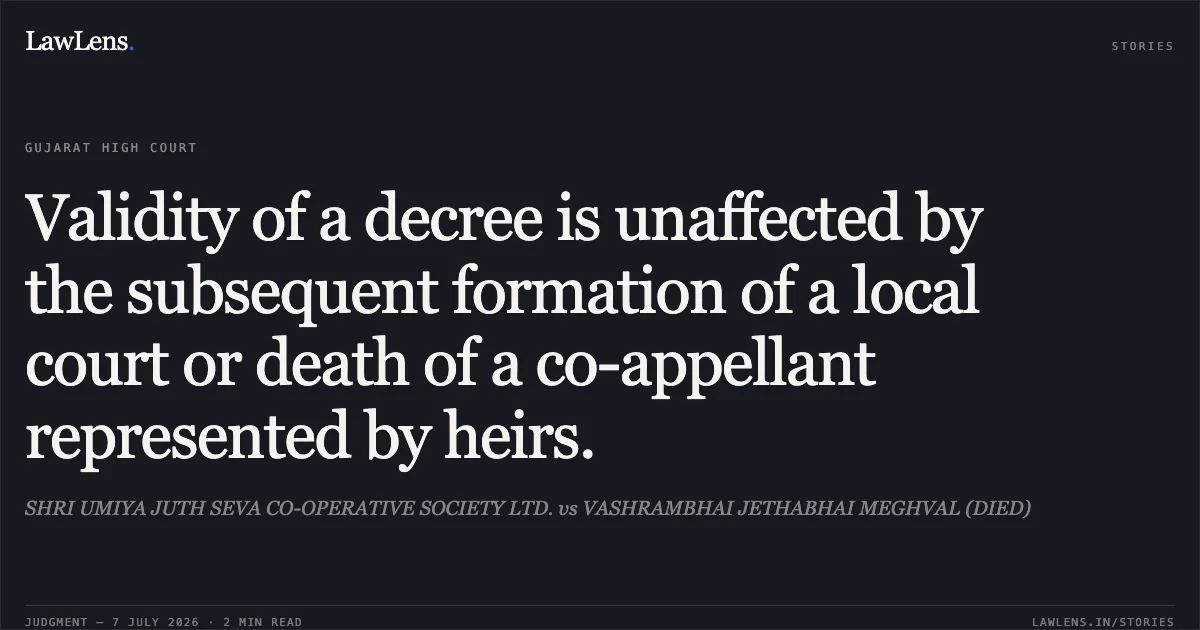
The decree was not without jurisdiction as it was validly instituted.
The decree was not a nullity because the deceased's legal representative was already a party to the proceedings.
Source reference: p.8The High Court rejected the revision application in limine, affirming the Executing Court's order as no jurisdictional error was found warranting interference under Section 115 of the CPC.
Source reference: p.9Acts & Sections Cited
2 provisions across 1 statute referred to in this judgment. Each provision opens on LawLens.
Code of Civil Procedure, 19082
Original Court PDF
SHRI UMIYA JUTH SEVA CO-OPERATIVE SOCIETY LTD.vsVASHRAMBHAI JETHABHAI MEGHVAL (DIED)
Click to open original judgment
Original judgment, available to read, download and summarize on LawLens.in