01Facts
The Respondent awarded the Appellant a contract for executing storm-water drainage and contingent works at Gurugram for ₹5,14,11,635.
¶ 3The contract contained Clause 25-A(vii), requiring a contractor invoking arbitration for claims of ₹1,00,000 or more to deposit 10% of the claim amount as security, refundable after the arbitral award subject to adjustment towards costs.
¶ 3Following a reduction in the scope and value of the contract, disputes arose regarding final payments.
¶ 4The High Court appointed a sole arbitrator under Section 11(6) of the Arbitration and Conciliation Act, 1996.
¶ 5The Respondent challenged the maintainability of the arbitration under Section 16 on the ground that the Appellant had not furnished the stipulated deposit.
¶ 5The Arbitrator directed the Appellant to make the deposit and, upon its refusal, dismissed the claim in its entirety.
¶ 6The Commercial Court dismissed the Appellant’s appeal under Section 37(2), relying principally on S.K. Jain v. State of Haryana.
¶ 7The Appellant challenged that decision before the Supreme Court, contending that the pre-deposit clause was arbitrary, discriminatory and inconsistent with Sections 18 and 31(8) of the Act.
¶ 8–1402Issues
i.1. Whether a contractual stipulation requiring only the contractor to make a pre-deposit of security or fees before invoking arbitration violates Section 18 of the Arbitration and Conciliation Act, 1996, which mandates equal treatment of parties?
¶ 32(A)ii.2. Whether a pre-deposit condition discourages alternative dispute resolution and undermines the objective of reducing the burden on courts?
¶ 32(B)iii.3. Whether such a pre-deposit condition is arbitrary, violates Article 14 of the Constitution, impermissibly burdens the right to sue, and is void under Section 28 of the Indian Contract Act, 1872?
¶ 29, 32(C)iv.4. Whether requiring a pre-deposit before determination of the merits bears a rational nexus with the objective of preventing frivolous claims, particularly when costs may be imposed under Section 31(8) of the Act after the arbitration?
¶ 32(D)v.5. Whether a refundable pre-deposit clause is legally valid?
¶ 32(E)vi.6. Whether S.K. Jain v. State of Haryana, (2009) 4 SCC 357, remains a valid and binding precedent?
¶ 25–26, 32(F)03Law Applied
The Court considered Section 18 of the Arbitration and Conciliation Act, 1996, which mandates equal treatment of parties at all stages of arbitration, and Section 31(8), which permits allocation of arbitral costs.
It also considered Section 28 of the Indian Contract Act, 1872, concerning agreements that restrain enforcement of contractual rights through ordinary legal proceedings.
In S.K. Jain v. State of Haryana, a three-Judge Bench upheld a refundable pre-deposit requirement as a reasonable measure to deter frivolous and inflated claims.
¶ 21In ICOMM Tele Ltd. v. Punjab State Water Supply, a two-Judge Bench regarded pre-deposit requirements as arbitrary where they deter arbitration and lack a direct nexus with preventing frivolous claims.
¶ 22Lombardi Engineering Ltd. v. Uttarakhand Jal Vidyut Nigam Ltd. held that party autonomy cannot validate contractual terms violating fundamental rights, while stating that S.K. Jain and ICOMM Tele were not necessarily in conflict because their clauses differed.
¶ 23The Constitution Bench in Central Organisation for Railway Electrification v. ECI-SPIC-SMO-MCML (JV) affirmed the mandatory nature of Section 18 and summarised the constitutional concerns surrounding excessive and disproportionate pre-deposit clauses.
¶ 24Under the doctrine of precedent, a smaller Bench cannot overrule or dissent from a larger-Bench decision; where it doubts its correctness, it must refer the issue to a larger Bench.
¶ 31Provisions in the judgment · 7 · Linked ones open on LawLens
Arbitration and Conciliation Act, 1996 Section 11Section 16Section 18Section 31Section 37Section 38
Indian Contract Act, 1872 Section 28
04Reasoning
The Court observed that S.K. Jain, decided by a three-Judge Bench, had upheld a refundable pre-deposit clause, whereas ICOMM Tele expressed the view that such conditions could deter arbitration and lack a sufficient nexus with preventing frivolous claims.
¶ 21–22Although the Court found the reasoning in ICOMM Tele persuasive, it held that a two-Judge Bench could not treat S.K. Jain as impliedly overruled or sub silentio, particularly because Lombardi Engineering had expressly found no conflict between the two decisions and neither Lombardi Engineering nor CORE had declared S.K. Jain to be bad law.
¶ 25–26Independently, the Court noted that a substantial pre-deposit imposed at the threshold could suppress legitimate claims, deter access to arbitration and render the right to sue illusory or nugatory.
¶ 27–29The competing considerations—party autonomy, deterrence of frivolous claims, equal treatment under Section 18, access to dispute resolution, and the availability of costs under Section 31(8)—required authoritative determination by a larger Bench.
¶ 29–3005Holding
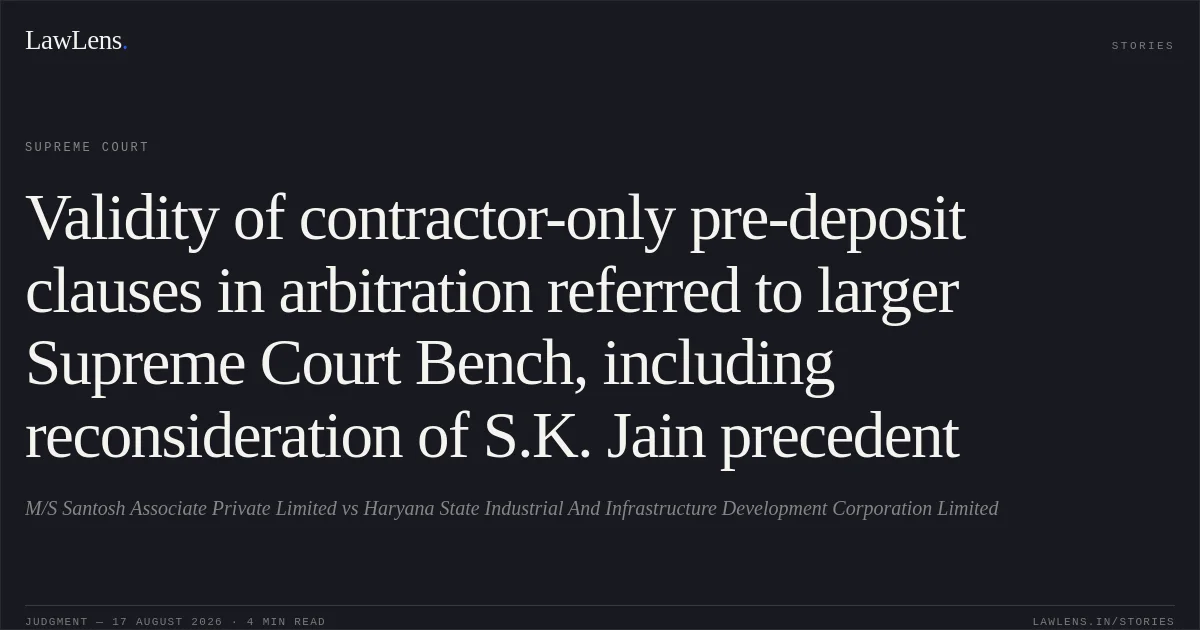
The Supreme Court did not finally determine the validity of Clause 25-A(vii) or the Appellant’s underlying claims.
¶ 30It held that the questions concerning the constitutional and statutory validity of pre-deposit requirements, the validity of refundable deposits, and the continuing authority of S.K. Jain warranted consideration by a larger Bench.
¶ 30The Registry was directed to place the Civil Appeal before the Chief Justice of India for appropriate directions regarding reference to a larger Bench.
¶ 33Original Court PDF
M/S Santosh Associate Private LimitedvsHaryana State Industrial And Infrastructure Development Corporation Limited
Click to open original judgment
Original judgment, available to read, download and summarize on LawLens.in