Facts
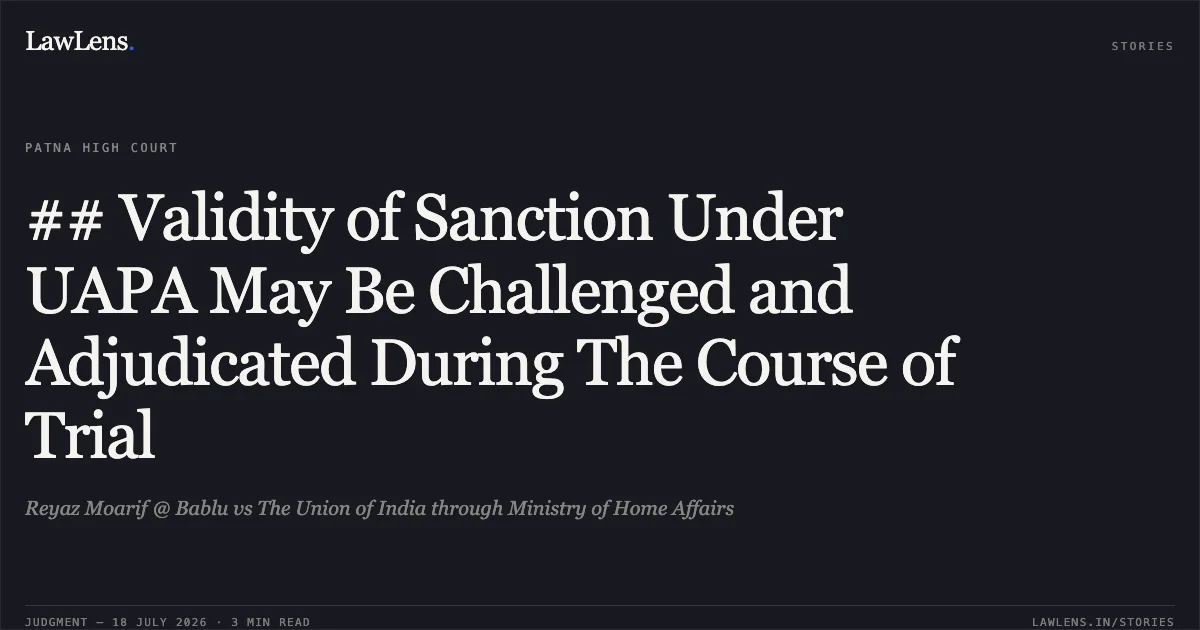
The four appellants are accused (Nos. 4, 28, 29, and 30) in Special Case No. 07/2022, facing trial for offenses under Sections 17, 18, and 18A of the Unlawful Activities (Prevention) Act, 1967 (UAPA).
Source reference: para. 2They filed an application under Section 45 of the UAPA challenging the validity of the prosecution sanction granted by the Central Government, arguing it was issued mechanically.
Source reference: para. 4The Special Court (NIA), Patna, rejected the application on 23.08.2025, holding that the challenge should have been raised at the stage of cognizance or charge framing, or otherwise after the conclusion of the trial, and imposed a cost of Rs. 10,000 on the appellants.
Source reference: para. 1, 3Issues
1. Whether a challenge to the validity of a prosecution sanction under Section 45 of the UAPA can be entertained by the Trial Court during the ongoing stage of trial, or if the accused must wait until the conclusion of the trial.
Source reference: para. 3, 11Law Applied
The Court primarily applied Section 45 of the UAPA, 1967, which mandates that no court shall take cognizance of specific offenses without previous sanction from the Central or State Government, based on an "independent review" by a prescribed authority.
Source reference: para. 9The Court relied on the Supreme Court precedent Fuleshwar Gope v. Union of India (2024), which establishes that while a challenge to sanction should ideally be raised at the earliest opportunity, the Trial Court has the competence to determine this question during the trial to assess its own jurisdiction to proceed.
Source reference: para. 11It further referenced the Karnataka High Court decision in NIA v. Fairoz Pasha (2025), which held that a court can examine the validity of a sanction order even after charges are framed by summoning the sanctioning authority to avoid unnecessary trial proceedings.
Source reference: para. 7, 11Reasoning
The High Court disagreed with the Trial Court’s view that the appellants were "prolonging the trial" by filing the application mid-trial. The Court noted that in a case involving 423 witnesses, where only 17 had been examined, waiting until the end of the trial to decide on the validity of the sanction would be inefficient.
Source reference: para. 4, 11Citing Fuleshwar Gope, the Court emphasized that a challenge to sanction involves factual inquiries—such as whether all relevant material was placed before the authority or if there was an application of mind—which must be determined by the Trial Court.
Source reference: para. 11The Court found that the legal "competence to proceed further" depends on the validity of the sanction; therefore, the Trial Court erred in refusing to hear the challenge simply because it was not raised at the stage of cognizance or charge framing.
Source reference: para. 11The Court highlighted that the right of an accused to avail legal remedies includes testing the sanction at the threshold or the earliest available opportunity during trial.
Source reference: para. 6, 11Holding
The Court held that the Trial Court is obligated to examine the challenge to the sanction order at the earliest opportunity once raised.
The High Court set aside the impugned order dated 23.08.2025 passed by the Special Judge (NIA), Patna and directed the Special Judge to reconsider the appellants’ application (Annexure-4) on its merits and pass a reasoned order within two months.
Source reference: para. 12Acts & Sections Cited
5 provisions across 2 statutes referred to in this judgment. Each provision opens on LawLens.
Unlawful Activities (Prevention) Act, 19673
Code of Criminal Procedure, 19732
Original Court PDF
Reyaz Moarif @ BabluvsThe Union of India through Ministry of Home Affairs
Click to open original judgment
Original judgment, available to read, download and summarize on LawLens.in