Facts
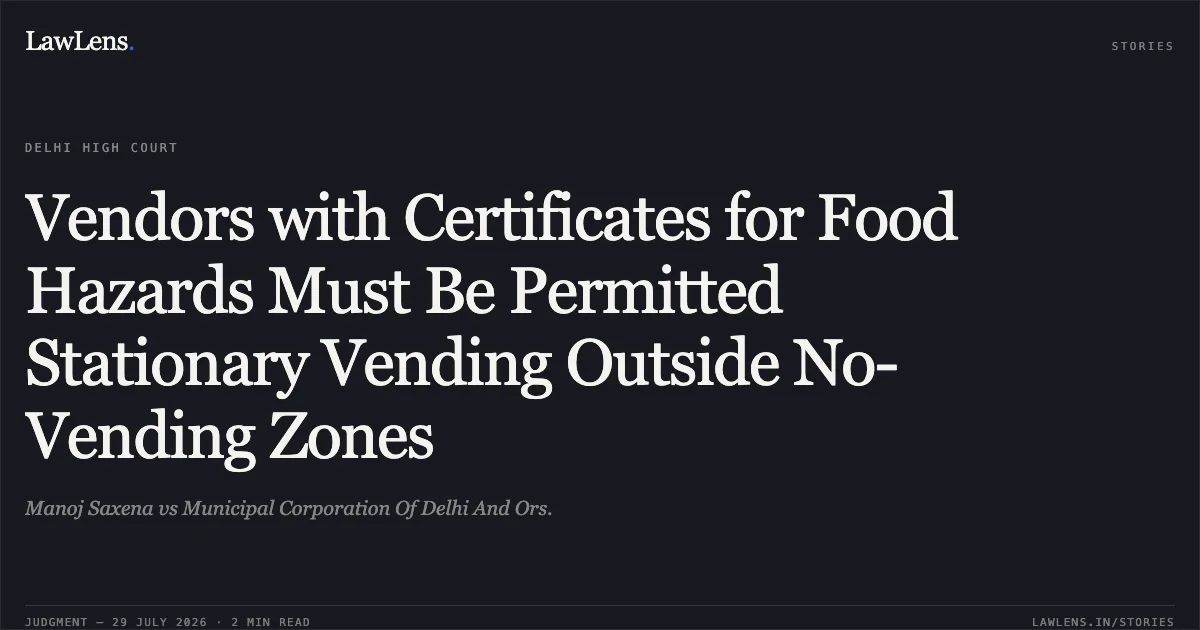
The Petitioner, a street vendor holding a Certificate of Vending (CoV) in the category of "Food/Snacks with gas cylinder/fire", filed a writ petition under Article 226 of the Constitution seeking directions to allow him to vend peacefully at a designated site in Kamla Nagar, Delhi.
Source reference: p. 1-2He alleged harassment by authorities and requested his representation dated July 16, 2026, be considered.
Source reference: p. 2The Respondent (MCD) contended that Kamla Nagar is a "No-Vending/No-Squatting Zone" and cited a prior High Court order in Jawahar Nagar Block Welfare Association v. UT of Delhi directing the removal of unauthorized encroachers in that specific area.
Source reference: p. 2-3Issues
1. Whether a street vendor holding a valid Certificate of Vending can be permitted to operate in an area designated as a ‘No-Vending Zone’
Source reference: p. 3-42. Whether the Petitioner can be exempted from the "mobile vendor" condition (restricting vending to 30 minutes in one spot) based on his category of vending
Source reference: p. 5-6Law Applied
The Court applied the Street Vendors (Protection of Livelihood and Regulation of Street Vending) Act, 2014, specifically Section 21 regarding the powers of the Town Vending Committee (TVC) to frame vending plans.
Source reference: p. 6It relied on the Delhi Street Vendors (Protection of Livelihood and Regulation of Street Vending) Scheme, 2019, which prescribes the conditions for CoVs, including health, hygiene, and mobility standards.
Source reference: p. 4The Court further applied the principle of judicial consistency by following its own recent precedent in Anil Kumar v. Municipal Corporation of Delhi, W.P.(C) 7593/2026, which balanced the rights of vendors in non-vending zones with administrative regulations.
Source reference: p. 5Reasoning
The Court observed that while the Petitioner holds a CoV, the terms of the certificate strictly prohibit vending in ‘No-Squatting’ or ‘No-Vending’ zones.
Source reference: para. 7Recognizing the need to protect the Petitioner's livelihood as a vendor of heated snacks (which requires more than the 30-minute limit usually imposed on mobile vendors), the Court reconciled the conflict between the "No-Vending" status of Kamla Nagar and the Petitioner's rights by providing an alternative accommodation.
Source reference: para. 8-9The Court reasoned that the MCD must identify a specific spot to prevent obstruction of pedestrians and vehicular traffic.
Source reference: para. 9It further analyzed the Petitioner’s category ("Food/Snacks with gas cylinder") and determined that Condition 11 of the CoV (30-minute stay limit) was impractical, thus exempting him from it to allow him to function as a stationary vendor at the identified spot.
Source reference: para. 9(vi)Holding
The Court disposed of the petition with a series of directions: (i) The MCD’s Assistant Commissioner must identify a specific spot for the Petitioner within one week; (ii) The Petitioner is permitted to use a small/medium gas cylinder and must maintain hygiene and a dustbin; (iii) The Petitioner is exempted from Condition 11 (mobile vendor limit) but must comply with all other CoV terms; and (iv) The Petitioner’s representation must be decided by the TVC-II within three months of its constitution.
The holding is subject to future plans framed by the TVC under Section 21 of the Act, and no vested rights were granted.
Source reference: p. 6Acts & Sections Cited
1 provisions across 1 statute referred to in this judgment. Each provision opens on LawLens.
Street Vendors (Protection of Livelihood and Regulation of Street Vending) Act, 20141
Original Court PDF
Manoj SaxenavsMunicipal Corporation Of Delhi And Ors.
Click to open original judgment
Original judgment, available to read, download and summarize on LawLens.in