Facts
The petitions arose from cross-complaints between family members following an incident on 17 April 2024, in the context of a property dispute.
Source reference: no citationIn the first case, the son-in-law alleged that his father-in-law and brother-in-law assaulted and threatened him; proceedings under Sections 323 and 506 IPC followed.
Source reference: para. 3–4In the second, the father-in-law complained against his son-in-law and daughter, leading to proceedings under Sections 323, 504, 506 read with Section 34 IPC.
Source reference: para. 3–4The petitioners sought quashing under Section 482 CrPC, contending that the complaints were retaliatory and arose from the family dispute.
Source reference: para. 6, 8The State and complainants opposed quashing, relying on the investigation materials, including witness statements and wound certificates.
Source reference: para. 7, 9Issues
1. Whether the cross-complaints and resulting criminal proceedings disclosed a prima facie basis to proceed against the petitioners for the alleged IPC offences
Source reference: para. 10–122. Whether, in the circumstances, continuation of the proceedings would amount to an abuse of the process of court and warrant quashing under Section 482 CrPC
Source reference: para. 12–14Law Applied
Section 482 CrPC preserves the High Court’s inherent power to prevent abuse of process and secure the ends of justice.
Source reference: para. 13Under the categories in State of Haryana v. Bhajan Lal, proceedings may be quashed, among other circumstances, where the allegations do not constitute an offence, are inherently improbable, or are manifestly mala fide and instituted to wreak vengeance.
Source reference: para. 13Relying on Mohammed Ali v. State of U.P., (2023) 15 SCC 488, the Court stated that where mala fides or vengeance are alleged, the Court may examine the surrounding circumstances and investigation materials, rather than the complaint alone.
Source reference: para. 13State of A.P. v. Golconda Linga Swamy, (2004) 6 SCC 522, permits consideration of materials that manifestly fail to support the accusation, while cautioning that the High Court should not undertake a trial-level assessment of evidentiary reliability.
Source reference: para. 13Reasoning
The Court found that the parties were family members embroiled in a dispute and that the complaints reflected mutual hostility, with allegations of trespass, assault and intimidation made against each other.
Source reference: para. 11It noted that neither side had been admitted to hospital, the wound certificates recorded no injuries beyond tenderness, and the witnesses cited in the charge sheets were relatives of the parties.
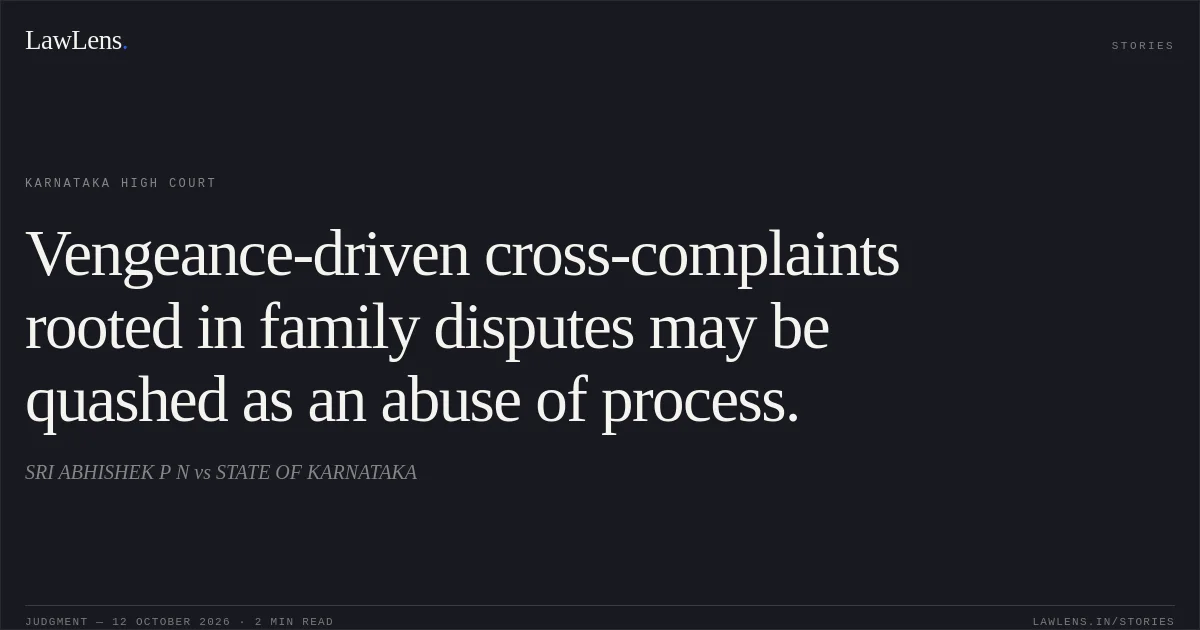
Source reference: para. 12Considering these circumstances together, the Court concluded that the proceedings appeared to have arisen from vengeance connected with the family dispute and fell within the principles permitting quashing to prevent abuse of process.
Source reference: para. 12–14Holding
The High Court allowed both petitions, holding that continuation of the proceedings would amount to an abuse of the process of court.
It quashed the proceedings against the petitioners in C.C. No. 18051/2024, arising from Crime No. 202/2024, for offences under Sections 323 and 506 IPC, and the proceedings in Crime No. 206/2024 for offences under Sections 323, 504 and 506 read with Section 34 IPC.
Source reference: para. 14; pp. 18–19Acts & Sections Cited
8 provisions across 3 statutes referred to in this judgment. Each provision opens on LawLens.
Code of Criminal Procedure, 19733
Bharatiya Nagarik Suraksha Sanhita, 20231
Indian Penal Code, 18604
Original Court PDF
SRI ABHISHEK P NvsSTATE OF KARNATAKA
Click to open original judgment
Original judgment, available to read, download and summarize on LawLens.in


