Facts
The petitioner filed an application seeking to quash the order dated 26.12.2019 passed by the Metropolitan Magistrate, Ahmedabad, in Criminal Case No. 116617 of 2019, which issued summons for an offense under the Negotiable Instruments (NI) Act.
Source reference: p. 1-2The complaint alleged that Accused No. 1 (Company) issued six cheques totaling Rs. 16,89,00,000/- on 28.09.2019 and 04.10.2019, which were subsequently dishonored.
Source reference: p. 3The petitioner (Accused No. 11) was named as a Director responsible for the company’s affairs.
Source reference: p. 3However, the petitioner provided Form DIR-11 and DIR-12, demonstrating he had resigned from the directorship on 30.03.2019, approximately five months prior to the issuance of the cheques.
Source reference: p. 2, 6Issues
1. Whether a Director who has resigned from a company prior to the issuance and dishonor of cheques can be held vicariously liable under Section 141 of the Negotiable Instruments Act
Source reference: p. 62. Whether bald and omnibus averments in a complaint are sufficient to attract criminal liability for a non-signatory Director under Section 138 of the NI Act
Source reference: p. 2, 4Law Applied
The Court applied the provisions of Sections 138, 141, and 142 of the Negotiable Instruments Act, 1881, which govern the dishonor of cheques and the vicarious liability of persons in charge of a company.
Source reference: p. 3National Small Industries Corporation Ltd. v. Harmeet Singh Paintal (2010), which established that penal provisions must be strictly construed and require specific roles to be attributed to Directors rather than mere cursory statements.
Source reference: para. 10N.K. Wahi v. Shekhar Singh (2007) and S.M.S. Pharmaceuticals Ltd. v. Neeta Bhalla (2005) to affirm that mere designation as a Director is insufficient for prosecution without clear allegations of their part in the transaction.
Source reference: para. 12-13Adhiraj Singh v. Yograj Singh (2023), stating that a Director who resigned before the cheque issuance cannot be held responsible under Section 141.
Source reference: para. 15Reasoning
The Court noted that the petitioner was neither a signatory to the cheques nor held the position of Director at the time the offense was committed, as his resignation effective 30.03.2019 was substantiated by statutory Form DIR-12.
Source reference: p. 5-6The cheques were issued in late September and October 2019, five months after his departure.
Source reference: p. 3, 6The Court reasoned that Section 141 requires a person to be in charge of and responsible for the conduct of the business at the time the offense was committed.
Source reference: para. 11Since the complainant failed to provide specific evidence or unambiguous allegations regarding the petitioner’s actual role in the specific transaction, and given the undisputed timing of the resignation, the petitioner could not be held vicariously liable for the company's default.
Source reference: para. 14-15Holding
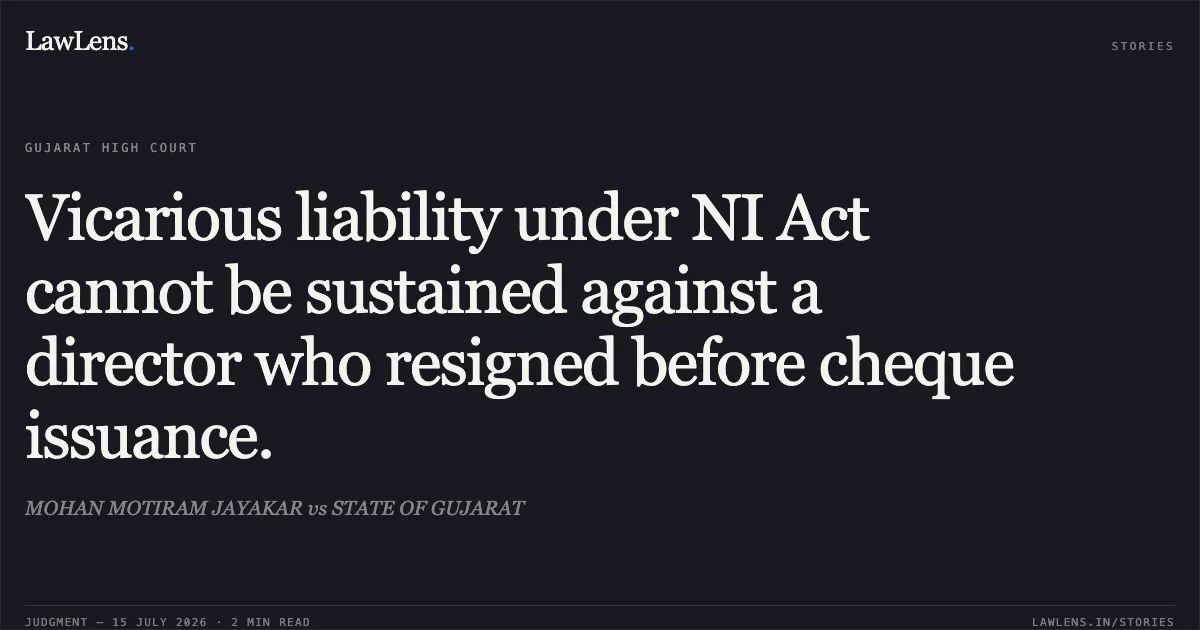
The Court answered the issues in the negative, holding that an ex-director cannot be prosecuted for cheques issued after their resignation.
The Court allowed the petition and quashed the impugned order dated 26.12.2019 and all consequential proceedings in Criminal Case No. 116617 of 2019 specifically against the petitioner. Rule was made absolute.
Source reference: para. 16, 17Acts & Sections Cited
3 provisions across 1 statute referred to in this judgment. Each provision opens on LawLens.
Negotiable Instruments Act, 18813
Original Court PDF
MOHAN MOTIRAM JAYAKARvsSTATE OF GUJARAT
Click to open original judgment
Original judgment, available to read, download and summarize on LawLens.in


