Facts
The Petitioner (Accused No. 3) challenged a summoning order dated 26.05.2018
Source reference: p. 1-2a subsequent revision dismissal dated 28.01.2019
Source reference: p. 2The Respondent/Complainant alleged that she invested ₹6,00,000 in a "One Person Company" (Accused No. 1) managed by its sole Director (Accused No. 2)
Source reference: p. 2A cheque for ₹4,00,000 issued to discharge the remaining liability was dishonoured
Source reference: p. 3The Complainant alleged the Petitioner was involved in day-to-day business and acted under the Director's instructions
Source reference: p. 2, 13However, the Petitioner was neither a Director, signatory, nor employee of the company according to MCA records
Source reference: p. 4, 15Issues
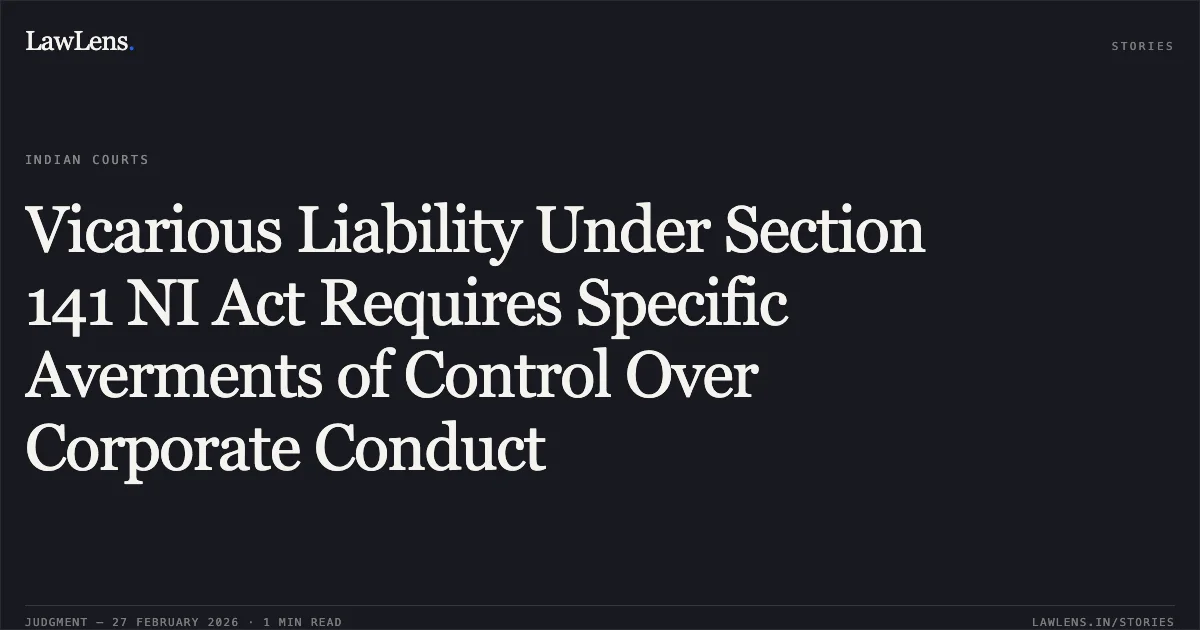
Whether the summoning of the Petitioner for offences under Sections 138 and 141 of the NI Act was legally sustainable despite him not being a Director or signatory of the cheque
Source reference: para. 7Law Applied
The Court applied Section 138 of the Negotiable Instruments Act, 1881, regarding the dishonour of cheques
Source reference: para. 8Section 141, which governs vicarious liability for companies
Source reference: para. 9It relied on *S.M.S. Pharmaceuticals Ltd. v. Neeta Bhalla*, establishing that a complaint must specifically aver that an accused was "in charge of and responsible for" the conduct of business at the time of the offence
Source reference: para. 12It further applied *Ashok Shewkramani v. State of Andhra Pradesh*, holding that bald assertions of being "busy with day-to-day affairs" are insufficient for vicarious liability
Source reference: para. 13and *S.P. Mani & Mohan Dairy v. Snehalatha Elangovan*, distinguishing between liability arising from control (SS. 1) and liability from consent/neglect (SS. 2)
Source reference: para. 9Reasoning
The Court observed that under Section 141(1), vicarious liability requires a person to be both "in charge of" and "responsible to" the company for its business conduct
Source reference: para. 14, 18In the present case, the Complainant admitted that Accused No. 1 was a "One Person Company" and Accused No. 2 was the sole Director
Source reference: para. 16, 19The allegations against the Petitioner—that he "acted under the instructions" of the Director—not only failed to meet the statutory threshold of being "in charge" but actually suggested a lack of independent control
Source reference: para. 18The Court reasoned that even if the Petitioner induced the investment or handed over the cheque, such acts as an associate or agent do not satisfy the strict requirements of Section 141 without evidence of formal responsibility for the company's management
Source reference: para. 20Holding
The Court answered the issue in the negative, holding that the necessary averments for vicarious liability were "conspicuously absent"
The High Court quashed the summoning order and the complaint (CC No. 749/2018) specifically against the Petitioner
Source reference: para. 22The proceedings against the other accused persons remain unaffected
Source reference: para. 23Acts & Sections Cited
2 provisions across 1 statute referred to in this judgment. Each provision opens on LawLens.
Negotiable Instruments Act, 18812
Original Court PDF
Ram Kumar Pathak v. Shashi Devi & Ors. CRL.M.C. 1143/2019
Click to open original judgment
Original judgment, available to read, download and summarize on LawLens.in