Facts
The Appellant finance company advanced ₹4.5 Crores to M/s Ravindra Bharathi Educational Society (Accused No. 1) through various tranches in 2018.
Source reference: para. 4Promissory notes and a Memorandum of Understanding (MoU) were executed by the Society’s President (Accused No. 2) and certain office bearers, including Respondents 1 and 4.
Source reference: paras. 5-6A cheque for ₹5,12,61,500 issued by the President was dishonored with the endorsement "Account Blocked".
Source reference: paras. 7-8The Appellant filed a complaint under Sections 138 and 141 of the Negotiable Instruments (NI) Act against the Society and its office bearers (Respondents 1-4: Vice-President, Treasurer, Executive Member, and Manager respectively).
Source reference: paras. 3, 9The High Court of Madras quashed the proceedings against the Respondents, holding that the complaint lacked specific averments regarding their day-to-day control over the Society.
Source reference: paras. 12-14Issues
1. Whether the High Court was justified in quashing the criminal proceedings against the Respondents under Section 482 of the Cr.PC by holding that the requirements of vicarious liability under Section 141 of the NI Act were not met.
Source reference: para. 25Law Applied
Section 141 of the NI Act, which stipulates that for a person to be vicariously liable for a company’s/society’s offense, they must have been "in charge of, and responsible to" the entity for the conduct of its business at the time of the offense.
Source reference: para. 26S.M.S. Pharmaceuticals Ltd. v. Neeta Bhalla, which requires specific averments in the complaint rather than mere reproduction of statutory language.
Source reference: para. 27National Small Industries Corporation Ltd. v. Harmeet Singh Paintal, which established that vicarious liability is person-specific and cannot be inferred merely from a designation.
Source reference: para. 28HDFC Bank Ltd. v. State of Maharashtra, clarifying that a complainant need not mechanically reproduce the statute if the substance of the allegations discloses a factual basis.
Source reference: para. 29Reasoning
The Court distinguished between the roles of the four Respondents. It found that Respondents 1, 2, and 4 were signatories to the underlying financial documents (MoU and promissory notes) or the dishonored cheque itself, which provided a prima facie factual foundation connecting them to the transaction and the conduct of the Society’s business.
Source reference: paras. 35-36, 42Conversely, regarding Respondent 3 (Executive Member), the Court found no specific role attributed to him other than his designation; he did not sign any documents, and the complaint relied on "omnibus" allegations.
Source reference: paras. 37-39The Court emphasized that while hyper-technicality should be avoided, vicarious liability must be founded on material facts rather than just an official position.
Source reference: paras. 32, 39Holding
The Supreme Court partly allowed the appeal.
It set aside the High Court’s order regarding Respondent Nos. 1 (Vice-President), 2 (Treasurer), and 4 (Manager), restoring the complaint against them as their active participation in the debt-creating transactions was evidenced by their signatures on key documents.
Source reference: paras. 43-44However, it upheld the quashing of proceedings against Respondent No. 3 (Executive Member) due to the absence of specific factual allegations or documentary evidence linking him to the management of the transaction.
Source reference: paras. 40, 44The trial court was directed to proceed with the restored complaint.
Source reference: para. 44Acts & Sections Cited
3 provisions across 2 statutes referred to in this judgment. Each provision opens on LawLens.
Code of Criminal Procedure, 19731
Negotiable Instruments Act, 18812
Original Court PDF
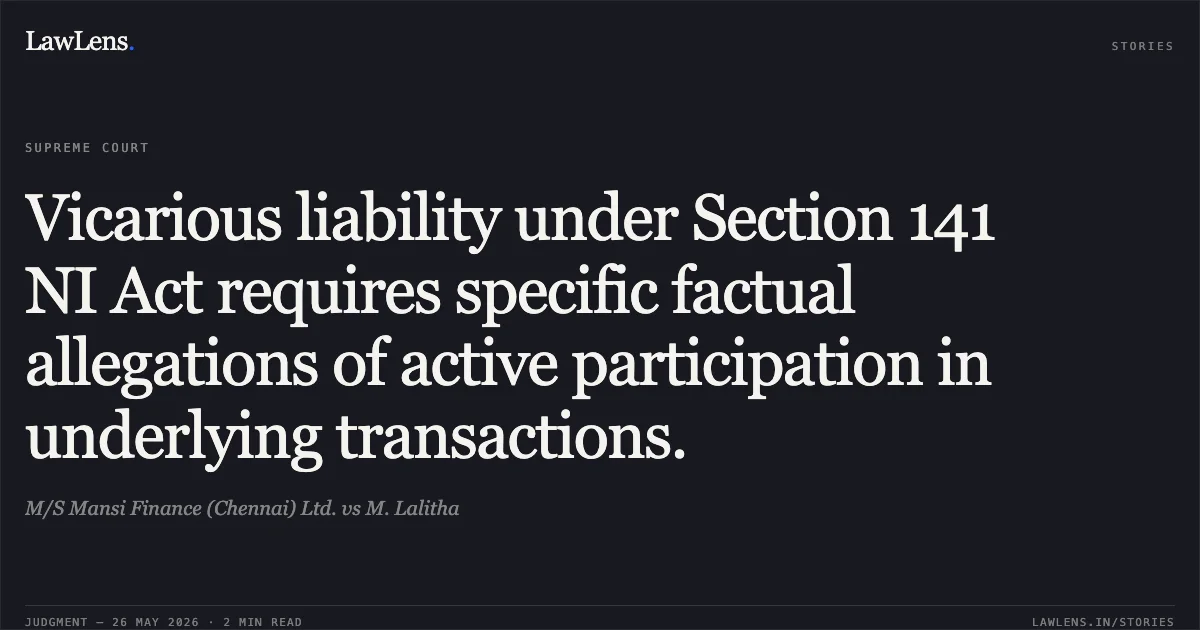
M/S Mansi Finance (Chennai) Ltd.vsM. Lalitha
Click to open original judgment
Original judgment, available to read, download and summarize on LawLens.in