Facts
The incident occurred on 05.09.1982 due to a land dispute between the deceased, Chandra Prakash Tiwari, and the accused.
Source reference: para. 4Radhe Krishna (A13) allegedly lured the deceased from his house under a false pretext, after which 12–13 accused persons surrounded and assaulted him with lathis.
Source reference: para. 4Ram Pratap (A1) was allegedly present with a firearm, threatening witnesses to prevent intervention.
Source reference: para. 4The deceased succumbed to injuries, and his body was later recovered from a nearby field.
Source reference: para. 5The Trial Court, via judgment dated 18.07.1983, convicted the appellants under Sections 147, 148, 302/149, 325/149, 323/149, and 201/149 of the IPC.
Source reference: para. 2During the pendency of the appeal, six appellants died, causing their appeals to abate.
Source reference: para. 14One appellant, Rakesh Kumar (A3), was found to be a juvenile at the time of the occurrence.
Source reference: para. 14, 76Issues
1. Whether the ocular testimonies of PW-1, PW-2, and PW-3 were reliable and sufficient to sustain the conviction despite allegations of prior enmity and minor discrepancies.
Source reference: para. 372. Whether accused A1 (Ram Pratap) could be held vicariously liable under Section 149 IPC in the absence of an overt act of physical assault.
Source reference: para. 583. Whether the charge under Section 201 IPC (causing disappearance of evidence) was legally sustainable based on the recovery of the body from a different location.
Source reference: para. 464. What is the appropriate legal course for appellant A3, who was a juvenile at the time of the offense, considering the passage of four decades.
Source reference: para. 78Law Applied
The Court primarily applied the principles of vicarious liability under Section 149 IPC and the definition of an unlawful assembly under Section 141 IPC, relying on Vinubhai Ranchhodbhai Patel v. Rajivbhai Dudabhai Patel (2018) to establish that a member is liable if they share a common object or know the offense is likely to be committed.
Source reference: para. 59, 63For the charge of screening offenders, the Court applied Section 201 IPC, guided by Sukhram v. State of Maharashtra (2007) and Palvinder Kaur v. State of Punjab (1952), which require proof of the intent to cause disappearance of evidence beyond mere suspicion.
Source reference: para. 48–49The Court also upheld the evidentiary value of an injured witness (PW-3), noting that their presence is naturally guaranteed.
Source reference: para. 43, 74Reasoning
The Court found the ocular evidence of PW-1, PW-2 (independent witness), and PW-3 (injured witness) credible and consistent regarding the assault and the presence of the accused.
Source reference: para. 38, 43It rejected the defense's argument regarding visibility obstructions at the site, noting that the place of assault was within the line of sight of the witnesses.
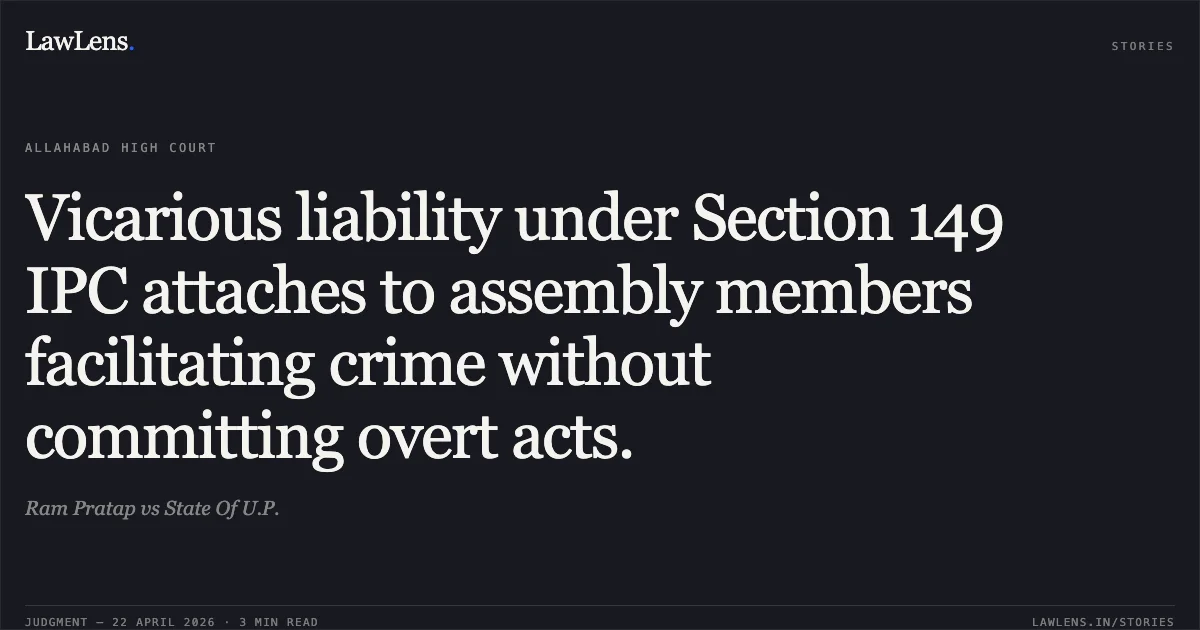
Source reference: para. 41–42Regarding A1, the Court held that although he did not physically strike the victim, his presence with a firearm to threaten witnesses facilitated the common object of the unlawful assembly, satisfying the criteria for vicarious liability under Section 149 IPC.
Source reference: para. 64, 67Conversely, the Court found the Section 201 IPC conviction unsustainable because no witness saw the accused moving the body, and the post-mortem report showed no dragging injuries; mere discovery of the body in a different field did not constitute proof of "causing disappearance of evidence" by the accused.
Source reference: para. 51–56Regarding A3’s juvenility, the Court noted he was 14 at the time of the offense and, after 40 years, sending him to a reformatory was impractical; hence, his 11 months of prior incarceration was deemed sufficient.
Source reference: para. 79–82Holding
The High Court partly allowed the appeals.
It affirmed the convictions of A1, A3, A4, A7, A8, A11, and A12 under Sections 302/149, 147, 325/149, and 323/149 IPC, and A1’s conviction under Section 148 IPC.
Source reference: para. 84The Court set aside the convictions under Section 201/149 IPC for all appellants due to lack of evidence.
Source reference: para. 84For A3 (juvenile), the sentence was restricted to the period already undergone.
Source reference: para. 85The remaining surviving appellants (A1, A4, A7, A8, A11, A12) were ordered to surrender within 15 days to serve their life sentences.
Source reference: para. 86Acts & Sections Cited
9 provisions across 1 statute referred to in this judgment. Each provision opens on LawLens.
Original Court PDF
Ram PratapvsState Of U.P.
Click to open original judgment
Original judgment, available to read, download and summarize on LawLens.in


