Facts
The Appellant (Victim) filed three appeals seeking the enhancement of sentences and the grant of compensation against Respondents Vijay Arora, Rohit Arora, and Rohan Arora.
Source reference: p. 2-3, para 3The Respondents were convicted under Section 307 read with Section 34 of the IPC by the Trial Court for an attempt to murder, wherein it was established that Rohan Arora shot the Appellant with a firearm while the others exhorted him.
Source reference: p. 2-3, para 3The Trial Court sentenced the convicts to three years of rigorous imprisonment and a fine of Rs. 50,000 each.
Source reference: p. 3, para 3Notably, the Trial Court recorded that a compromise had previously been initiated between the parties, although the Appellant claimed readiness to return the settlement amount.
Source reference: p. 3, para 3Issues
1. Whether an appeal filed by a victim for the enhancement of a sentence on the grounds of its inadequacy is maintainable under the law
Source reference: p. 4, para 62. Whether the High Court Division Bench is the appropriate forum for a victim's appeal seeking compensation when the sentence is already being challenged before a Single Judge
Source reference: p. 8-9, para 9-10Law Applied
Section 413 of the Bharatiya Nagarik Suraksha Sanhita, 2023 (BNSS), which is identical to Section 372 of the Code of Criminal Procedure, 1973 (CrPC). These provisions stipulate that a victim has a limited right to appeal only against (i) acquittal, (ii) conviction for a lesser offence, or (iii) imposition of inadequate compensation.
Source reference: p. 4-5, para 8The Supreme Court’s decision in Parvinder Kansal v. State (NCT of Delhi) (2020) 19 SCC 496, which establishes that the power to seek enhancement of a sentence on grounds of inadequacy is exclusively vested in the State under Section 377 of the CrPC/Section 418 of the BNSS, and not the victim.
Source reference: p. 5-8, para 8The precedent set in Muskan v. State (Govt. of NCT of Delhi) & Anr. [CRL.A. 598/2015].
Source reference: p. 5-8, para 8Reasoning
The Court reasoned that the right to appeal is a creature of statute and must be strictly confined to the contingencies expressly provided in the BNSS/CrPC.
Source reference: p. 7-8, para 8Since Section 413 of the BNSS (proviso to Section 372 CrPC) does not explicitly include "inadequacy of sentence" as a ground for a victim’s appeal, the Appellant’s prayer for enhancement of the three-year sentence was found legally impermissible.
Source reference: p. 8, para 8Regarding the issue of compensation, the Court noted that while the Trial Court did not award compensation, it had referenced a prior compromise and a retracted MoU involving a payment of Rs. 22,00,000.
Source reference: p. 8-9, para 9The Court observed that because the main judgment was already under challenge before a Single Judge, the specific prayer for compensation should also be addressed there rather than by the Division Bench.
Source reference: p. 9, para 10Holding
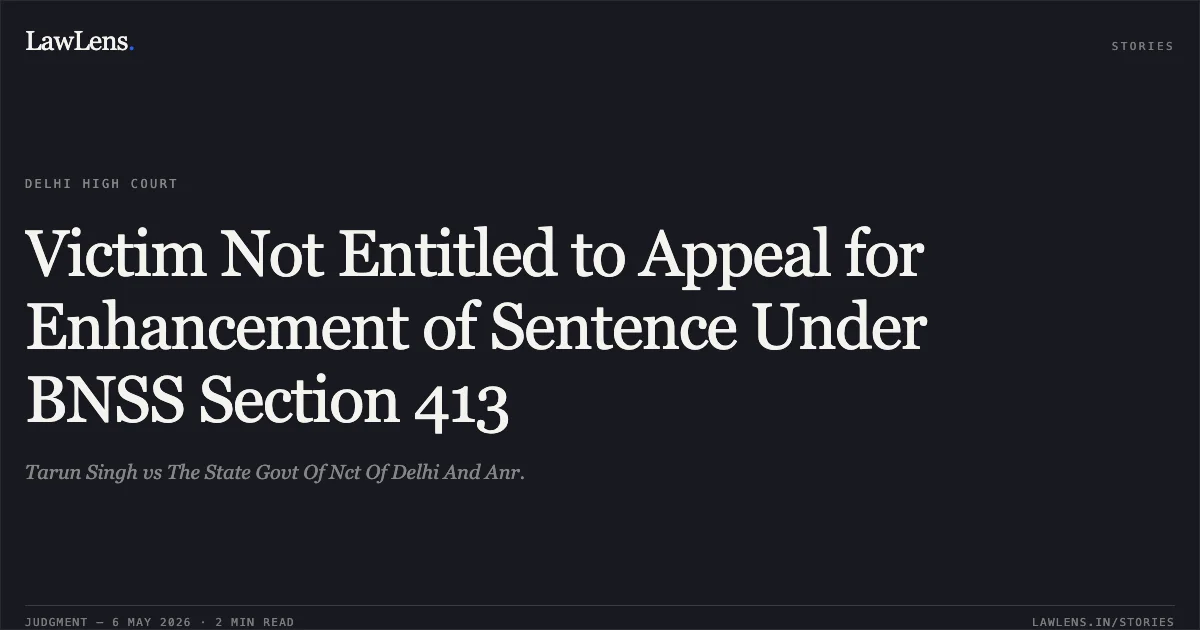
The Court held that the appeals for enhancement of sentence at the behest of the victim are not maintainable.
The appeals were dismissed as withdrawn, granting the Appellant liberty to approach the Single Judge specifically to challenge the order on sentence regarding the grant of compensation under Section 413 of the BNSS.
Source reference: p. 9, para 11No observations were made on the merits regarding the adequacy of compensation.
Source reference: p. 9, para 12Acts & Sections Cited
5 provisions across 3 statutes referred to in this judgment. Each provision opens on LawLens.
Indian Penal Code, 18602
Bharatiya Nagarik Suraksha Sanhita, 20231
Code of Criminal Procedure, 19732
Original Court PDF
Tarun SinghvsThe State Govt Of Nct Of Delhi And Anr.
Click to open original judgment
Original judgment, available to read, download and summarize on LawLens.in