Facts
The appellant (original complainant) filed a criminal complaint against the respondent-accused under Sections 406, 477-A, and 114 of the Indian Penal Code (IPC).
Source reference: p. 1Following a police investigation and charge-sheet, the Trial Court consolidated multiple criminal cases (Nos. 153 to 157 of 1993).
Source reference: p. 1On 07.11.2023, the Chief Judicial Magistrate, Ahmedabad (Rural), delivered a judgment acquitting the respondent of all charges.
Source reference: p. 1The appellant subsequently filed the present appeal against acquittal before the High Court of Gujarat under Section 378(4) of the CrPC.
Source reference: p. 1Issues
1. Whether an appeal against an order of acquittal passed by a Magistrate in respect of a cognizable and non-bailable offence should be filed in the High Court or the Sessions Court
Source reference: p. 2, para. 42. Whether the victim’s right to appeal under the proviso to Section 372 of the CrPC is independent of the conditions set out in Section 378(4) regarding special leave
Source reference: p. 3, para. 6Law Applied
Section 378(1)(b) of the CrPC, which mandates that appeals against acquittal orders passed by a Magistrate in cognizable and non-bailable cases are to be filed in the Sessions Court.
Source reference: p. 2, para. 4The precedent in Subhash Chand v. State (Delhi Administration) (2013) 2 SCC 17, which established that the High Court’s jurisdiction is barred in such instances.
Source reference: p. 2, para. 4Celestium Financial v. A. Gnanasekaran, 2025(3) RCR (Criminal) 208, and Mohanlal v. Gaurav Kumar, 2025 PHHC 162308, affirming that a "victim" has an absolute right to prefer an appeal under the proviso to Section 372 of the CrPC (now Section 413 of BNSS) without requiring special leave from the High Court.
Source reference: p. 3, para. 5-6Reasoning
The Court observed that since the acquittal was ordered by a Magistrate in a case involving cognizable and non-bailable offences (Sections 406 and 477-A IPC), the statutory route for appeal is governed by Section 378(1)(b) and the proviso to Section 372.
Source reference: p. 2-3Applying the ratio from Subhash Chand, the Court reasoned that the High Court is not the appropriate forum for the initial appeal in such cases.
Source reference: p. 2The Court further noted the Supreme Court's reasoning in Celestium Financial, which emphasizes that a victim's right to appeal is a substantive right on par with an accused’s right to appeal a conviction, and should not be circumscribed by the procedural requirement of seeking "leave to appeal" under Section 378(4).
Source reference: p. 3-4Consequently, the matter was deemed fit for transfer to the Sessions Court rather than being entertained by the High Court.
Source reference: p. 4, para. 8Holding
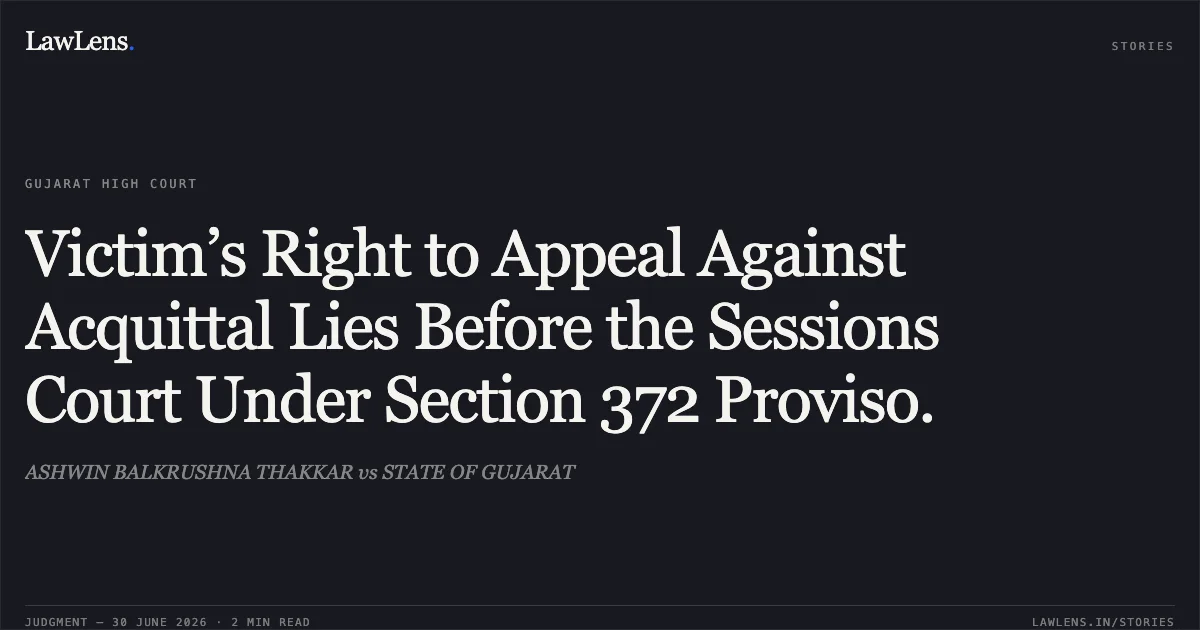
The High Court held that the appeal was maintainable before the Sessions Court rather than the High Court.
The Court disposed of the appeal by directing the Registry to transfer the entire record and proceedings to the concerned Sessions Court. The Sessions Court was directed to treat the matter as an appeal under the proviso to Section 372 of the Code (or Section 413 of the BNSS), issue fresh notices to the parties, and endeavor to dispose of the case expeditiously.
Source reference: p. 4-5, para. 8-9Acts & Sections Cited
10 provisions across 4 statutes referred to in this judgment. Each provision opens on LawLens.
Bharatiya Nagarik Suraksha Sanhita, 20231
Code of Criminal Procedure, 19735
Indian Penal Code, 18602
Negotiable Instruments Act, 18812
Original Court PDF
ASHWIN BALKRUSHNA THAKKARvsSTATE OF GUJARAT
Click to open original judgment
Original judgment, available to read, download and summarize on LawLens.in


