Facts
The petitioner’s son, who was suffering from depressive disorders, was admitted to a hospital and died by suicide.
Source reference: no citationThe petitioner alleged that the death resulted from the negligence of a doctor and a nurse. An FIR was registered for offences under Section 304A read with Section 34 of the IPC, a bailable offence. The Judicial Magistrate, 9th Court, Alipore, acquitted the accused. The petitioner filed an appeal before the High Court, which rejected it as not maintainable while granting liberty to approach the Sessions Court. Although the appeal had initially been admitted by a Single Judge, another Single Judge dismissed it at the final-hearing stage on the question of maintainability
Source reference: pp.4–5Issues
Whether a Coordinate Bench of the High Court could subsequently reject the appeal as not maintainable despite its earlier admission by another Single Judge
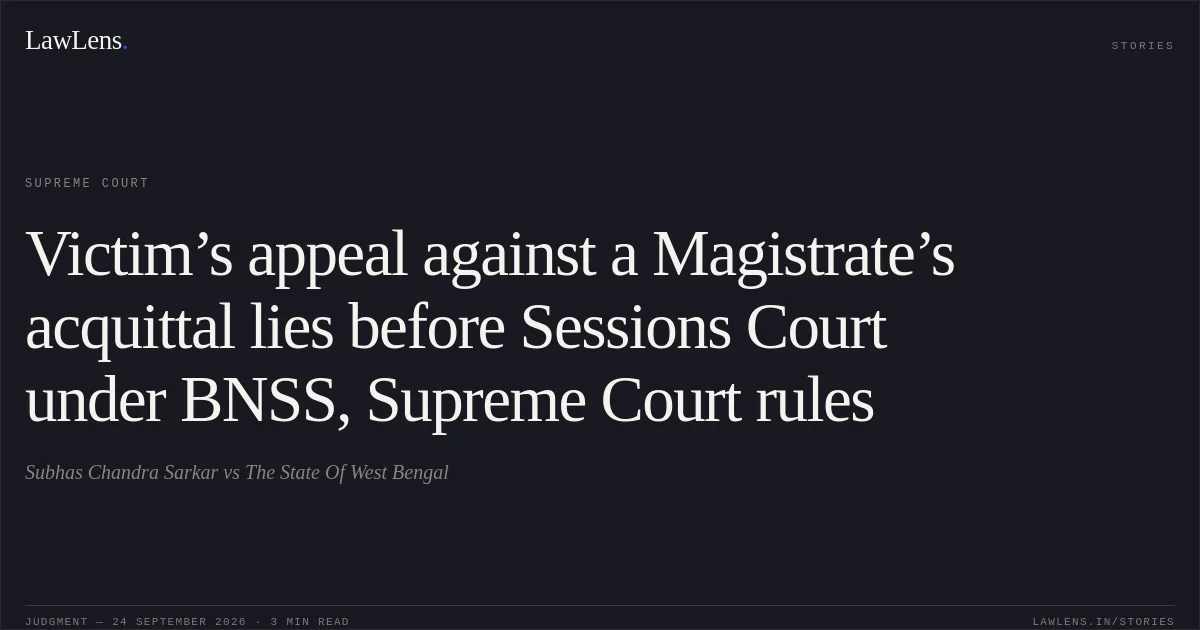
Source reference: pp.2–4Whether an appeal preferred by the victim against an order of acquittal passed by a Magistrate in respect of a bailable offence lies before the High Court under Section 419 of the BNSS or before the Court of Session under the proviso to Section 413 read with Section 415(3) of the BNSS
Source reference: pp.3–6Law Applied
Section 378(2) of the CrPC concerns appeals against acquittal in cases investigated by the Delhi Special Police Establishment or another agency empowered under a Central Act, and was held inapplicable here
Source reference: p.3Under Section 419 of the BNSS, a State appeal against a Magistrate’s acquittal in a cognizable and non-bailable offence lies to the Court of Session with the District Magistrate’s sanction, while other State appeals against acquittal ordinarily lie to the High Court with the State Government’s sanction
Source reference: p.4However, the proviso to Section 413 of the BNSS independently confers upon a victim a right to appeal against an acquittal, conviction for a lesser offence, or inadequate compensation, and directs that the appeal lie to the court to which an appeal ordinarily lies against the conviction of that court
Source reference: p.5Section 415(3) of the BNSS provides that an appeal from a conviction recorded by a Magistrate of the First or Second Class lies to the Court of Session
Source reference: p.6The Court distinguished Rajan Chadha v. Sanjay Arora, 2025 SCC OnLine SC 899, holding that the decision did not establish that a later Coordinate Bench is barred from examining maintainability on the basis of the statutory scheme
Source reference: pp.2–4Reasoning
The Court held that the earlier admission of the appeal did not prevent the later Single Judge from examining its statutory maintainability at the final-hearing stage; the principle in Rajan Chadha was confined to the impermissible reversal of a concluded finding of contempt and did not apply to a jurisdictional determination based on statute
Source reference: pp.2–4Section 419 of the BNSS was not decisive because the present appeal was instituted by the victim, not by the State. The applicable provision was therefore the proviso to Section 413, which requires the victim’s appeal against acquittal to be filed before the court competent to hear an appeal against the corresponding conviction. Since a conviction by a Magistrate of the First Class is appealable to the Sessions Court under Section 415(3), the petitioner’s appeal against the Magistrate’s acquittal was likewise required to be filed before the Sessions Court
Source reference: pp.5–6Holding
The Supreme Court upheld the High Court’s order rejecting the appeal as not maintainable before it and held that the petitioner’s victim appeal against the Magistrate’s acquittal lies before the jurisdictional Sessions Court
The petitioner was granted liberty to file the appeal before the Sessions Court, and the Court directed that if it was filed within one month from the date of the Supreme Court’s order, it would be admitted and heard on merits without considering the delay attributable to the bona fide proceedings before the High Court and Supreme Court. The Court expressed no view on the merits of the acquittal. The Special Leave Petition was accordingly rejected with these directions
Source reference: p.7Acts & Sections Cited
8 provisions across 3 statutes referred to in this judgment. Each provision opens on LawLens.
Code of Criminal Procedure, 19731
Bharatiya Nagarik Suraksha Sanhita, 20236
Indian Penal Code, 18601
Original Court PDF
Subhas Chandra SarkarvsThe State Of West Bengal
Click to open original judgment
Original judgment, available to read, download and summarize on LawLens.in