01Facts
The appellant, the original complainant, filed a criminal complaint against the respondents-accused under Sections 427, 506(2) and 114 of the Indian Penal Code.
¶ 1–2 · p. 1Following investigation, the police filed a charge-sheet. The accused pleaded not guilty, and the Judicial Magistrate First Class, Sami, acquitted them by judgment dated 17 December 2011.
¶ 1–2 · p. 1The complainant thereafter instituted the present appeal under Section 378 of the Code of Criminal Procedure, 1973 (“CrPC”) before the High Court.
¶ 1–2 · p. 1During the hearing, the parties addressed the maintainability and proper forum of an appeal by a complainant/victim against an order of acquittal, particularly in light of conflicting authorities concerning Sections 372 and 378 CrPC.
¶ 4–8 · pp. 2–502Issues
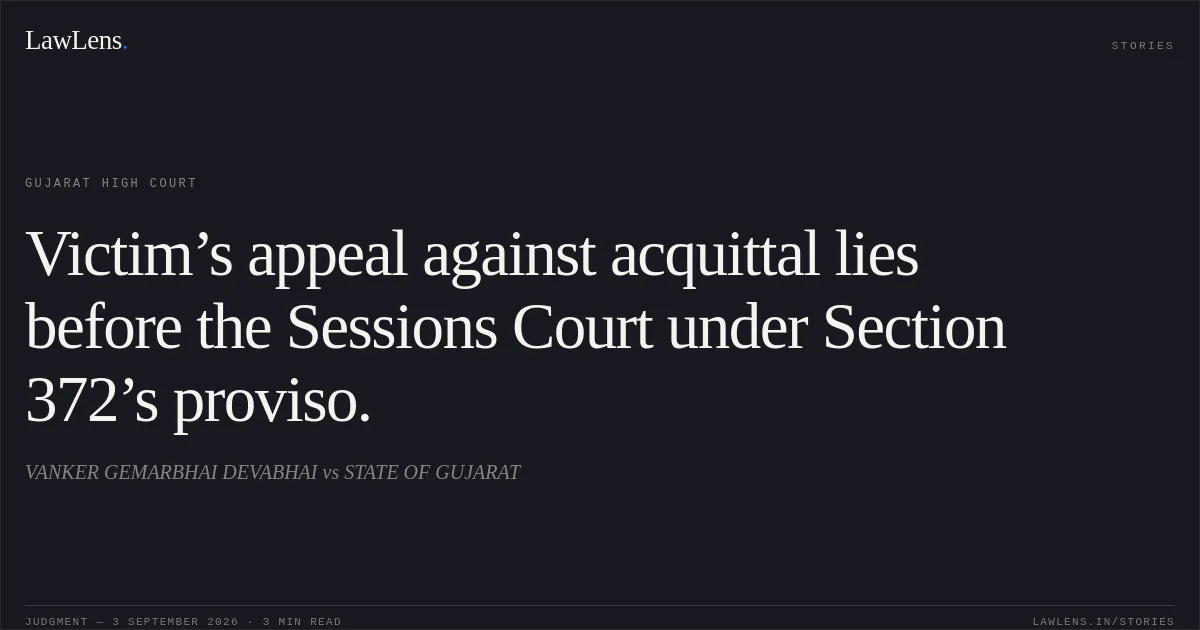
i.1. Whether an appeal against the Magistrate’s order of acquittal, filed by the original complainant as a victim, was required to be treated as an appeal under the proviso to Section 372 CrPC and heard by the Sessions Court rather than by the High Court under Section 378 CrPC.
¶ 4–9 · pp. 2–5ii.2. Whether the appeal could be transferred to and re-numbered before the concerned Sessions Court without the High Court examining the merits of the acquittal.
¶ 8–10 · pp. 5–603Law Applied
Section 378(1)(a)–(b) CrPC governs appeals against acquittal and, as explained in Subhash Chand v. State (Delhi Administration), an appeal against an acquittal by a Magistrate in a cognizable and non-bailable case may lie before the Sessions Court at the instance of the Public Prosecutor as directed by the District Magistrate, whereas the State Government’s power under Section 378(1)(b) does not extend to such cases.
¶ 4 · p. 2The proviso to Section 372 CrPC confers on a victim a right to appeal against acquittal, conviction for a lesser offence, or inadequate compensation; Section 2(wa) defines “victim.”
¶ 5–6 · pp. 3–4Relying on M/s. Celestium Financial v. A. Gnanasekaran, the Court noted the principle that a victim’s appeal under the proviso to Section 372 is not subject to the special-leave requirement under Section 378(4) and lies before the Sessions Court.
¶ 5–6 · pp. 3–4However, M/s. Everest Automobiles v. M/s. Ranjit Enterprises noted that Celestium Financial had not considered Satya Pal Singh v. State of M.P. and Subhash Chand, and indicated that the issue warranted authoritative consideration by a larger Bench.
¶ 7–8 · pp. 4–5The corresponding provision under the Bharatiya Nagarik Suraksha Sanhita, 2023 (“BNSS”) was identified as Section 413.
¶ 9 · p. 5Provisions in the judgment · 11 · Linked ones open on LawLens
Code of Criminal Procedure, 1973 Section 378Section 372Section 374Section 200Section 2
Indian Penal Code, 1860 Section 427Section 506Section 114
Negotiable Instruments Act, 1881 Section 138Section 143
Bharatiya Nagarik Suraksha Sanhita, 2023 Section 413
04Reasoning
The High Court did not determine the evidentiary merits of the acquittal. Instead, it considered the jurisdictional question arising from the appellant’s status as the original complainant and potential victim, together with the statutory scheme governing appeals against acquittal.
¶ 4–9 · pp. 2–5In view of the authorities recognising a victim’s right to appeal under the proviso to Section 372 CrPC, and the resulting competence of the Sessions Court to hear such an appeal, the Court concluded that the matter should be placed before the concerned Sessions Court.
¶ 4–9 · pp. 2–5The Court also acknowledged that the legal position was subject to conflicting Supreme Court decisions and was pending authoritative resolution, but considered transfer appropriate without prejudging that controversy or the merits of the case.
¶ 7–10 · pp. 4–605Holding
The High Court disposed of the appeal by directing the Registry to transfer the entire appeal record, including the certified copy of the impugned judgment and the record and proceedings, to the concerned Sessions Court.
¶ 9 · p. 5The Sessions Court was directed to treat and number the matter as an appeal under the proviso to Section 372 CrPC, or Section 413 BNSS, and to issue notice to the parties.
¶ 9 · p. 5The Sessions Court was further requested to endeavour to dispose of the matter expeditiously, considering its long pendency.
¶ 9 · p. 5The High Court expressly clarified that it had not examined the merits of the acquittal.
¶ 10 · p. 6Original Court PDF
VANKER GEMARBHAI DEVABHAIvsSTATE OF GUJARAT
Click to open original judgment
Original judgment, available to read, download and summarize on LawLens.in