Facts
The plaintiff, an Armed Constable in the Gujarat Police Department, was served a charge-sheet on 21.04.1989 for unauthorized absenteeism on ten different occasions.
Source reference: p. 2During the departmental inquiry, the department examined witnesses on 15.06.1989; however, the intimation letter dated 08.06.1989 was only received by the plaintiff on 16.06.1989.
Source reference: p. 3Despite the plaintiff notifying the Inquiry Officer of this lapse via a letter dated 23.06.1989, the department proceeded ex-parte, leading to his dismissal on 16.11.1989.
Source reference: p. 3-4The Trial Court dismissed the plaintiff's suit, holding there was no violation of natural justice.
Source reference: p. 4On appeal, the First Appellate Court reversed this, quashing the dismissal due to the lack of opportunity to cross-examine witnesses but denied back-wages on the "no work no pay" principle.
Source reference: p. 5-6Both the State and the plaintiff filed second appeals.
Source reference: p. 6Issues
1. Whether the departmental authorities violated the principles of natural justice by not granting a fair opportunity of hearing/cross-examination to the plaintiff
Source reference: p. 6, Issue 12. Whether the suit was maintainable despite the plaintiff not exhausting alternative departmental appeals or revisions
Source reference: p. 6, Issue 23. Whether the plaintiff is entitled to back-wages, pay, allowances, and notional service benefits for the period between dismissal and superannuation
Source reference: p. 7, Issue I & IILaw Applied
Section 100 of the Civil Procedure Code (CPC) regarding the scope of second appeals, emphasizing that findings of fact should not be disturbed unless perverse.
Source reference: p. 19Canara Bank v. V. K. Awasthy (2005), which establishes that fairness in action is a core facet of natural justice and necessitates a fair hearing.
Source reference: p. 17Russi Fisheries (P) Ltd. v. Bhavna Seth (2026), which limits High Court interference in factual findings to cases of gross inexcusable error.
Source reference: p. 19-20While a quashed order usually allows for a de novo inquiry, such a course may be declined if the employee has since retired, as seen in Mangal Singh F. Poon v. State of Gujarat (1991).
Source reference: p. 21Reasoning
The High Court found that the department’s failure to ensure the plaintiff received notice of the witness examination prior to the hearing date was a fatal procedural defect.
Source reference: p. 14-15It rejected the State’s argument that notice on every adjourned date was unnecessary, noting that once the department opted to send an intimation for the examination of witnesses, it was duty-bound to ensure receipt before the hearing.
Source reference: p. 17-18The Court upheld the Appellate Court's finding of fact that the plaintiff received notice only after the witnesses were examined, rendering the inquiry report vitiated due to the denial of cross-examination.
Source reference: p. 15-16Regarding maintainability, the Court ruled that under Section 9 of the CPC, a civil suit is maintainable unless specifically barred by law; here, the disciplinary rules for the police force did not bar the jurisdiction of civil courts.
Source reference: p. 18The Court determined that while back-wages were not warranted as the plaintiff did not work and did not prove he was unemployed, the quashing of the dismissal necessitates the protection of continuity of service.
Source reference: p. 22-23Holding
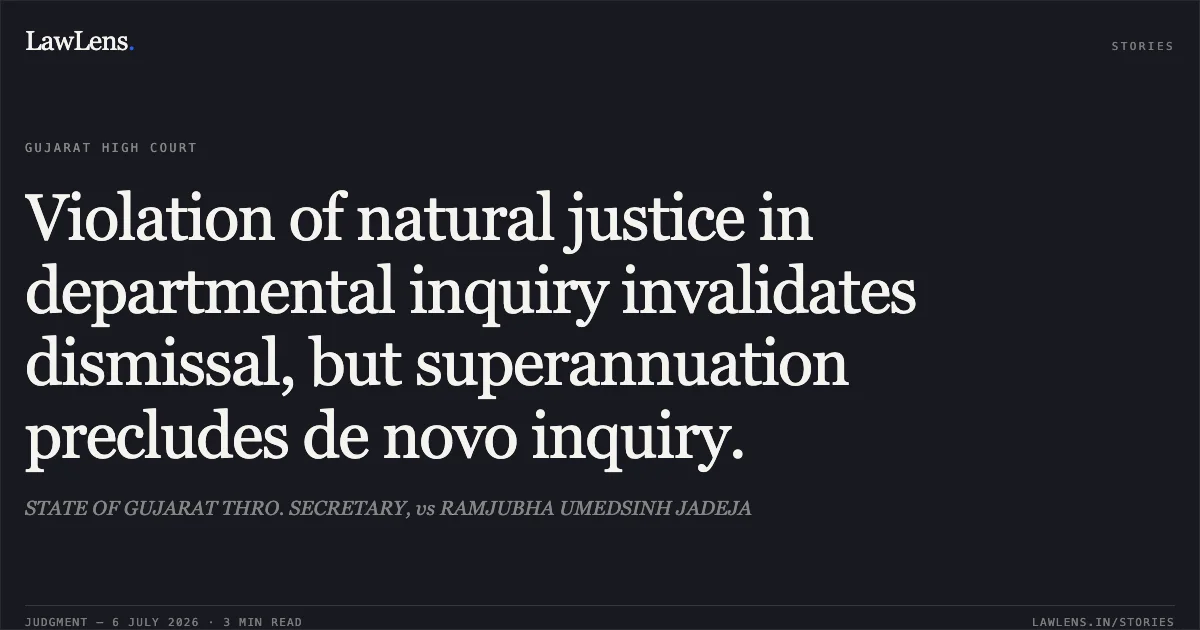
The High Court dismissed the State's appeal and partly allowed the plaintiff's appeal, holding that the dismissal was illegal due to the violation of natural justice.
The Court ordered that since the plaintiff reached superannuation on 31.12.2017 during the pendency of the litigation, a de novo inquiry is not feasible. The plaintiff is not entitled to actual back-wages but is entitled to notional benefits and continuity of service from the date of dismissal until retirement. The State is directed to calculate and pay all retiral dues (pension, gratuity, leave encashment) by 31.10.2026, failing which a 6% interest rate shall apply.
Source reference: p. 21-22, p. 23Acts & Sections Cited
3 provisions across 1 statute referred to in this judgment. Each provision opens on LawLens.
Code of Civil Procedure, 19083
Original Court PDF
STATE OF GUJARAT THRO. SECRETARY,vsRAMJUBHA UMEDSINH JADEJA
Click to open original judgment
Original judgment, available to read, download and summarize on LawLens.in