Facts
An FIR, being Case Crime No. 425 of 2024, was registered on 6 October 2024 at Police Station Kotwali Dehat, District Saharanpur, by a Head Constable against the applicants under Sections 121(1), 125, 126(1), 221, 223, 190, 191(2), 351(3) and 352 of the Bharatiya Nyaya Sanhita, 2023 (“BNS”), and Section 7 of the Criminal Law (Amendment) Act, 1932.
Source reference: paras. 3–5, 14Sections 221 and 223 BNS correspond, respectively, to offences earlier covered by Sections 186 and 188 IPC.
Source reference: paras. 3–5, 14The applicants contended that the FIR was lodged by the police on its own motion, without a written complaint by the concerned public servant, as required by Section 215(1)(a) of the Bharatiya Nagarik Suraksha Sanhita, 2023 (“BNSS”).
Source reference: paras. 3–5, 14The Investigating Officer submitted a charge-sheet dated 19 January 2025.
Source reference: para. 2The Additional Chief Judicial Magistrate-I, Saharanpur, took cognizance and issued the summoning order dated 8 April 2025 in Criminal Case No. 1617 of 2025.
Source reference: para. 2The applicants sought quashing of the charge-sheet, cognizance/summoning order and the entire criminal proceedings under Section 528 BNSS.
Source reference: para. 2They also challenged the cognizance order as cryptic, mechanical and lacking specification of the penal provisions and names of the accused.
Source reference: para. 16Issues
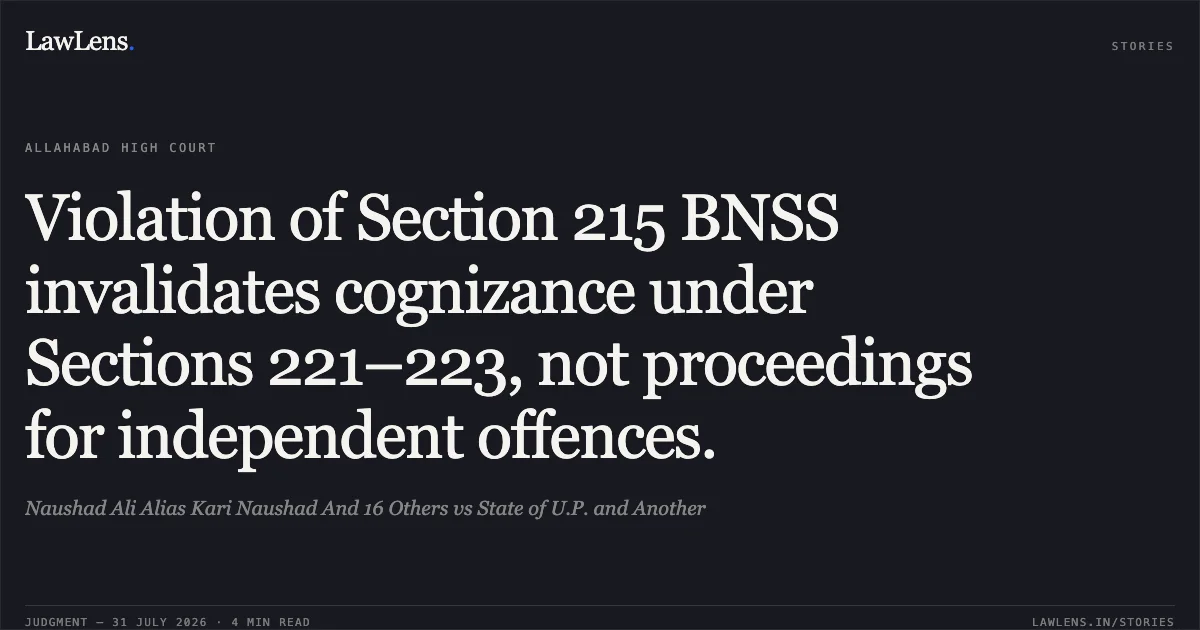
Whether the Magistrate could take cognizance of offences under Sections 221 and 223 BNS on the basis of a police report, in the absence of a written complaint by the concerned public servant as mandated by Section 215(1)(a) BNSS?
Source reference: paras. 9–15Whether the statutory defect relating to Sections 221 and 223 BNS required quashing of the entire charge-sheet and criminal proceedings, including the other non-barred offences?
Source reference: paras. 17–20Whether the cognizance/summoning order dated 8 April 2025 was invalid for being cryptic and demonstrating non-application of judicial mind?
Source reference: para. 16Law Applied
The Court applied Section 215(1)(a) BNSS, which prohibits a court from taking cognizance of offences punishable under Sections 206 to 223 BNS, including their abetment, attempt or conspiracy, except upon a written complaint by the concerned public servant or an authorised/superior public servant.
Source reference: para. 9The Court held that this statutory requirement is mandatory and that cognizance taken on a police report without such complaint is without jurisdiction.
Source reference: para. 10It relied on Daulat Ram v. State of Punjab, AIR 1962 SC 1206, D.K. Rajendran v. State of T.N., AIR 2010 SC 3718, and B.N. John v. State of U.P., 2025 SCC OnLine SC 7, which affirm that non-compliance with the corresponding Section 195 CrPC requirement vitiates cognizance and consequential proceedings.
Source reference: paras. 10, 13The Court also relied on Ramendra Sharma v. State of U.P., Yogeshwar Sood v. State of U.P., and other decisions holding that prosecution for offences covered by Section 195 CrPC cannot be initiated merely through a police FIR and charge-sheet.
Source reference: paras. 5–6, 11–12At the same time, under Section 528 BNSS, the High Court’s inherent jurisdiction is to prevent abuse of process and secure the ends of justice; an illegality affecting some offences does not automatically require quashing of proceedings for independent, non-barred offences.
Source reference: paras. 17–20Reasoning
The Court found that the FIR had been registered by the Head Constable without any written complaint from the competent public servant, and that no such complaint was produced on record.
Source reference: para. 14Consequently, the Magistrate lacked jurisdiction to take cognizance of Sections 221 and 223 BNS on the basis of the police report, and the cognizance order was therefore legally unsustainable.
Source reference: para. 15The Court further held that the order was independently defective because it did not specify the relevant penal provisions or the names of the accused and reflected no adequate application of judicial mind.
Source reference: para. 16However, the charge-sheet also alleged offences under Sections 121(1), 125, 126(1), 190, 191(2), 351(3) and 352 BNS and Section 7 of the Criminal Law (Amendment) Act, 1932, which were not subject to the statutory bar in Section 215(1)(a) BNSS.
Source reference: para. 17The Court declined to extinguish the prosecution for those offences merely because cognizance had wrongly been taken under Sections 221 and 223 BNS.
Source reference: paras. 17–20It therefore set aside the cognizance/summoning order but refused to quash the charge-sheet and the entire criminal proceedings.
Source reference: paras. 17–20Holding
The application was partly allowed.
The cognizance/summoning order dated 8 April 2025 was set aside because cognizance of Sections 221 and 223 BNS had been taken without the mandatory written complaint contemplated by Section 215(1)(a) BNSS, and because the order was cryptic and non-speaking.
Source reference: para. 20The prayer to quash the charge-sheet and the entire criminal proceedings was refused, since the remaining alleged offences were not covered by the statutory bar.
Source reference: paras. 17–20The matter was remitted to the Additional Chief Judicial Magistrate-I, Saharanpur, to pass a fresh order on the question of cognizance, if required, in accordance with the applicable law.
Source reference: para. 21Acts & Sections Cited
54 provisions across 4 statutes referred to in this judgment. Each provision opens on LawLens.
Bharatiya Nagarik Suraksha Sanhita, 20232
Bharatiya Nyaya Sanhita, 2023
Code of Criminal Procedure, 19732
Original Court PDF
Naushad Ali Alias Kari Naushad And 16 OthersvsState of U.P. and Another
Click to open original judgment
Original judgment, available to read, download and summarize on LawLens.in