Facts
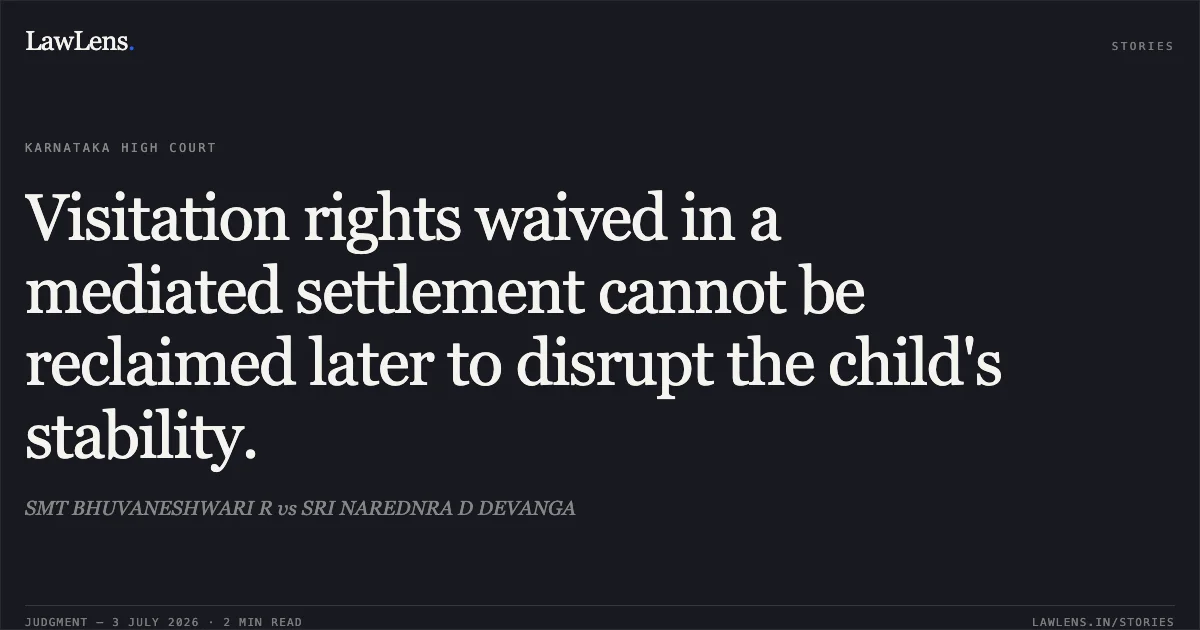
The petitioner (mother) and respondent (father) dissolved their marriage via a decree of divorce in M.C. No. 1010 of 2023 on September 26, 2024.
Source reference: p. 2-3The decree was based on a memorandum of settlement dated September 24, 2024, entered before the Karnataka Mediation Centre, wherein the respondent specifically renounced all visitation rights and agreed to the petitioner being the permanent custodian and guardian of their minor son.
Source reference: p. 2, 4Subsequently, the respondent filed G & WC No. 178/2025 seeking visitation rights, despite having remarried and allegedly providing no financial or emotional support.
Source reference: p. 3On January 30, 2026, the Principal Judge, Family Court, Bengaluru, granted visitation rights and ordered the respondent to pay 50% of educational expenses.
Source reference: p. 2, 5The petitioner challenged this order via a Writ Petition under Articles 226 and 227 of the Constitution.
Source reference: p. 1Issues
1. Whether a parent who has voluntarily renounced visitation rights in a court-approved mediation settlement can subsequently maintain a petition for visitation
Source reference: p. 52. Whether the Family Court erred in granting visitation rights and imposing financial obligations contrary to the settled terms of a previous divorce decree
Source reference: p. 5Law Applied
The court primarily applied the principle of sanctity of mediated settlements and the "welfare of the child" doctrine under the Guardians and Wards Act.
Source reference: p. 2, 4It emphasized the legal finality of terms entered under the Legal Services Authorities Act via Mediation.
Source reference: p. 2, 4The court applied the equitable principle that a party cannot claim rights (visitation) while simultaneously avoiding duties (financial and emotional responsibility).
Source reference: p. 5The court also exercised its supervisory jurisdiction under Article 227 of the Constitution to rectify a failure in the proper appreciation of facts by the lower court.
Source reference: p. 5Reasoning
The Court observed that the marriage dissolution was predicated on a specific settlement where, under Clause 3, the father "voluntarily and cautiously" gave up his visitation rights.
Source reference: p. 4-5The High Court noted that the respondent failed to appear to defend the petition, reinforcing the petitioner's claims.
Source reference: p. 2The Court reasoned that the Family Court failed to appreciate that the respondent had previously mispresented facts to obtain the impugned order and had shown no interest in the child's upbringing since birth.
Source reference: p. 3, 5The Court held that since the father renounced his responsibilities—both emotional and financial—he cannot be permitted to interfere in the child's life by commencing litigation just one year after the settlement.
Source reference: p. 5The Court determined that the Family Court’s order was not based on a proper appreciation of these facts.
Source reference: p. 5Holding
The Court answered the issues in favor of the petitioner, holding that the respondent had no locus standi to seek visitation against the express terms of the settlement.
The Writ Petition was allowed, and the order dated January 30, 2026, passed by the Principal Judge, Family Court, Bengaluru, in G & WC No. 178 of 2025, was set aside.
Source reference: p. 6The petitioner remains the permanent custodian without interference from the respondent.
Source reference: p. 5Acts & Sections Cited
4 provisions across 1 statute referred to in this judgment. Each provision opens on LawLens.
Indian Penal Code, 18604
Original Court PDF
SMT BHUVANESHWARI RvsSRI NAREDNRA D DEVANGA
Click to open original judgment
Original judgment, available to read, download and summarize on LawLens.in