Facts
The petitioner, a visually challenged person with 40% visual impairment, applied pursuant to the advertisement dated 9 March 2019 for the post of Teacher (Physical Education), against vacancies reserved for Persons with Disabilities (PwDs).
Source reference: p. 2; paras 2–3The advertisement stated that reservation would be governed by the applicable statutes, rules and Government instructions, but did not restrict eligibility to any particular category of disability.
Source reference: p. 2; para. 2; p. 6; para. 11After scrutiny of his qualifications and disability certificate, the petitioner was appointed on 24 August 2021 and continued in service without any allegation of misconduct or unsatisfactory performance.
Source reference: p. 2; para. 3; p. 5; para. 8On 19 January 2023, the Joint Director issued a show-cause notice proposing termination on the ground that, according to a committee constituted by the Directorate of Public Instructions, only persons with OA (One Arm Affected) and HH (Hard of Hearing) disabilities were suitable for the post, whereas the petitioner had visual impairment.
Source reference: p. 2; para. 3The petitioner challenged the notice, contending that no statutory provision or valid Government order excluded persons with visual impairment from appointment to the post. The State did not oppose the petitioner’s submissions.
Source reference: p. 4; paras 4–6Issues
1. Whether the respondents could treat persons with visual impairment as ineligible for the post of Teacher (Physical Education) on the basis of a subsequent committee recommendation or executive opinion, when the advertisement did not prescribe such restriction.
Source reference: p. 6; paras 9–112. Whether the show-cause notice proposing termination of the petitioner’s appointment, made after verification of his disability certificate and completion of the selection process, was legally sustainable.
Source reference: p. 6–7; paras 11–133. Whether an executive recommendation could curtail employment rights available to PwDs under the Rights of Persons with Disabilities Act, 2016, in the absence of a statutory rule, notification or valid order excluding visual impairment.
Source reference: p. 5–6; paras 9–10Law Applied
The Court applied the Rights of Persons with Disabilities Act, 2016, as a beneficial and social-welfare legislation guaranteeing equality, dignity, participation and non-discrimination in employment for persons with benchmark disabilities.
Source reference: p. 7; para. 13It held that an executive recommendation or committee opinion lacking statutory force cannot curtail rights conferred by the Act or invalidate an appointment validly made.
Source reference: p. 5; para. 9The Court also relied on Clause 4(3)(b) of the General Administration Department Circular dated 27 September 2014, which treats the list of identified posts as non-exhaustive, permits departments to identify additional suitable posts, and prohibits reduction of posts already identified for reservation.
Source reference: p. 5–6; para. 10In In Re: Recruitment of Visually Impaired in Judicial Service, 2025 SCC OnLine SC 481, the Supreme Court emphasised constitutional equality, non-discrimination, reasonable accommodation and protection against indirect disability-based exclusion.
Source reference: p. 7–8; paras 14–15The Court further relied on Rajdhani Yadav v. Collector, Korea, affirmed in Chief Executive Officer, Janpad Panchayat, Baikunthpur v. Collector, Korea, for the principle that appointment of a PwD candidate should not be invalidated merely because the candidate’s disability category differs from the initially identified category where no suitable candidate in the latter category is available.
Source reference: p. 8–9; para. 16Reasoning
The petitioner possessed benchmark visual disability, had disclosed his disability, and was found eligible after verification by the competent selection authorities.
Source reference: p. 5; para. 8The advertisement did not state that only candidates with OA or HH disabilities could apply, nor did the respondents produce any statutory rule, notification or order excluding persons with blindness or low vision from the post.
Source reference: p. 5–6; paras 9–11Accordingly, the subsequent committee recommendation could not operate retrospectively to introduce a new eligibility condition or undermine an appointment already made.
Source reference: p. 5–6; paras 9–11The Court further found that the respondents’ position was inconsistent with the 2014 Circular, which permitted expansion—not reduction—of employment opportunities for PwDs.
Source reference: p. 5–6; para. 10Since the petitioner had neither concealed material facts nor obtained appointment through fraud or misrepresentation, the respondents could not invalidate their own appointment decision on the basis of a later administrative opinion.
Source reference: p. 6–7; para. 12Such exclusion, unsupported by statutory authority, was held to be arbitrary and contrary to the rights-based and non-discriminatory framework of the RPwD Act, 2016.
Source reference: p. 7–8; paras 13–15Holding
The Court answered the issues in favour of the petitioner.
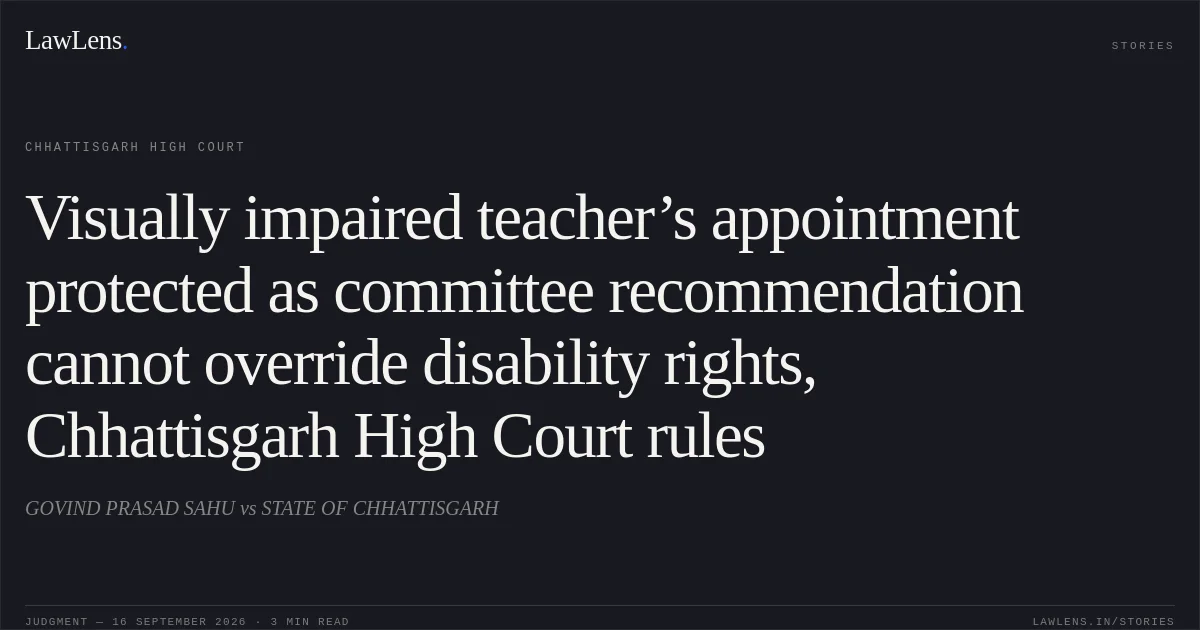
It held that the respondents could not declare him ineligible for the post of Teacher (Physical Education) solely because he had visual impairment, where the advertisement contained no such restriction and no statutory provision excluded his disability category.
Source reference: p. 5–7; paras 9–13The show-cause notice dated 19 January 2023 issued by the Joint Director, Education, Bilaspur Division, was quashed.
Source reference: p. 9; para. 17As the petitioner was already continuing in employment, no further consequential direction was considered necessary.
Source reference: p. 9; para. 17The writ petition was accordingly allowed.
Source reference: p. 9; para. 17Original Court PDF
GOVIND PRASAD SAHUvsSTATE OF CHHATTISGARH
Click to open original judgment
Original judgment, available to read, download and summarize on LawLens.in