Facts
The applicants are retired employees from Northern Railway who opted to commute a portion of their pension for a lump sum, as per CCS (Commutation of Pension) Rules, 1981, and Railway Service (Commutation of Pension) Rules, 1993.
Source reference: p.2They availed the benefit where the commuted portion was to be restored after fifteen years from the month following the payment of the commuted value of pension (CVP).
Source reference: p.2-3The applicants contended that the entire commuted value of pension, with interest, is recovered within 10 years, yet the government deducts installments for 15 years (180 installments), which they argued is unjustified.
Source reference: p.3They sought the quashment of Rule 11A of the Railway Service (Commutation of Pension) Rules, 1993.
Source reference: p.3The respondents contested the claim.
Source reference: p.3Issues
1. Whether the applicants are entitled to the restoration of their commuted pension earlier than the stipulated 15-year period.
Source reference: p.32. Whether Rule 11A of the Railway Service (Commutation of Pension) Rules, 1993, is arbitrary or illegal, justifying its quashment.
Source reference: p.3Law Applied
The court primarily applied the principle of voluntary acceptance of terms and conditions, stating that having availed a voluntary benefit under specific terms, one cannot later challenge those terms.
Source reference: p.4, p.5It relied on the precedent set by the Hon'ble Punjab and Haryana High Court in *Shila Devi and others v. State of Punjab* (CWP No. 9426/2023, order dated 27.11.2024).
Source reference: p.3-4It also relied on *Surender Singh Jakhar's case*.
Source reference: p.6These judgments held that once pensioners voluntarily opt for pension commutation under specific rules (like Rule 10A of CCS (Commutation of Pension) Rules, 1981, which is *pari materia* to the challenged rule), they are bound by the accepted terms, including the 15-year restoration period.
Source reference: p.3-4The court also noted that matters related to commutation of pension are complex affairs, necessitating judicial intervention only in cases of manifest and apparent arbitrariness.
Source reference: p.4Reasoning
The Tribunal adopted the reasoning of the Punjab and Haryana High Court in *Shila Devi's case*.
Source reference: p.3-4The High Court had dismissed 808 writ petitions challenging a *pari materia* rule, stating that petitioners, having voluntarily availed the benefit of pension commutation, could not later seek variation in the terms and conditions accepted with "open eyes".
Source reference: p.4The present applicants, like those in *Shila Devi's case*, voluntarily opted for pension commutation.
Source reference: p.5The Tribunal noted that the commutation of pension is an offer which employees can accept or reject, but once accepted, it forms a binding contract, making it impermissible to challenge the terms as arbitrary or illegal at a later stage.
Source reference: p.5-6The court also highlighted that the determination of commutative periods involves complex calculations and specialized expertise, and judicial intervention is warranted only for "manifest and apparent arbitrariness".
Source reference: p.4No such arbitrariness was demonstrated by the applicants.
Source reference: p.4Holding
The Tribunal concluded that the issue is no longer *res integra*, having been settled by the Hon’ble Punjab and Haryana High Court in *Shila Devi’s case* and *Surender Singh Jakhar’s case*.
Consequently, the Original Application was disposed of in terms of these judgments.
Source reference: p.6The applicants' grievances regarding the 15-year restoration period for commuted pension were rejected, implicitly upholding the validity of Rule 11A of the Railway Service (Commutation of Pension) Rules, 1993.
Source reference: p.3, p.6No costs were awarded.
Source reference: p.7Original Court PDF
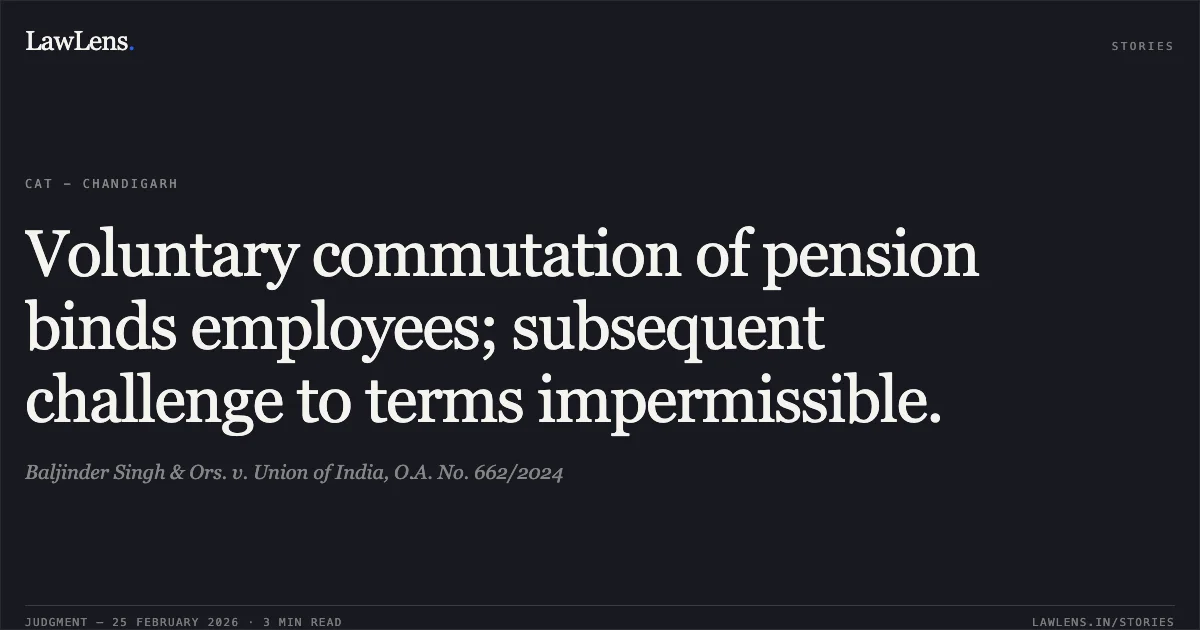
Baljinder Singh & Ors. v. Union of India, O.A. No. 662/2024
Click to open original judgment
Original judgment, available to read, download and summarize on LawLens.in