Facts
On October 8, 2020, the complainant (Raju Patel) and Rakesh Sen were intercepted by unknown persons who looted ₹4,000, identification cards, and documents while inflicting injuries
Source reference: para. 2Following an investigation and identification by the victims, the appellant was charged under Section 394 of the IPC and Section 25 of the Arms Act
Source reference: para. 2On December 28, 2023, the IIIrd Additional Sessions Judge, Sihora, District Jabalpur, convicted the appellant under Section 394 IPC (on two counts), sentencing him to seven years of Rigorous Imprisonment (R.I.) and a fine of ₹3,000 on each count, while acquitting other co-accused persons
Source reference: para. 1, 7During the pendency of the appeal, the appellant and the victims entered into a voluntary compromise, which was verified by the Registrar
Source reference: para. 8The appellant, who was 19 years old at the time of the offense and a first-time offender, sought a reduction in sentence to the period already undergone
Source reference: para. 9Issues
1. Whether the conviction of the appellant under Section 394 of the IPC is sustainable based on the trial record?
Source reference: para. 122. Whether the sentence imposed on the appellant can be reduced to the period already undergone in light of a compromise between the parties for a non-compoundable offense?
Source reference: para. 13-17Law Applied
Section 394 of the Indian Penal Code (IPC) regarding voluntarily causing hurt in committing robbery
Source reference: para. 1Section 320 of the Code of Criminal Procedure (Cr.P.C.) regarding the non-compoundable nature of Section 394 IPC
Source reference: para. 16, 17The Supreme Court precedents of Ishwar Singh v. State of Madhya Pradesh [AIR 2009 SC 675], Unnikrishnan alias Unnikuttan v. State of Kerala [AIR 2017 SC 1745], and Murali v. State [(2021) 1 SCC 726], which establish that while non-compoundable offenses cannot be formally compounded, an amicable settlement is a relevant factor for reducing the quantum of sentence to the period already undergone
Source reference: para. 13-15Section 395 of the Bharatiya Nagarik Suraksha Sanhita (BNSS), 2023, regarding the payment of compensation
Source reference: para. 18Reasoning
The court first independently reviewed the evidence and upheld the conviction, finding the trial court’s judgment well-reasoned and supported by the testimony of ten witnesses and documentary evidence
Source reference: para. 12Regarding the sentence, the court acknowledged that Section 394 IPC is non-compoundable; however, it emphasized that the compromise was genuine, voluntary, and intended to maintain social harmony
Source reference: para. 8, 16The court noted the appellant's young age (19 years) at the time of the incident, his status as a first offender, and his 26-month period of incarceration
Source reference: para. 9, 17Applying the principles from Ishwar Singh and Unnikrishnan, the court reasoned that the interests of justice would be served by modifying the sentence to the period already undergone while increasing the fine amount to provide compensation to the victims
Source reference: para. 17-18Holding
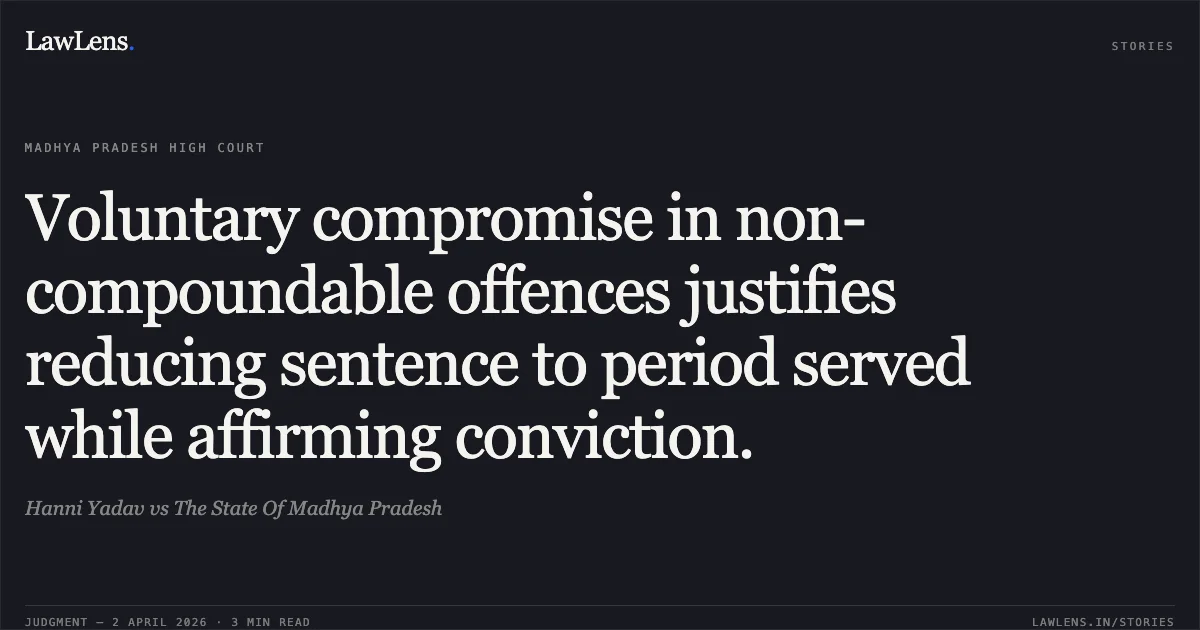
The court upheld the conviction under Section 394 IPC but partially allowed the appeal regarding the sentence
The substantive sentence of seven years R.I. was reduced to the period already undergone (approximately 26 months)
Source reference: para. 17, 18The fine was enhanced from ₹3,000 to ₹5,000 on each count (total ₹10,000), to be paid as compensation to the injured parties under Section 395 of the BNSS, 2023
Source reference: para. 18The appellant was ordered to be released forthwith, subject to the deposit of the enhanced fine within 60 days, failing which the original trial court sentence would be reinstated
Source reference: para. 19Acts & Sections Cited
6 provisions across 4 statutes referred to in this judgment. Each provision opens on LawLens.
Code of Criminal Procedure, 19732
Indian Penal Code, 18602
Arms Act, 19591
Bharatiya Nagarik Suraksha Sanhita, 20231
Original Court PDF
Hanni YadavvsThe State Of Madhya Pradesh
Click to open original judgment
Original judgment, available to read, download and summarize on LawLens.in


