Facts
On September 14, 2022, the complainant reported that his minor daughter (the victim) failed to return from school.
Source reference: para. 3Investigation revealed that the victim had been in regular telephonic contact with the appellant and voluntarily left with him.
Source reference: para. 9The duo traveled through Raipur, Hyderabad, and Vijayawada, eventually residing together in Agrapalli for approximately one month, where they established physical relations.
Source reference: para. 9, 24The victim’s age was determined to be approximately 15 years and 10 months.
Source reference: para. 20On October 16, 2023, the Special Judge (F.T.S.C.) POCSO Act, Mungeli, convicted the appellant under Sections 363 and 366 of the IPC and Section 6 of the POCSO Act, sentencing him to 20 years of rigorous imprisonment.
Source reference: para. 2Issues
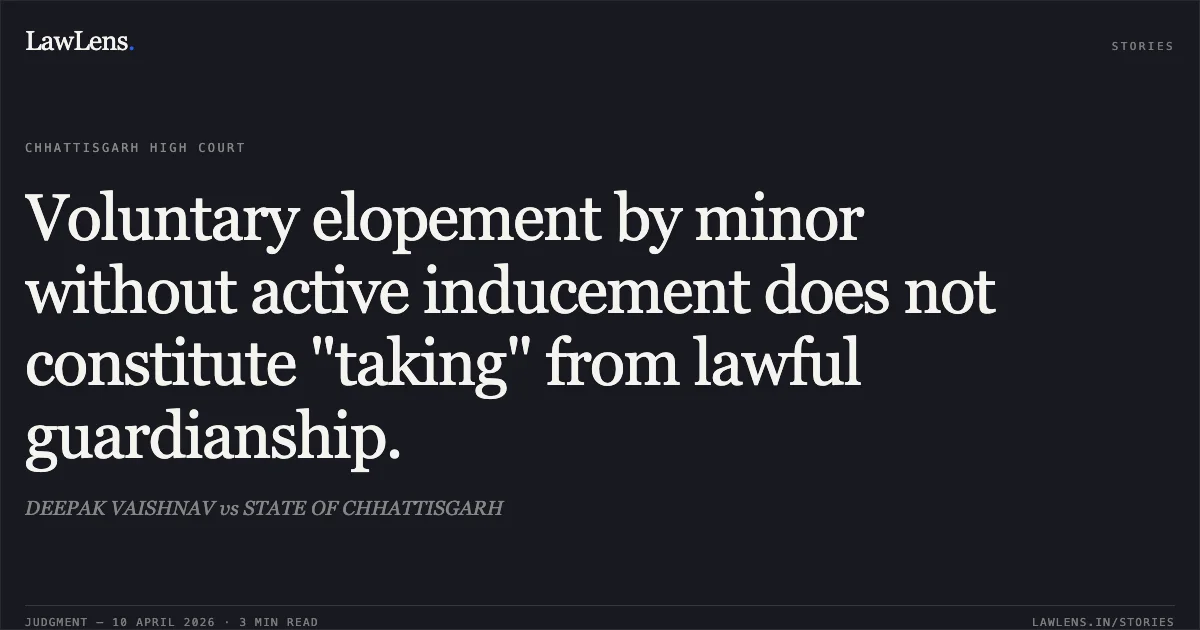
1. Whether the act of the appellant constitutes "taking" from lawful guardianship under Section 363 of the IPC when the minor voluntarily accompanies the accused.
Source reference: para. 122. Whether the conviction under Section 366 of the IPC is sustainable in the absence of evidence regarding inducement or force.
Source reference: para. 173. Whether the prosecution proved the charge of aggravated penetrative sexual assault under Section 6 of the POCSO Act beyond reasonable doubt, considering medical evidence and the victim's conduct.
Source reference: para. 26Law Applied
The court applied Section 361 of the IPC, which defines kidnapping from lawful guardianship as taking or enticing a minor.
Source reference: para. 13It relied on the precedent in S. Varadarajan v. State of Madras, establishing that if a minor leaves her guardian's protection voluntarily without any active solicitation or persuasion by the accused, it does not amount to "taking".
Source reference: para. 15The court further referenced Jaya Mala v. Home Secretary, noting a two-year margin of error in radiological age determination.
Source reference: para. 21The court referenced Tilku Alias Tilak Singh v. State of Uttarakhand, which held that minors nearing majority who understand right from wrong and voluntarily accompany an accused do not fall under the ambit of Sections 363 and 366 IPC.
Source reference: para. 23Reasoning
The court observed that the victim was in regular telephonic contact with the appellant and had proposed elopement herself in her Section 164 statement.
Source reference: para. 24Applying the S. Varadarajan principle, the court found no evidence of "taking" or "enticement," as the victim traveled across multiple states and stayed in a rented room for a month without raising any protest or alarm.
Source reference: para. 16, 25Regarding Section 366 IPC, the court held that mere accompaniment without inducement for forced intercourse does not satisfy the statutory requirements.
Source reference: para. 19On the POCSO charge, the court noted significant lacunae: the medical examination found no internal or external injuries, and the FSL report (Ex.P-29) was negative.
Source reference: para. 18Furthermore, given the victim's age was near 16 years and considering the judicial notice of age margins, her voluntary conduct and lack of resistance severely undermined the prosecution's claim of non-consensual or forced assault.
Source reference: para. 20, 26Holding
The Court allowed the appeal and set aside the judgment of conviction and order of sentence dated October 16, 2023.
It held that the prosecution failed to establish the essential ingredients of "taking" under Section 363 IPC or "inducement" under Section 366 IPC, and failed to prove the POCSO charge beyond reasonable doubt.
Source reference: para. 26The appellant was acquitted of all charges and ordered to be released forthwith.
Source reference: para. 27The court also directed compliance with Section 437-A CrPC (now Section 481 of the BNSS) regarding the furnishing of personal bonds.
Source reference: para. 28Acts & Sections Cited
12 provisions across 4 statutes referred to in this judgment. Each provision opens on LawLens.
Indian Penal Code, 18605
Code of Criminal Procedure, 19734
Bharatiya Nagarik Suraksha Sanhita, 20231
Original Court PDF
DEEPAK VAISHNAVvsSTATE OF CHHATTISGARH
Click to open original judgment
Original judgment, available to read, download and summarize on LawLens.in