Facts
The wife applied under Section 12 of the Protection of Women from Domestic Violence Act, 2005 (DV Act), alleging domestic violence and seeking protection, residence, monetary and other reliefs, including return of marriage articles.
Source reference: para. 3The husband admitted the marriage but denied the allegations, contending that the wife had left voluntarily and could maintain herself through her own employment.
Source reference: para. 3The Magistrate dismissed the application; on the wife’s appeal, the Family Court reversed that decision in part, directing the husband to provide alternative accommodation or rent, pay ₹20,000 monthly in addition to ₹14,000 maintenance already awarded by the Family Court, Dharwad, and pay ₹14 lakh compensation in addition to ₹6 lakh permanent alimony.
Source reference: paras. 3–10The husband challenged the appellate order in revision under Sections 397 and 401 of the Code of Criminal Procedure, arguing, among other things, that the wife was employable, he had financial responsibilities, and the appellate court had failed to properly assess the evidence.
Source reference: paras. 11–14, 20–21Issues
1. Whether the Family Court’s order granting residence, monetary and compensation reliefs to the wife suffered from illegality, perversity or material irregularity warranting interference in revision
Source reference: para. 202. Whether the husband’s retirement and financial responsibilities provided a ground to set aside or modify the reliefs granted by the Family Court
Source reference: paras. 21, 29–32Law Applied
The Court considered Sections 12, 19 and 20 of the DV Act, which provide for applications seeking relief, residence orders and monetary relief, respectively.
Source reference: paras. 1, 9Relying on Juveria Abdul Majid Patni v. Atif Iqbal Mansoori, (2014) 10 SCC 736, it stated that the end of a domestic relationship does not extinguish liability for domestic violence committed during that relationship, and that monetary relief under Section 20 may be granted in addition to maintenance under Section 125 CrPC or another law.
Source reference: paras. 24–26It also referred to Ajay Kumar Reddy v. State of Chhattisgarh, 2018 Cri LJ 1155, for the proposition that dissolution of marriage does not, by itself, bar a divorced wife from seeking relief under the DV Act in relation to the former domestic relationship.
Source reference: para. 27In revision, interference was warranted only if the impugned appellate findings were shown to be illegal, perverse or affected by material irregularity.
Source reference: paras. 20, 29–30Reasoning
The High Court reviewed the appellate judgment and the evidence and found that the Family Court had reappreciated the record and given reasons for the reliefs granted.
Source reference: paras. 29–30The husband did not establish that its findings were contrary to the evidence, perverse, illegal or materially irregular.
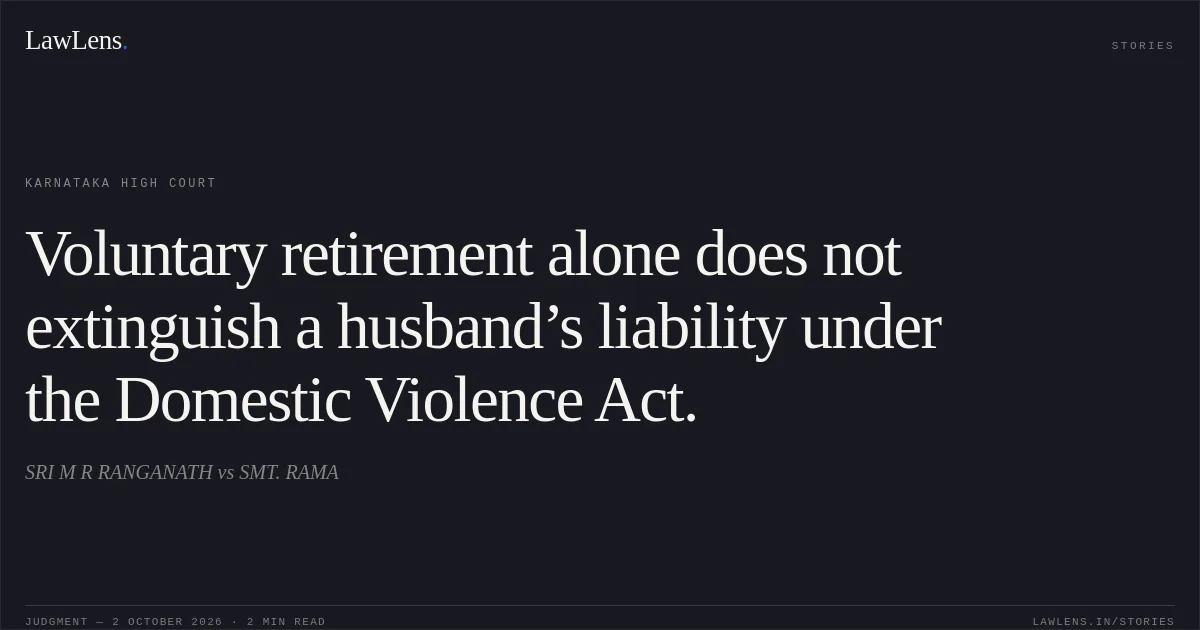
Source reference: paras. 29–30His voluntary retirement did not, by itself, end his obligations arising from the matrimonial relationship or the wife’s rights under the DV Act; nor had he established a sufficient basis to interfere with the reliefs.
Source reference: paras. 31–32The Court therefore declined to reassess the appellate award on the grounds advanced in revision.
Source reference: paras. 31–32Holding
The Court answered the revision issue in the negative and dismissed the petition.
It confirmed the Family Court’s order of 18 March 2021, including the alternative-accommodation/rent direction, the additional monthly maintenance of ₹20,000 and the additional compensation of ₹14 lakh.
Source reference: paras. 32–33Acts & Sections Cited
15 provisions across 4 statutes referred to in this judgment. Each provision opens on LawLens.
Code of Criminal Procedure, 19733
Protection of Women from Domestic Violence Act, 20053
Indian Penal Code, 18607
Original Court PDF
SRI M R RANGANATHvsSMT. RAMA
Click to open original judgment
Original judgment, available to read, download and summarize on LawLens.in