Facts
The Respondent, a Manager at UCO Bank, submitted a three-month notice for voluntary retirement (VR) on 04.10.2010
Source reference: para. 5During the notice period, the Bank issued a show-cause notice (SCN) on 11.11.2010 regarding suspicious transactions but did not formally refuse the VR request before the notice period expired on 04.01.2011
Source reference: para. 6, 30The Respondent ceased work on 16.05.2011
Source reference: para. 7The Bank communicated its refusal of the VR request only on 29.06.2011 and subsequently issued a charge-sheet on 05.03.2012, leading to the Respondent's dismissal
Source reference: para. 7-8The High Court of Chhattisgarh quashed the dismissal, holding that the Respondent stood retired voluntarily upon the expiry of the notice period. The Bank appealed to the Supreme Court
Source reference: para. 1-2Issues
1. Whether a notice of voluntary retirement under Regulation 29 of the Pension Regulations is deemed accepted if not refused within the specified notice period.
Source reference: para. 15(a)2. Whether the issuance of a show-cause notice constitutes the "institution of disciplinary proceedings" as contemplated under Regulation 20(3) of the Service Regulations.
Source reference: para. 15(b)3. Whether disciplinary action and dismissal initiated after the effective date of voluntary retirement are legally sustainable.
Source reference: para. 15(c)Law Applied
The Court applied Regulation 29 of the UCO Bank (Employees’) Pension Regulations, 1995, which mandates that voluntary retirement becomes effective if the appointing authority does not refuse permission before the expiry of the notice period
Source reference: para. 16-17It further interpreted Regulation 20(3) of the UCO Bank (Officers’) Service Regulations, 1979, which defines the "pendency" of disciplinary proceedings for the purpose of restricting an officer from leaving service
Source reference: para. 31-32The Court relied on the "deemed acceptance" doctrine established in Dinesh Chandra Sangma v. State of Assam, B.J. Shelat v. State of Gujarat, and Tek Chand v. Dile Ram, which distinguish between rules requiring active consent and those where retirement is automatic absent a timely refusal.
Source reference: para. 19, 21, 27It also distinguished the "initiation" of proceedings under UCO Bank v. Rajinder Lal Capoor (I II)
Source reference: para. 38-41Reasoning
The Court harmoniously constructed Regulation 29 of the Pension Regulations and Regulation 20(3) of the Service Regulations.
Source reference: para. 34-35It held that while Regulation 20(3) allows the Bank to restrain an official during pending proceedings, this must be exercised by a positive act of refusal within the notice period prescribed by Regulation 29
Source reference: para. 34-35The Court observed that the SCN dated 11.11.2010 merely sought an explanation and did not manifest a clear intention to institute disciplinary proceedings
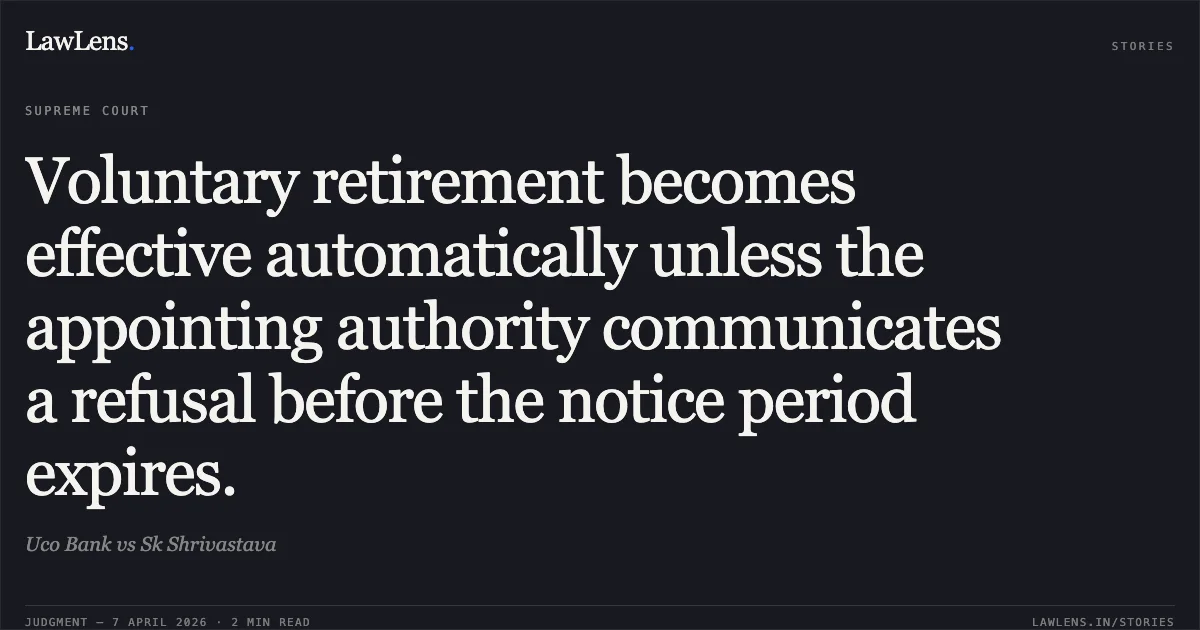
Source reference: para. 37Since the Bank failed to communicate a formal refusal or withholding of permission before 04.01.2011 (the expiry of the three-month notice), the Respondent’s voluntary retirement became effective ipso facto by efflux of time
Source reference: para. 43Consequently, the master-servant relationship ceased on that date, rendering the subsequent charge-sheet of 2012 and the dismissal order void for lack of jurisdiction
Source reference: para. 43, 45Holding
The Supreme Court dismissed the Bank’s appeals and upheld the High Court’s judgments
It held that the Respondent’s voluntary retirement was deemed effective from 04.01.2011 due to the Bank's failure to refuse the request within the notice period
Source reference: para. 43The Court declared the subsequent disciplinary proceedings and dismissal order illegal
Source reference: para. 45The Appellant-Bank was directed to settle all post-retiral dues with applicable interest within three months
Source reference: para. 45Acts & Sections Cited
1 provisions across 1 statute referred to in this judgment. Each provision opens on LawLens.
Indian Penal Code, 18601
Original Court PDF
Uco BankvsSk Shrivastava
Click to open original judgment
Original judgment, available to read, download and summarize on LawLens.in


