Facts
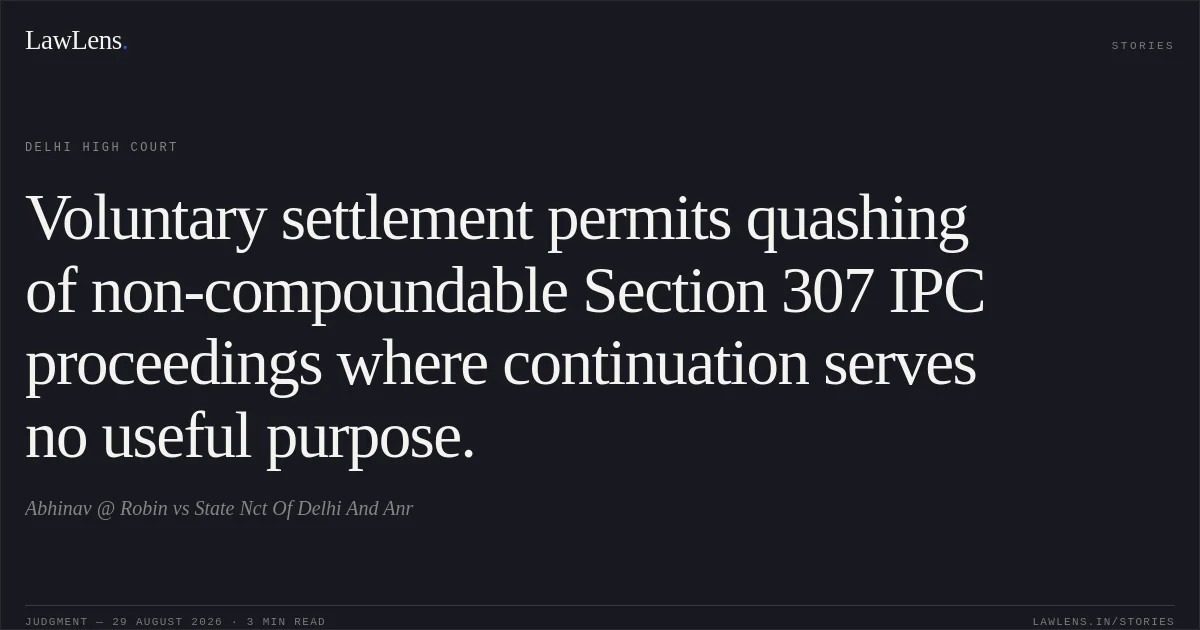
The petitioner sought quashing of FIR No. 148/2022, registered at Police Station Chanakya Puri for an offence under Section 307 IPC, along with consequential proceedings, on the basis of a settlement with the complainant.
Source reference: p.1, para.1The petitioner and complainant, Vikas Kumar, were friends and roommates. On 10 August 2022, while they were drinking, a dispute arose regarding payment of rent, during which the petitioner allegedly attacked the complainant with a sharp cutter-like object, causing an injury to his neck.
Source reference: p.1, para.2Charges had been framed and eight prosecution witnesses had been examined, although the complainant had not yet entered the witness box.
Source reference: p.2, para.3The parties subsequently executed a Memorandum of Understanding dated 21 May 2026.
Source reference: p.2, para.4The complainant confirmed the settlement, stated that he had voluntarily accepted Rs.1,00,000/- towards medical expenses, had pardoned the petitioner, and had no objection to quashing of the FIR.
Source reference: p.2, paras.5–6The petitioner had remained in custody for approximately two months and reportedly had no involvement in any other criminal case.
Source reference: p.2, para.7Issues
1. Whether the High Court could exercise its inherent jurisdiction under Section 528 of the Bharatiya Nagarik Suraksha Sanhita, 2023, to quash proceedings arising from a non-compoundable offence under Section 307 IPC on the basis of a voluntary settlement between the accused and the complainant.
Source reference: pp.2–3, paras.8–112. Whether, in view of the parties’ settlement, the nature and circumstances of the occurrence, and the complainant’s lack of objection, continuation of the criminal proceedings would serve any useful purpose.
Source reference: p.3, paras.10–11Law Applied
The Court applied Section 528 of the Bharatiya Nagarik Suraksha Sanhita, 2023, which preserves the High Court’s inherent power to make orders necessary to give effect to the process of law, prevent abuse of process, or secure the ends of justice.
Source reference: p.3, para.11It relied on Gian Singh v. State of Punjab & Anr., (2012) 10 SCC 303; Narinder Singh v. State of Punjab & Anr., (2014) 6 SCC 466; Dimpey Gujral v. Union Territory, Chandigarh, (2013) 11 SCC 497; and Naushey Ali v. State of Uttar Pradesh, (2025) 4 SCC 78, for the principle that proceedings relating to non-compoundable offences may nevertheless be quashed on the basis of a genuine settlement where continuation would be futile.
Source reference: p.3, para.8The Court also relied on Antonnette Promilla Fernandez v. State NCT of Delhi & Anr., 2026 SCC OnLine Del 809, and Mohd. Umair @ Umer v. State (Govt. NCT of Delhi) & Ors., Crl. M.C. 674/2021, decided on 12 March 2021, recognising that the power is discretionary and must be exercised in accordance with settled principles.
Source reference: p.3, paras.8–9Reasoning
The Court found the settlement to be voluntary and genuine because the complainant appeared in person, was identified by counsel and the Investigating Officer, confirmed receipt of medical compensation, and expressly stated that he had pardoned the petitioner and had no objection to quashing.
Source reference: p.2, paras.5–6The dispute arose between friends and roommates during a spontaneous quarrel concerning rent while they were drinking, rather than from a premeditated dispute.
Source reference: p.3, para.10The petitioner had apologised, undertaken not to repeat such conduct, spent approximately two months in custody, and had no reported involvement in another case.
Source reference: p.2, para.7Although the offence under Section 307 IPC was non-compoundable and the trial had progressed, the complainant had not yet been examined, and the parties had amicably resolved their dispute.
Source reference: p.3, paras.10–11In these circumstances, the Court concluded that continuing the prosecution would serve no meaningful purpose and that quashing would secure the ends of justice.
Source reference: p.3, paras.10–11Holding
The Court answered the issues in favour of the petitioner and exercised its inherent jurisdiction under Section 528 BNSS to quash the proceedings.
FIR No. 148/2022 dated 11 August 2022, registered at Police Station Chanakya Puri under Section 307 IPC, and all consequential proceedings were quashed, subject to the petitioner depositing Rs.10,000/- with the Delhi High Court Legal Services Committee within six weeks.
Source reference: p.4, para.12The petitioner was further directed to submit proof of deposit, the MoU dated 21 May 2026, and the original affidavits before the Trial Court within an additional two weeks, so that they could form part of the trial-court record.
Source reference: p.4, para.12The petition was accordingly disposed of.
Source reference: p.4, para.13Acts & Sections Cited
3 provisions across 3 statutes referred to in this judgment. Each provision opens on LawLens.
Indian Penal Code, 18601
Code of Criminal Procedure, 19731
Bharatiya Nagarik Suraksha Sanhita, 20231
Original Court PDF
Abhinav @ RobinvsState Nct Of Delhi And Anr
Click to open original judgment
Original judgment, available to read, download and summarize on LawLens.in
![A police constable cannot be removed for unauthorized absence without a Rule 359-compliant inquiry.. Mohammad Sidiq Khan vs D/o Home Ut Of Jammu & Kashmir. CAT - ['Srinagar']. LawLens](/stories/thumbnails/a-police-constable-cannot-be-removed-for-unauthorized-absence-without-a-rule-359-compliant-7b43fc316bd94f22a62676153bbc9d54.webp)
![A Review DPC lacks authority to determine or alter inter se seniority.. SAURABH KUMAR vs REVENUE. CAT - ['Patna']. LawLens](/stories/thumbnails/a-review-dpc-lacks-authority-to-determine-or-alter-inter-se-seniority-4b21640f20af46fcabdfc8273d2ce959.webp)