Facts
The appellant, arrayed as A5, faced charges under Sections 191(2), 191(3), 296(b), 115(2), 118(1) and 353(3) of the Bharatiya Nyaya Sanhita, 2023, read with Sections 3(1)(r), 3(1)(s) and 3(2)(va) of the SC/ST (Prevention of Atrocities) Act, 1989.
Source reference: para. 2The prosecution alleged that, following a dispute over sewage-channel maintenance near the complainant’s shop, a group assaulted and caste-abused the complainant.
Source reference: para. 2; para. 7The appellant’s counsel said he had been in Singapore and voluntarily surrendered on 11 September 2026; the prosecution opposed bail on the ground that he had absconded and might do so again. The complainant also opposed release.
Source reference: paras. 2–5The Special Court had declined bail, and the appellant challenged that order under Section 14A(2) of the SC/ST Act.
Source reference: para. 1Issues
Whether the appellant, who surrendered before the Court after being described by the prosecution as absconding, should be granted bail pending trial.
Source reference: paras. 4, 8Whether conditions could adequately address the concerns about the appellant’s attendance and possible flight.
Source reference: paras. 4, 8–9Law Applied
Section 14A(2) of the SC/ST Act provides the appellate route invoked to challenge the Special Court’s bail order.
Source reference: para. 1The charged provisions were Sections 191(2), 191(3), 296(b), 115(2), 118(1) and 353(3) of the BNS, read with Sections 3(1)(r), 3(1)(s) and 3(2)(va) of the SC/ST Act.
Source reference: para. 2The Court considered bail on the circumstances before it and imposed conditions to secure the appellant’s participation in the proceedings.
Source reference: paras. 8–9It directed that breach of a condition could be addressed by an application to cancel bail, referring to P.K. Shaji v. State of Kerala, AIR 2005 SC 100.
Source reference: para. 9(v)Reasoning
The Court noted that the appellant had surrendered and submitted himself to the Court’s process, and that the case was at the stage of furnishing copies of the prosecution documents.
Source reference: para. 8It also recorded that the co-accused had obtained bail after surrendering.
Source reference: para. 7In light of these circumstances, the Court considered bail appropriate, while addressing the prosecution’s concern that the appellant might abscond through conditions requiring sureties, surrender of his passport, prior permission to travel abroad, and daily reporting to the Trial Court.
Source reference: paras. 4, 8–9Holding
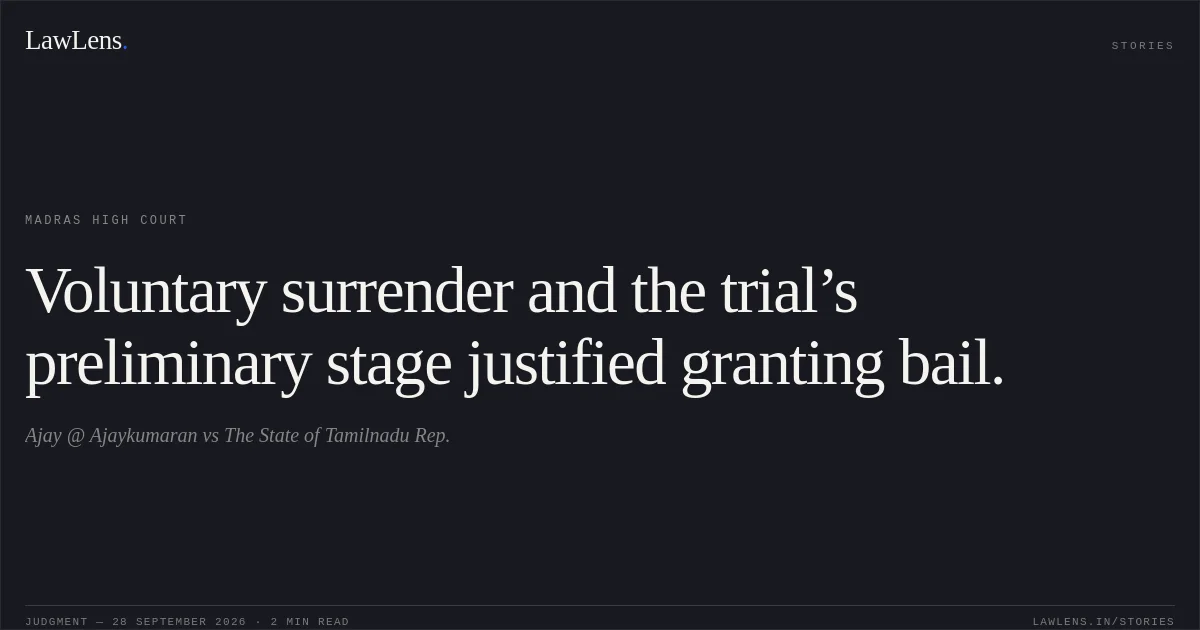
The Court allowed the appeal, set aside the refusal of bail, and ordered the appellant’s release on a bond of ₹20,000 with two sureties for the like sum.
It further required the appellant to surrender his passport, obtain prior written permission before going abroad, and report daily to the Trial Court at 10:30 a.m. until further orders; breach could prompt an application for cancellation of bail.
Source reference: paras. 9(ii)–(v)Acts & Sections Cited
6 provisions across 2 statutes referred to in this judgment. Each provision opens on LawLens.
Scheduled Castes and the Scheduled Tribes (Prevention of Atrocities) Act, 19891
Bharatiya Nyaya Sanhita, 20235
Original Court PDF
Ajay @ AjaykumaranvsThe State of Tamilnadu Rep.
Click to open original judgment
Original judgment, available to read, download and summarize on LawLens.in