Facts
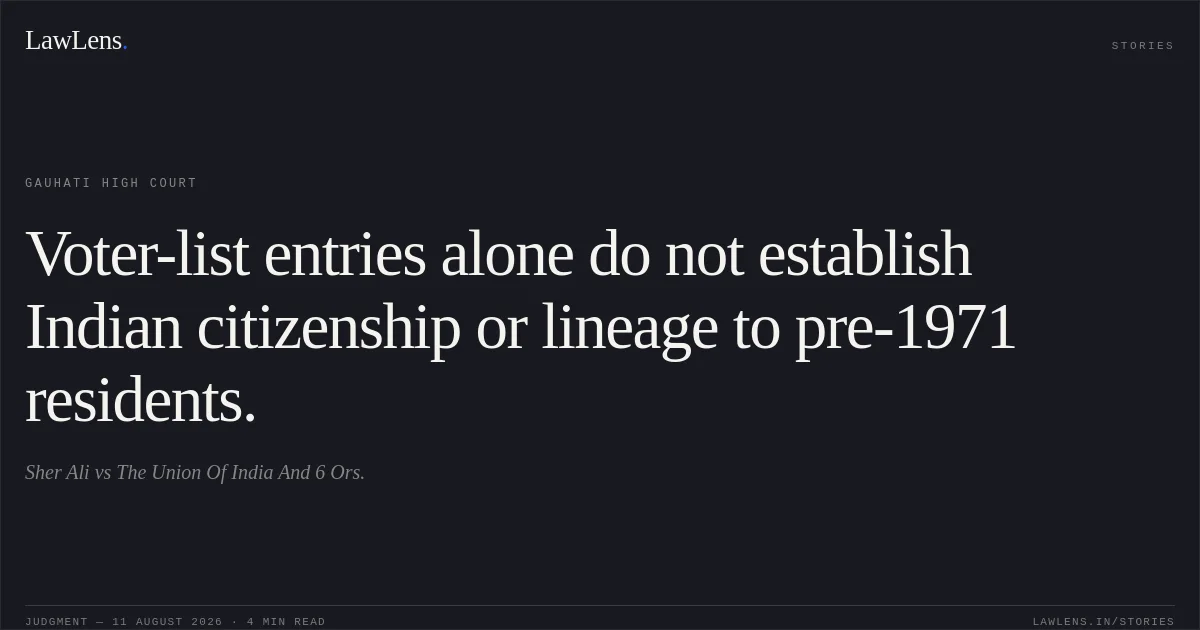
The petitioner challenged the opinion dated 16 July 2019 of the Foreigners Tribunal, Barpeta 11th, which declared him a foreigner belonging to the post-25 March 1971 stream.
Source reference: p.2, para. 2He claimed to be an Indian citizen, born and permanently residing at Kharballi, and asserted that his parents, Kaser Ali and Basatan Nessa, were recorded in the 1966 electoral roll, while his mother and brother appeared in the 1970 roll.
Source reference: p.3, para. 3His own name first appeared in the 1985 electoral roll, followed by subsequent entries in the 1989, 2010 and 2017 rolls.
Source reference: pp.3–4, para. 3; pp.6–7, para. 6The petitioner relied on six electoral rolls, a jamabandi, an EPIC and oral evidence from himself and Amzad Ali, who claimed to be the petitioner’s nephew and the grandson of Kaser Ali and Basatan Nessa.
Source reference: pp.7–8, paras. 9–10The Tribunal rejected the documents and oral evidence, holding that the petitioner failed to establish his relationship with the persons appearing in the pre-1971 electoral rolls and that his earliest established presence in Assam was in 1985.
Source reference: p.9, para. 11Issues
Whether the petitioner established, through the electoral rolls and oral evidence, that he was an Indian citizen or that he was descended from the projected parents whose names appeared in the 1966 and 1970 electoral rolls.
Source reference: pp.10–12, paras. 14–17Whether the absence of evidence showing the continuous presence of the petitioner or his projected parents in India between 1970 and 1985 defeated his claim under Section 6A(3)(b) of the Citizenship Act, 1955.
Source reference: p.12, para. 16Whether the jamabandi produced as Ext.7 was legally proved and could establish the petitioner’s pre-25 March 1971 linkage or citizenship.
Source reference: p.12, para. 18Whether the Foreigners Tribunal’s opinion declaring the petitioner a post-25 March 1971 foreigner warranted interference under Article 226 of the Constitution.
Source reference: pp.2, 12–13, paras. 2, 17–19Law Applied
The Court applied Section 6A(3)(b) of the Citizenship Act, 1955, requiring proof of the relevant statutory conditions, including the petitioner’s or his parents’ presence in India during the prescribed period.
Source reference: p.12, para. 16It relied on Md. Fakharuddin v. Union of India, W.P.(C) 4512/2016, for the principle that inclusion in an electoral roll or long residence in India, by itself, is not conclusive proof of Indian citizenship.
Source reference: p.10, para. 14It also relied on Aziz Miya @ Md. Aziz Mia v. Union of India, 2024 (4) GLT 246, holding that a claimant must substantiate the identity and relationship of the person appearing in a pre-cut-off-date electoral roll and cannot establish citizenship merely by asserting that such person was his father.
Source reference: p.10, para. 14Further, the Court held that an electronically generated land record requires proof in accordance with Section 65B of the Evidence Act, 1872, and that marking a document as an exhibit is distinct from proving its contents.
Source reference: p.12, para. 18Reasoning
The Court found that the petitioner’s name first appeared in the 1985 electoral roll, when he was recorded as aged 35, and that he did not appear in any electoral roll alongside his projected father, Kaser Ali, or his brother, Idrish Ali.
Source reference: pp.10–11, para. 15Although Kaser Ali and Basatan Nessa appeared in the 1966 roll and Basatan Nessa appeared with Idrish Ali in the 1970 roll, the petitioner produced no reliable documentary or other corroborative evidence connecting himself to those persons.
Source reference: p.11, para. 15The disappearance of the projected father after 1966 and of the projected mother and brother after 1970, coupled with the unexplained 15-year gap before the petitioner’s appearance in 1985, failed to establish continuous presence in India as required by Section 6A(3)(b).
Source reference: p.11, paras. 15–16The oral testimony of the petitioner and Amzad Ali was insufficient because their claimed familial relationships were not independently substantiated.
Source reference: pp.8–9, paras. 10–11Ext.7 also did not assist the petitioner: it was a system-generated printout unsupported by a Section 65B certificate, and no witness properly proved its contents or established that the relevant title existed before 25 March 1971.
Source reference: p.12, para. 18Accordingly, the Tribunal’s findings were not shown to be perverse or legally unsustainable.
Source reference: p.12, para. 18Holding
The High Court held that the petitioner failed to prove his Indian citizenship, his linkage with the persons named in the pre-1971 electoral rolls, or the continuous presence of himself or his projected parents in India prior to and after 25 March 1971.
The challenge to the Foreigners Tribunal’s opinion dated 16 July 2019 therefore failed, and the writ petition was dismissed.
Source reference: pp.12–13, paras. 17–19The consequences of the Tribunal’s declaration were directed to follow, and the interim bail granted to the petitioner on 28 August 2020 was vacated.
Source reference: p.13, paras. 19–20The Registry was directed to return the Tribunal records with a copy of the judgment.
Source reference: p.13, para. 21Acts & Sections Cited
2 provisions across 2 statutes referred to in this judgment. Linked provisions open on LawLens.
Citizenship Act, 19551
Indian Evidence Act, 18721
Original Court PDF
Sher AlivsThe Union Of India And 6 Ors.
Click to open original judgment
Original judgment, available to read, download and summarize on LawLens.in