Facts
The 12 applicants participated in the selection process for Group 'D' posts in the North Eastern Railway (NER) pursuant to Advertisement No. NER/RRC/D/2007/1 dated 06.12.2007
Source reference: p. 3Although they cleared the Physical Eligibility Test, written exam, and medical/document verification, they were placed in a "20% extra candidate" list/waiting list and were not offered appointments
Source reference: p. 4-6The applicants alleged that the respondents shifted positions by surrendering 500 vacancies (specifically Trackman posts in the Construction Division) midway through the process, leaving several notified posts vacant
Source reference: p. 4, 9The matter was previously dismissed by the Tribunal but remanded for fresh adjudication by the Hon’ble High Court of Allahabad via Writ A No. 8561 of 2021 on 17.05.2024
Source reference: p. 4Issues
1. Whether the ratio laid down in Dinesh Kumar Kashyap v. South East Central Railway (2019) is applicable to a different recruitment cycle (2007) and whether waiting-list candidates have an indefeasible right to appointment
Source reference: p. 27-282. Whether the respondents acted arbitrarily or illegally by surrendering 500 vacancies during the selection process
Source reference: p. 28-29Law Applied
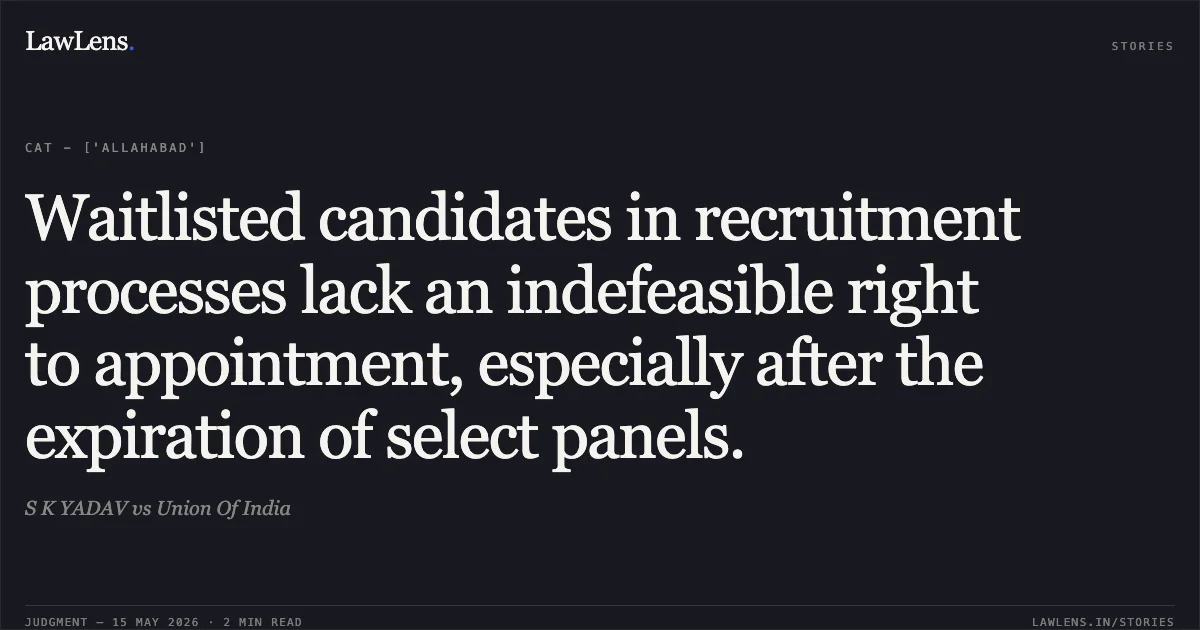
The Court primarily relied on the Constitution Bench judgment in Shankarsan Dash v. Union of India, which established that inclusion in a select list does not confer an indefeasible right to appointment, and the State is not under a legal duty to fill all vacancies unless rules specifically dictate
Source reference: para. 20It further applied the principles from Tej Prakash Pathak v. Rajasthan High Court, holding that eligibility criteria cannot be changed midway unless the advertisement or rules expressly permit such modifications
Source reference: para. 17, 21The Court also distinguished Dinesh Kumar Kashyap v. South East Central Railway, noting its relief was restricted to the specific 2010 recruitment cycle and to those who approached the court within a specific timeline
Source reference: para. 16, 21Reasoning
The Tribunal found that the advertisement expressly stated that the number of vacancies was provisional and "liable to be increased or decreased"
Source reference: para. 17Therefore, the surrender of 500 Trackman posts in the Construction Division due to their abolition was a bona fide exercise of administrative discretion permitted by the terms of recruitment
Source reference: para. 17, 19, 22Regarding the Dinesh Kumar Kashyap precedent, the Tribunal reasoned that its applicability is recruitment-specific (2010 cycle) and cannot be automatically extended to the 2007 recruitment, especially where the life of the select list has long expired
Source reference: para. 16, 21The Tribunal noted that the applicants were of lower merit than the last selected candidate and held that a replacement panel cannot be treated as a perpetual "reservoir" for appointments
Source reference: para. 21No evidence was found suggesting that candidates with lower merit than the applicants were appointed
Source reference: para. 23Holding
The Tribunal answered the issues in the negative and dismissed the Original Application
It held that the applicants acquired no vested right to appointment merely by being on a replacement list, particularly when the vacancies were lawfully reduced and the panel's validity had expired
Source reference: para. 21, 23The prayer for appointment against the second selection/waiting list was refuced
Source reference: para. 23Acts & Sections Cited
3 provisions across 1 statute referred to in this judgment. Linked provisions open on LawLens.
the Act3
Original Court PDF
S K YADAVvsUnion Of India
Click to open original judgment
Original judgment, available to read, download and summarize on LawLens.in