Facts
The dispute concerned the title and character of the land—whether it belonged to the Gram Panchayat as shamilat deh land or constituted wakf property of the Punjab Wakf Board.
Source reference: p.1The High Court held that the dispute fell within the exclusive jurisdiction of the Collector under Section 11 of the Punjab Village Common Lands (Regulation) Act, 1961, while Section 13 barred the jurisdiction of civil courts.
Source reference: pp.1–2Respondent No. 4, claiming to be a tenant of the Wakf Board, sought suspension of ejectment orders passed by the District Development and Panchayat Officer and the Director, Rural Development and Panchayats; an interim direction required him to deposit ₹10,000 per acre for use and occupation, and this Court subsequently directed maintenance of status quo.
Source reference: p.2Before the Supreme Court, the Wakf Board produced a State Government notification dated 19 September 1970 listing the disputed property among Sunni wakfs under the Central Wakf Act, 1954.
Source reference: p.4Issues
1. Whether the dispute regarding whether the property is wakf property falls within the jurisdiction of a Wakf Tribunal under Section 6 of the Wakf Act, 1995, notwithstanding the jurisdiction conferred on the Collector under the Punjab Village Common Lands (Regulation) Act, 1961?
Source reference: pp.2–42. Whether the bar under Section 85 of the Wakf Act, 1995 excludes the jurisdiction of the Collector and other authorities where the disputed property is included in the list of wakfs?
Source reference: p.33. Whether, if the property is not included in the list of wakfs, the question whether it is shamilat deh land must be determined by the Collector under the Regulation Act, 1961?
Source reference: p.4Law Applied
Section 6 of the Wakf Act, 1995 empowers the Wakf Tribunal to determine whether a property specified in the list of wakfs is wakf property, and makes the Tribunal’s decision final; Section 6(5) bars institution or commencement of proceedings in any court concerning such questions.
Source reference: p.2Section 85 of the Wakf Act bars the jurisdiction of civil courts, revenue courts and other authorities in matters relating to wakf property or matters required to be determined by the Tribunal.
Source reference: p.3The expression “list of wakfs” includes not only lists published under Section 5(2), but also entries in the register of wakfs maintained under Section 37, pursuant to Section 3(k).
Source reference: p.4Accordingly, the Collector’s jurisdiction under the Punjab Village Common Lands (Regulation) Act, 1961 is ousted where the dispute concerns property included in the list of wakfs. If the property is not so included, the question whether it is shamilat deh land remains for determination by the Collector under the Regulation Act, whose provisions also exclude civil-court jurisdiction.
Source reference: p.4The Court also referred to Habib Alladin v. Mohammed Ahmed, 2026 SCC OnLine SC 119.
Source reference: p.4Reasoning
The Supreme Court held that the foundational question was not merely whether the Gram Panchayat could seek ejectment, but whether the disputed land was wakf property.
Source reference: pp.2–3Since the Wakf Board produced a 19 September 1970 notification purporting to include the property in the list of Sunni wakfs, the statutory mechanism under Section 6 of the Wakf Act was attracted.
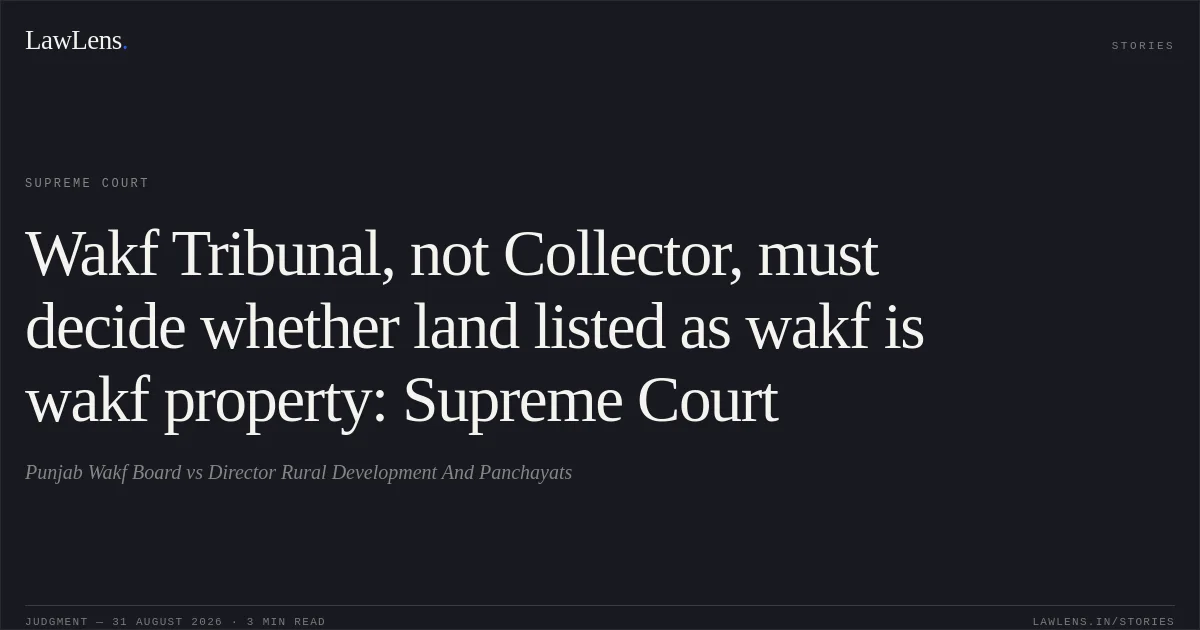
Source reference: p.4Consequently, the Tribunal, rather than the Collector acting under the Regulation Act, was required to first determine whether the property was wakf property.
Source reference: p.4The Court directed the Tribunal to verify the notification and ascertain whether the specific disputed property was in fact included in it. Only if the property was not included in the wakf list would the matter revert to the Collector for determination of its status as shamilat deh land.
Source reference: pp.4–5Holding
The appeals were allowed and the High Court’s judgment was set aside.
The parties were permitted to approach the competent Wakf Tribunal for determination of whether the disputed property was wakf property, and the Tribunal was directed to specifically examine the 19 September 1970 notification before adjudicating the dispute.
Source reference: pp.4–5If the property was not covered by the notification or wakf list, the issue was to be considered by the Collector under the Punjab Village Common Lands (Regulation) Act, 1961.
Source reference: p.5Pending applications, if any, were disposed of.
Source reference: p.5Acts & Sections Cited
5 provisions across 1 statute referred to in this judgment. Each provision opens on LawLens.
Unified Waqf Management, Empowerment, Efficiency and Development Act, 19955
Original Court PDF
Punjab Wakf BoardvsDirector Rural Development And Panchayats
Click to open original judgment
Original judgment, available to read, download and summarize on LawLens.in