Facts
The petitioners are associated with the "Hazrat Sahid Pir Mehmoodshah Bukhari Dada Waqf," a registered Waqf situated in Dhandhuka
Source reference: p. 2Petitioner No. 1 was appointed as a trustee in 2014, but alleged that the administrative scheme was framed without consulting beneficiaries, resulting in biased income distribution and financial irregularities
Source reference: p. 2The petitioners claimed that other trustees were mismanaging Waqf properties and excluding Petitioner No. 1 from management
Source reference: p. 2Consequently, they filed an application under Section 69 of the Waqf Act on 25.01.2022 for a new administration scheme and another under Section 70 on 08.10.2024 regarding mismanagement
Source reference: p. 2-3Despite several reminders, the Gujarat State Waqf Board (Respondent) failed to act on these applications, leading the petitioners to seek a writ of mandamus under Article 226 of the Constitution
Source reference: p. 3Issues
1. Whether the Respondent-Waqf Board should be directed to decide the petitioners' pending applications under Sections 69 and 70 of the Waqf Act, 1995, within a specific time-bound schedule
Source reference: p. 1-2Law Applied
The Court exercised its jurisdiction under Article 226 of the Constitution of India regarding the enforcement of statutory duties
Source reference: p. 1The primary statutory provisions were Section 69 of the Waqf Act, 1995, which empowers the Board to frame or modify schemes for the proper administration of a Waqf
Source reference: p. 2Section 70 of the same Act, which provides the Board with the power to conduct inquiries into the administration and mismanagement of Waqf properties
Source reference: p. 3Reasoning
The Court noted the petitioners' contention that the Board's inaction was "illegal, unconstitutional, improper, and in gross violation of statutory provisions"
Source reference: p. 3-4During the hearing, the counsel for the Respondent Board did not dispute the delay but provided a formal assurance that the applications would be decided within six months
Source reference: p. 4The Court accepted this assurance as a sufficient remedy for the petitioners' grievance of administrative delay.
Source reference: p. 4The Court reasoned that a time-bound direction would serve the interests of justice, provided that all concerned parties were given an opportunity to be heard, thereby ensuring compliance with the principles of natural justice while fulfilling the Board's statutory obligations under the Waqf Act
Source reference: p. 4Holding
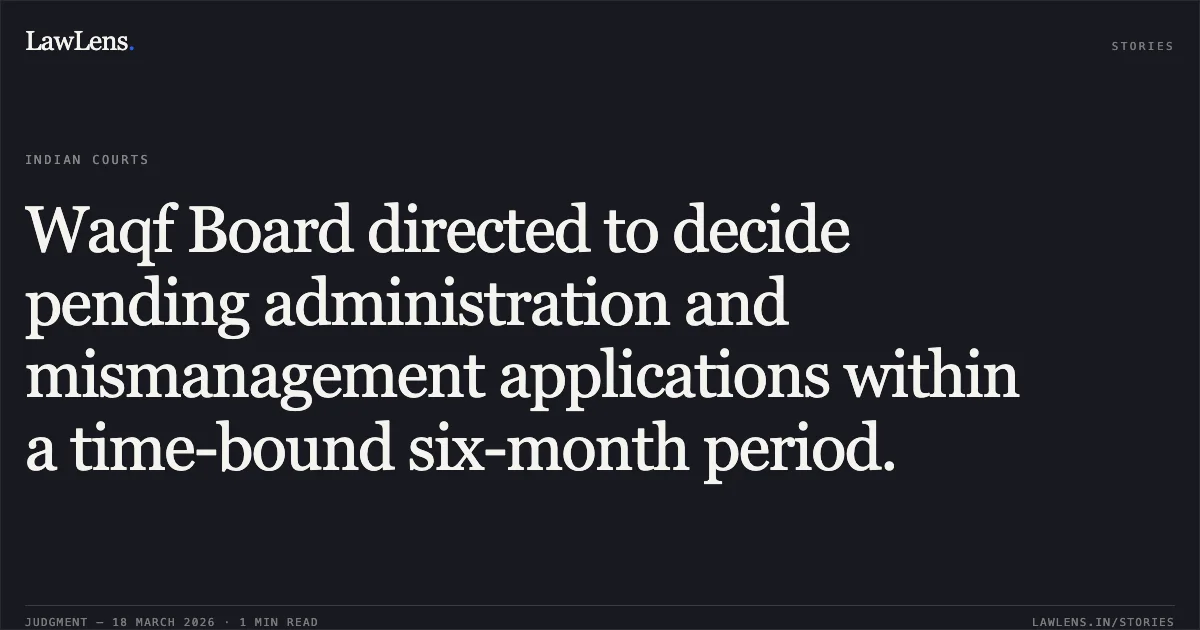
The Court disposed of the petition by directing the Gujarat State Waqf Board to decide the applications filed by the petitioners within six months from the date of receipt of the order
The holding stipulated that the applications must be decided in accordance with the law and after providing a "proper opportunity to all the concerned parties"
Source reference: p. 4Rule was discharged, and direct service was permitted
Source reference: p. 4Acts & Sections Cited
2 provisions across 1 statute referred to in this judgment. Linked provisions open on LawLens.
Waqf (Amendment) Act, 20252
Original Court PDF
DILAVARMIYA DADUMIYA SUMRAvsGUJARAT STATE WAQF BOARD
Click to open original judgment
Original judgment, available to read, download and summarize on LawLens.in