Facts
The Appellant (biological mother) challenged a Family Court order dated 20.03.2025, which dismissed her guardianship petition and granted permanent custody of her two children, Ayaan Ali and Aleena, to Respondent No. 1 (paternal aunt/Bua)
Source reference: p. 1-2Following the death of the children’s father in July 2016, the children moved to their paternal family’s residence in August 2016
Source reference: p. 2Parallel petitions were filed by the paternal grandmother (later substituted by the aunt) and the mother
Source reference: p. 2The Family Court, after interacting with the children, found they preferred staying with their aunt and that a change in custody would be detrimental to their welfare
Source reference: p. 2During the appeal, the son attained majority, and the daughter (aged 15) reiterated her desire to remain in Mumbai with her aunt
Source reference: p. 3-4Issues
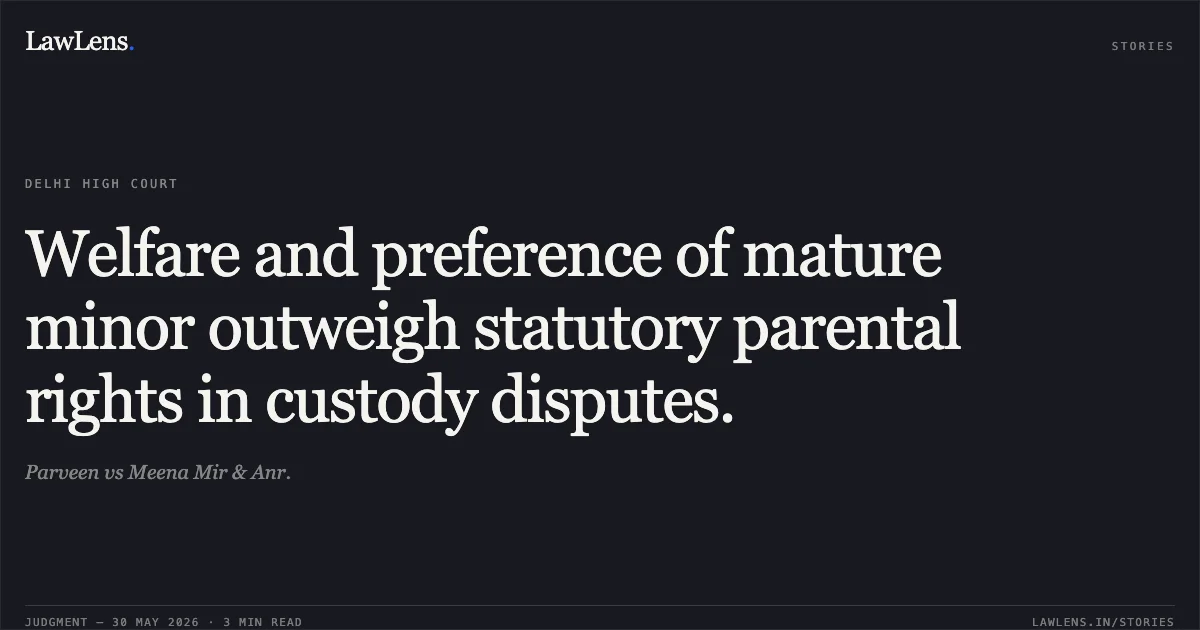
1. Whether the statutory preference for a natural parent under Section 19(b) of the Guardians and Wards Act, 1890, overrides the "welfare of the child" principle in custody disputes
Source reference: p. 62. Whether the consistent preference of a minor of mature understanding should be the determinative factor in deciding custody
Source reference: p. 6-7Law Applied
The Court primarily applied the principle of parens patriae jurisdiction and Section 13 of the Hindu Minority and Guardianship Act (analogous to the welfare principle in the Guardians and Wards Act), asserting that the "paramount consideration" is the welfare and best interests of the child, which overrides all statutory and parental rights
Source reference: p. 4-5the court relied on Gaurav Nagpal v. Sumedha Nagpal (2009), stating that "welfare" must be construed in its widest sense, including ethical and emotional well-being
Source reference: p. 4It further cited Nil Ratan Kundu v. Abhijit Kundu (2008), which established that if a minor is old enough to form an intelligent preference, the court must consider that preference in its decision-making process
Source reference: p. 5-6Reasoning
The Court reasoned that while the Appellant is the biological mother and ordinarily holds a preferential legal position under Section 19(b) of the Guardians and Wards Act, such rights are not absolute and must yield to the child's welfare
Source reference: p. 6The Court observed that the children had resided with the paternal family for nearly a decade (since 2016), creating a settled social and emotional environment in Mumbai
Source reference: p. 6During an independent interaction with the 15-year-old minor, the Court found her capable of expressing a "reasoned preference" free from coercion or tutoring
Source reference: p. 4The Court concluded that uprooting the child at a sensitive adolescent stage against her clear wishes would cause psychological distress and disrupt her educational continuity
Source reference: p. 7Regarding allegations of parental alienation and violation of visitation, the Court held that while these are concerns, the present and future welfare of the child remains the "determinative consideration," necessitating the maintenance of the current arrangement
Source reference: p. 7Holding
The High Court dismissed the appeal and sustained the Family Court’s judgment, holding that the welfare of the minor child was best served by remaining with Respondent No. 1
It ruled that since the son (Ayaan Ali) had attained majority, the question of his custody was moot, and he was free to reside where he chose
Source reference: p. 8The Court directed that the visitation rights previously granted to the mother (specific dates in June and December, plus weekly video calls) must be "strictly complied with" by the Respondent in letter and spirit to ensure meaningful interaction
Source reference: p. 8Acts & Sections Cited
3 provisions across 3 statutes referred to in this judgment. Each provision opens on LawLens.
Family Courts Act, 19841
Guardians and Wards Act, 18901
Hindu Minority and Guardianship Act, 19561
Original Court PDF
ParveenvsMeena Mir & Anr.
Click to open original judgment
Original judgment, available to read, download and summarize on LawLens.in