Facts
The plaintiffs sought Letters of Administration with the registered Will dated 19 December 1983 of K. Neelakandan annexed.
Source reference: p. 2–4After the defendants contested the Will, the original petition was converted into a Testamentary Original Suit.
Source reference: p. 2–4The trial court dismissed the suit because the plaintiffs had not proved the Will through an attesting witness or by the alternative method under Section 69 of the Evidence Act.
Source reference: p. 2–4, 6In the appeal, the plaintiffs relied on the testimony of PW1, the testator’s son, and PW2, who identified the testator’s signature.
Source reference: p. 7–8Neither attesting witness was examined; the plaintiffs gave inconsistent accounts of whether the witnesses were dead or could not be located, and did not take steps to secure their attendance.
Source reference: p. 7–8The appeal challenged the dismissal of the suit.
Source reference: p. 6Issues
1. Whether the Will was proved in accordance with Sections 63(c) of the Indian Succession Act and 68 of the Evidence Act despite neither attesting witness being examined.
Source reference: p. 6, 9–102. If no attesting witness could be found, whether the plaintiffs satisfied Section 69 of the Evidence Act by proving the handwriting of at least one attesting witness and the testator’s signature.
Source reference: p. 10–12Law Applied
Section 63(c) of the Indian Succession Act, 1925 requires a Will to be attested by at least two witnesses, each of whom must have seen the testator sign or received the testator’s acknowledgement, and each of whom must sign the Will in the testator’s presence.
Source reference: p. 8–9Under Section 68 of the Indian Evidence Act, 1872, at least one attesting witness must be called to prove a document required by law to be attested, where such a witness is alive, subject to the court’s process and capable of giving evidence; the statutory proviso does not exempt Wills.
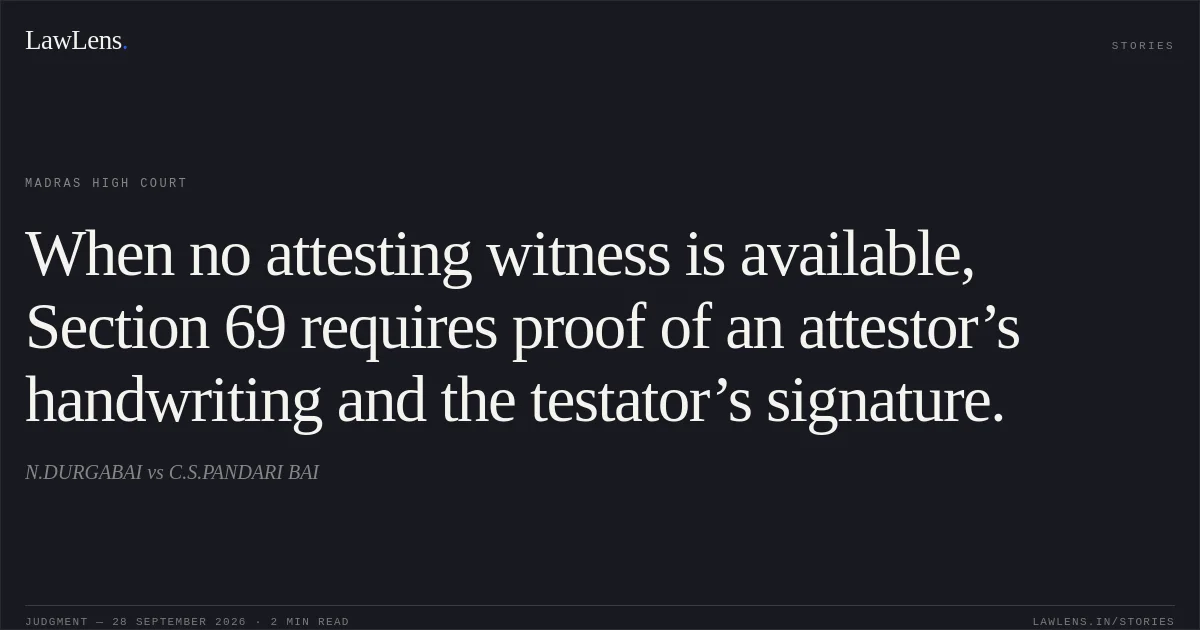
Source reference: p. 10Where no attesting witness can be found, Section 69 requires proof that the attestation of at least one witness is in that witness’s handwriting and that the executant’s signature is in the executant’s handwriting.
Source reference: p. 10–11The Court also relied on Ramesh Chand (D) through LRs v. Suresh Chand, 2025 INSC 1059, for the mandatory nature of proof of a Will under the applicable statutory requirements.
Source reference: p. 11Reasoning
The Court accepted that PW1 and PW2 supported the testator’s signature and execution of the Will, but held that this did not establish due attestation as required by Section 63(c).
Source reference: p. 7, 12–13Since neither attesting witness testified, the plaintiffs had to meet Section 69.
Source reference: p. 12–13They did not do so: PW2 did not identify either attesting witness or their signatures, and neither PW1 nor PW2 expressly proved the handwriting or signature of an attesting witness.
Source reference: p. 12–13The evidence therefore established the testator’s signature but not the statutory attestation of the Will.
Source reference: p. 13–14Holding
The Court held that the plaintiffs failed to prove the Will in the manner required by Sections 63(c) of the Indian Succession Act and 68 or 69 of the Evidence Act.
It affirmed the dismissal of the Testamentary Original Suit and dismissed the appeal; the parties were directed to bear their own costs.
Source reference: p. 13–14Acts & Sections Cited
1 provisions across 1 statute referred to in this judgment. Each provision opens on LawLens.
Indian Succession Act, 19251
Original Court PDF
N.DURGABAIvsC.S.PANDARI BAI
Click to open original judgment
Original judgment, available to read, download and summarize on LawLens.in