01Facts
The appellant, Krishna Bhagya Jala Nigam Limited (KBJNL), is the beneficiary for whose purposes private lands were acquired.
pp. 3-4It was not impleaded in the Reference Court proceedings, which ended in an award.
¶ 3 · pp. 3-4KBJNL challenged the award in W.P. No. 108222/2025. On 16.06.2026, the learned Single Judge quashed the award, remitted the matter to the Reference Court, and imposed conditions (Nos. 4 to 9) on the conduct of the remanded reference.
¶ 3 · pp. 4-5KBJNL filed this writ appeal only against Conditions 4 to 9.
¶ 3 · p. 1The parties relied on Writ Appeal No. 100590/2026 c/w No. 100503/2026, decided on the same common judgment, where the Division Bench (i) dispensed with service of notice on unserved private respondents, (ii) affirmed the quashing and remand, (iii) set aside Conditions (iv) to (ix), and (iv) directed the Reference Court to decide the reference afresh with a 02.09.2026 appearance date.
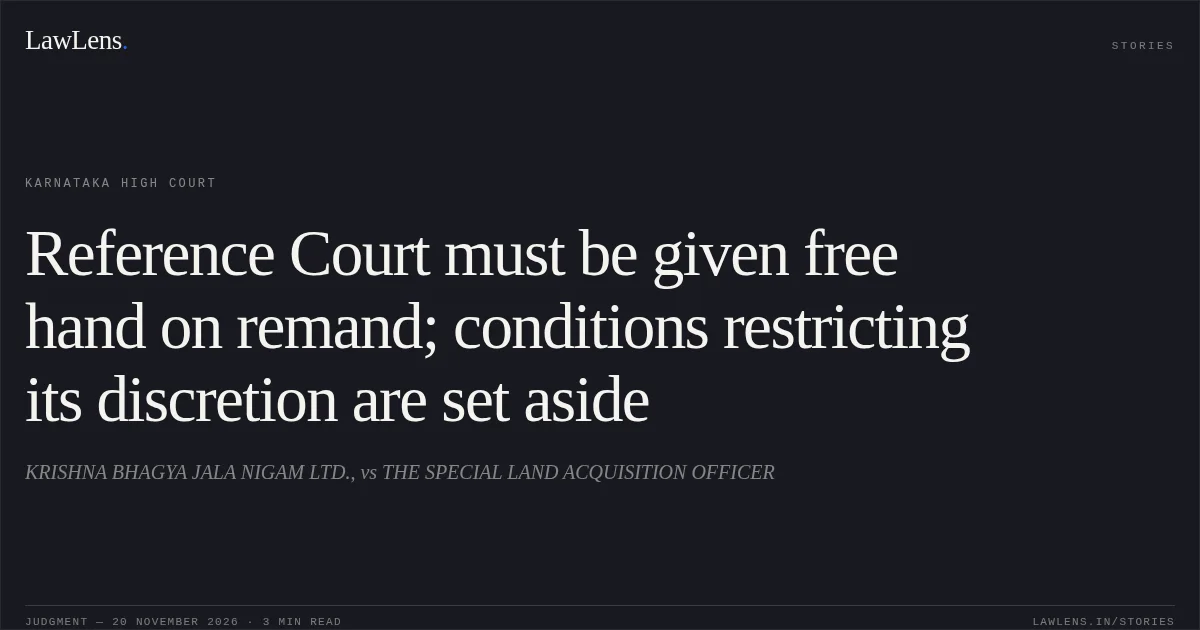
¶ 4 · pp. 5-10That order relied on W.A. No. 100475/2026 (06.08.2026), which held that the Reference Court "must be given a free hand" because the writ petition raised only the legal objection that the award was passed in the beneficiary's absence.
¶ 4 · p. 8KBJNL and the AAG sought a similar order in the present appeal.
¶ 5 · p. 1002Issues
i.1. Whether the conditions (Nos. 4 to 9) imposed by the learned Single Judge, which regulated the beneficiary's participation and the timelines and deposit requirements in the remanded reference, are sustainable where the only ground accepted was the beneficiary's non-impleadment.
¶ 3 · pp. 3-4 · ¶ 4 · p. 8 (quoting W.A. No. 100475/2026 · ¶ 7)ii.2. Whether notice must be served on the unserved private respondents before the writ appeal is decided.
¶ 2 · p. 4 · ¶ 4 · p. 5iii.3. Whether the present appeal should be disposed of on the terms of the earlier Division Bench order in W.A. No. 100590/2026.
¶ 5-6 · p. 1003Law Applied
Where a reference award is set aside solely because the beneficiary was not a party, the Reference Court must be left a "free hand" to decide the reference in accordance with law, and single-judge directions that restrict that discretion are impermissible, as held in W.A. No. 100475/2026 and W.A. No. 100590/2026.
¶ 4 · pp. 8-9Under the principle of expeditious disposal, the Reference Court is to decide the reference promptly, and claimants may seek directions if there is undue delay.
¶ 4 · p. 9The power to dispose of the writ appeal without notice rests on the safeguard that the Reference Court will issue notice to unserved parties.
¶ 2 · p. 4 · ¶ 7 · p. 11The judgment does not cite any specific provision of the Land Acquisition Act, 1894, or of the Karnataka High Court Act, 1961, beyond the appeal's jurisdictional basis under Section 4 of the latter.
Provisions in the judgment · 1 · Linked ones open on LawLens
KARNATAKA HIGH COURT ACT, 1961 Section 4
04Reasoning
The writ petition rested solely on the legal defect of a judgment passed without the beneficiary's participation, so the Single Judge's quashing and remand were justified, but conditions (iv) to (ix) went beyond that defect by controlling cross-examination, evidence, the sequence of disposal, and deposit obligations.
¶ 4 · pp. 8-9Since the same issue arose in the connected appeals, the Court held there was "no reason" to treat this appeal differently.
¶ 6 · p. 10The Court dispensed with notice to the unserved private respondents, relying on the Reference Court's duty to issue notice on remand, and fixed a fresh appearance date before the Reference Court.
¶ 2 · p. 4 · ¶ 7 · p. 11The Court did not separately examine the merits of Conditions 4 to 9, and its reasoning rests on consistency with the earlier decisions.
05Holding
The Court held that Conditions 4 to 9 were not sustainable and that the writ appeal should be disposed of in the same terms as W.A. No. 100590/2026.
¶ 6-7 · pp. 10-11The writ appeal is disposed of, and the parties are to appear before the Reference Court on 16.12.2026.
¶ 7 · p. 11The Reference Court is directed to issue notice to unserved parties and to proceed with the reference in accordance with law.
¶ 7 · p. 11The pending I.As. are disposed of as not surviving.
¶ 8 · p. 11Original Court PDF
KRISHNA BHAGYA JALA NIGAM LIMITEDvsTHE SPECIAL
Click to open original judgment
Original judgment, available to read, download and summarize on LawLens.in