01Facts
The appellant, Krishna Bhagya Jala Nigam Ltd. (KBJNL), is the beneficiary for whose benefit the private respondents' lands were acquired.
¶ 3KBJNL was not impleaded before the Reference Court, which passed an award.
¶ 3KBJNL challenged the award in W.P. No. 108217/2025. On 16.06.2026 the learned Single Judge quashed the award, remitted the matter to the Reference Court with a direction to implead KBJNL, and imposed nine operative conditions.
¶ 3 · pp. 5–p.7Conditions (iv)–(ix) permitted KBJNL to file objections and cross-examine claimants, required the Reference Court to call for information on enhanced compensation paid to similarly placed landowners, fixed time limits of six months and one year, and required KBJNL to deposit 25% of the awarded compensation within two months, failing which claimants could seek relief.
pp. 5–p.7KBJNL appealed only against conditions 4 to 9.
pp. 2–p.3 · ¶ 3The respondents' counsel had not been served with notice, and the Court heard the appeal finally without notice, subject to a safeguard for the unserved claimants.
¶ 2The Court noted that the same issue had been decided in W.A. No. 100590/2026 c/w W.A. No. 100503/2026 and W.A. No. 100475/2026.
¶ 4 · pp. 4–p.1002Issues
i.1. Whether the conditions (Nos. 4 to 9) imposed by the learned Single Judge, which restrict the Reference Court's discretion in deciding the reference after remand, are sustainable.
¶ 3 · p. 3ii.2. Whether the appeal may be disposed of in terms of the co-ordinate bench's decision in W.A. No. 100590/2026 and connected matters, which set aside similar conditions.
¶ 4 · ¶ 5–6 · pp. 9–p.10iii.3. Whether notice must be issued to the unserved respondents before the matter is finally heard.
¶ 2 · ¶ 703Law Applied
The Court relied on Section 4 of the Karnataka High Court Act, 1961, which provides the statutory basis for the writ appeal.
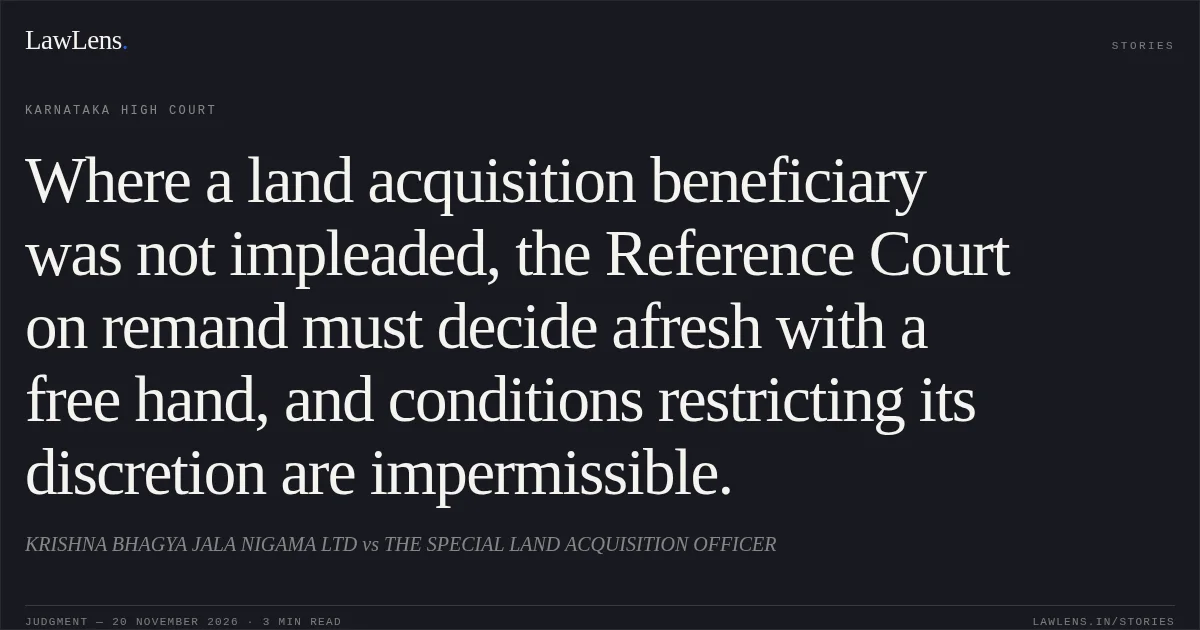
p. 2The Court followed the co-ordinate bench's decision in W.A. No. 100475/2026 (dated 06.08.2026), reproduced in W.A. No. 100590/2026, for the principle that where a writ petition is founded solely on the legal defect of an award passed in the absence of a necessary beneficiary, the Reference Court must be given a "free hand" to decide the reference in accordance with law, and the Single Judge may not impose conditions that restrict its discretion on the manner of deciding the reference.
p. 8, quoting W.A. No. 100475/2026 · ¶ 7While quashing of the award and remand with impleadment (Directions (i)–(iii)) stand, conditions (iv)–(ix) are set aside.
pp. 8–p.9, quoting para. 8 and Order (iii)The co-ordinate bench directed expeditious disposal and reserved liberty to claimants to seek directions on undue delay. No Supreme Court authority is cited in the judgment.
p. 8, quoting para. 9Provisions in the judgment · 1 · Linked ones open on LawLens
KARNATAKA HIGH COURT ACT, 1961 Section 4
04Reasoning
The Court found the present appeal identical in material respects to W.A. No. 100590/2026, in which the same conditions were challenged. The Court held that the sole ground on which the award was quashed was the legal defect of non-joinder of the beneficiary. Once that ground was accepted, the Single Judge's directions on cross-examination, evidence, enhanced-compensation verification, and deposit exceeded what was necessary to cure the defect and improperly curtailed the Reference Court's discretion. Because conditions (iv)–(ix) are set aside in the lead appeal, and condition (viii), the 25% deposit, falls within that range, the same relief follows here, though the judgment does not expressly identify condition (viii) as covered.
¶ 4 · ¶ 6 · p. 7 · p. 8, quoting para. 7 · p. 9Because the respondents had not been served, the Court relied on the safeguard that the Reference Court would issue notice to unserved parties on the next date of appearance.
¶ 2 · ¶ 705Holding
The Court held that the appeal is to be disposed of in terms of W.A. No. 100590/2026 and connected matters. In substance, the Single Judge's remand with impleadment is preserved, while the conditions restricting the Reference Court's discretion, including the deposit requirement, are effectively set aside.
¶ 6–7 · pp. 8–p.9The parties are directed to appear before the Reference Court on 16.12.2026. The Reference Court is directed to issue notice to unserved parties and proceed in accordance with law. Pending I.As. are disposed of.
¶ 7 · ¶ 8Original Court PDF
KRISHNA BHAGYA JALA NIGAMA LTDvsTHE SPECIAL LAND ACQUISITION OFFICER
Click to open original judgment
Original judgment, available to read, download and summarize on LawLens.in